Kirjojen hintavertailu. Mukana 12 275 184 kirjaa ja 12 kauppaa.

Kirjahaku

Etsi kirjoja tekijän nimen, kirjan nimen tai ISBN:n perusteella.

5 kirjaa tekijältä Andrew M. Cooper

William Blake and the Productions of Time

William Blake and the Productions of Time

Andrew M. Cooper

TAYLOR FRANCIS LTD
2024
nidottu
Challenging the idea that a writer’s work reflects his experiences in time and place, Andrew M. Cooper locates the action of William Blake’s major illuminated books in the ahistorical present, an impersonal spirit realm beyond the three-dimensional self. Blake, Cooper shows, was a formalist who exploited eighteenth-century scientific and philosophical research on vision, sense, and mind for spiritual purposes. Through irony, dialogism, two-way syntax, and synesthesia, Blake extended and refined the prophetic method Milton forged in Paradise Lost to bring the performativity of traditional oral song and storytelling into print. Cooper argues that historicist attempts to place Blake’s vision in perspective, as opposed to seeing it for oneself, involve a deeply self-contradictory denial of his performativity as a poet-artist. Rather, Blake’s expansion of linear reading into a space of creative, self-conscious collaboration laid the basis for his lifelong critique of dualism in religion and science, and anticipated the non-Euclidean geometrics of twentieth-century Modernism.
William Blake and the Productions of Time

William Blake and the Productions of Time

Andrew M. Cooper

Ashgate Publishing Limited
2013
sidottu
Challenging the idea that a writer’s work reflects his experiences in time and place, Andrew M. Cooper locates the action of William Blake’s major illuminated books in the ahistorical present, an impersonal spirit realm beyond the three-dimensional self. Blake, Cooper shows, was a formalist who exploited eighteenth-century scientific and philosophical research on vision, sense, and mind for spiritual purposes. Through irony, dialogism, two-way syntax, and synesthesia, Blake extended and refined the prophetic method Milton forged in Paradise Lost to bring the performativity of traditional oral song and storytelling into print. Cooper argues that historicist attempts to place Blake’s vision in perspective, as opposed to seeing it for oneself, involve a deeply self-contradictory denial of his performativity as a poet-artist. Rather, Blake’s expansion of linear reading into a space of creative, self-conscious collaboration laid the basis for his lifelong critique of dualism in religion and science, and anticipated the non-Euclidean geometrics of twentieth-century Modernism.
A Bastard Kind of Reasoning

A Bastard Kind of Reasoning

Andrew M. Cooper

STATE UNIVERSITY OF NEW YORK PRESS
2023
pokkari
Ranges widely and deeply across William Blake's oeuvre to show how his post-Newtonian vision of space-time anticipates Einsteinian relativity.What do Einsteinian relativity, eighteenth-century field theory, Neoplatonism, and the overthrow of three-dimensional perspective have in common? The poet and artist William Blake's geometry-the conception of space-time that informs his work across media and genres. In this illuminating, inventive new study, Andrew M. Cooper reveals Blake to be the vehicle of a single imaginative vision in which art, literature, physics, and metaphysics stand united. Romantic-period physics was not, as others have assumed, materialist. Blake's cosmology forms part of his age's deep reevaluation of body and soul, of matter and Heaven, and even probes what it is to understand understanding, reason, and substance. Far from being anti-Newtonian, Blake was prophetically post-Newtonian. His poetry and art realized the revolutionary potential of Enlightened natural philosophy even as that philosophy still needed an Einstein for its physics to snap fully into focus. Blake's mythmaking exploits the imaginative reach of formal abstractions to generate a model of how sensation imparts physical extension to the world. More striking still, Cooper shows how Blake's art of vision leads us today to visualize four-dimensional concepts of space, time, and Man for ourselves.
A Bastard Kind of Reasoning

A Bastard Kind of Reasoning

Andrew M. Cooper

STATE UNIVERSITY OF NEW YORK PRESS
2023
sidottu
Ranges widely and deeply across William Blake's oeuvre to show how his post-Newtonian vision of space-time anticipates Einsteinian relativity.What do Einsteinian relativity, eighteenth-century field theory, Neoplatonism, and the overthrow of three-dimensional perspective have in common? The poet and artist William Blake's geometry-the conception of space-time that informs his work across media and genres. In this illuminating, inventive new study, Andrew M. Cooper reveals Blake to be the vehicle of a single imaginative vision in which art, literature, physics, and metaphysics stand united. Romantic-period physics was not, as others have assumed, materialist. Blake's cosmology forms part of his age's deep reevaluation of body and soul, of matter and Heaven, and even probes what it is to understand understanding, reason, and substance. Far from being anti-Newtonian, Blake was prophetically post-Newtonian. His poetry and art realized the revolutionary potential of Enlightened natural philosophy even as that philosophy still needed an Einstein for its physics to snap fully into focus. Blake's mythmaking exploits the imaginative reach of formal abstractions to generate a model of how sensation imparts physical extension to the world. More striking still, Cooper shows how Blake's art of vision leads us today to visualize four-dimensional concepts of space, time, and Man for ourselves.
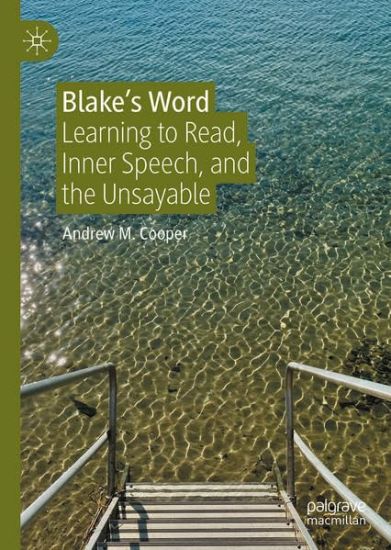
Blake’s Word

Blake’s Word

Andrew M. Cooper

Springer International Publishing AG
2025
sidottu
This book explores how William Blake conceived the act of reading as an imaginative activation of Jesus the Word, the anonymous, unsayable potency of language that underlies speech. Through illuminated printing, Blake sought to incarnate this Word by re-educating his late-Enlightened audience in the fundamentals of reading – not through morality tales but at the level of physiology and synaesthesia where seen writing is turned into meaningful mental sounds. By wrongfooting the automaticity of skilled adult parsing, Blake’s grammar and syntax restore a cognitive element of anticipation to semiotic decoding and prophetically open the immediate future to interpretation. Such speaking-forth of the divine unsayability not only critiques 18th-century Deism’s God-given “language of nature,” it also sometimes skirts unreadability. Therefore, as this study demonstrates, Blake strove hard to develop his reading program in relation to a range of well-known philosophers including Plato and Bacon, Berkeley and Hume, Swedenborg and Rousseau, whose ideas on cognition and language his work casts in a new light even today.