Kirjojen hintavertailu. Mukana 12 016 292 kirjaa ja 12 kauppaa.

Kirjahaku

Etsi kirjoja tekijän nimen, kirjan nimen tai ISBN:n perusteella.

6 kirjaa tekijältä Andrew W. Appel

Compiling with Continuations

Compiling with Continuations

Andrew W. Appel

Cambridge University Press
2007
pokkari
The control and data flow of a program can be represented using continuations, a concept from denotational semantics that has practical application in real compilers. This book shows how continuation-passing style is used as an intermediate representation on which to perform optimisations and program transformations. Continuations can be used to compile most programming languages. The method is illustrated in a compiler for the programming language Standard ML. However, prior knowledge of ML is not necessary, as the author carefully explains each concept as it arises. This is the first book to show how concepts from the theory of programming languages can be applied to the producton of practical optimising compilers for modern languages like ML. This book will be essential reading for compiler writers in both industry and academe, as well as for students and researchers in programming language theory.
Modern Compiler Implementation in Java

Modern Compiler Implementation in Java

Andrew W. Appel

Cambridge University Press
1997
pokkari
This textbook explains all phases of a modern compiler: lexical analysis, parsing, abstract syntax, semantic actions, intermediate representations, instruction selection via tree matching, dataflow analysis, graph-colouring register allocation with coalescing, and runtime systems. It covers current techniques in code generation and register allocation, as well as functional and object-oriented languages, which are missing from most books on the topic. The author illustrates the most accepted and successful techniques in a concise way, rather than as an exhaustive catalogue of every possible variant. Detailed descriptions of the interfaces between modules of a compiler are illustrated with actual Java classes. A unique feature of the book is a well designed compiler implementation project in Java, including front-end and 'high-tech' back-end phases, so that students can build a complete working compiler in one semester. The textbook is meant for use in a one-semester first course for undergraduates in compiler design. Accompanying support software is available.
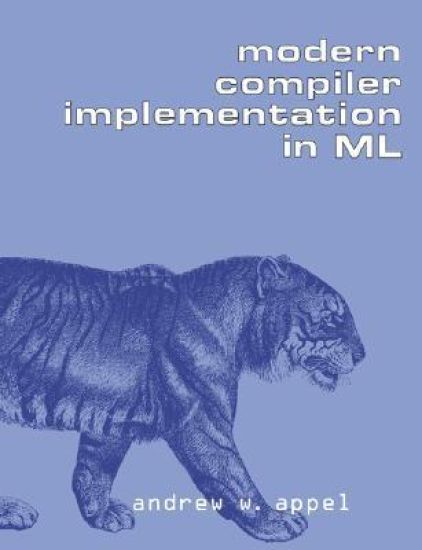
Modern Compiler Implementation in ML

Modern Compiler Implementation in ML

Andrew W. Appel

Cambridge University Press
2004
pokkari
This new, expanded textbook describes all phases of a modern compiler: lexical analysis, parsing, abstract syntax, semantic actions, intermediate representations, instruction selection via tree matching, dataflow analysis, graph-coloring register allocation, and runtime systems. It includes good coverage of current techniques in code generation and register allocation, as well as functional and object-oriented languages, that are missing from most books. In addition, more advanced chapters are now included so that it can be used as the basis for two-semester or graduate course. The most accepted and successful techniques are described in a concise way, rather than as an exhaustive catalog of every possible variant. Detailed descriptions of the interfaces between modules of a compiler are illustrated with actual C header files. The first part of the book, Fundamentals of Compilation, is suitable for a one-semester first course in compiler design. The second part, Advanced Topics, which includes the advanced chapters, covers the compilation of object-oriented and functional languages, garbage collection, loop optimizations, SSA form, loop scheduling, and optimization for cache-memory hierarchies.
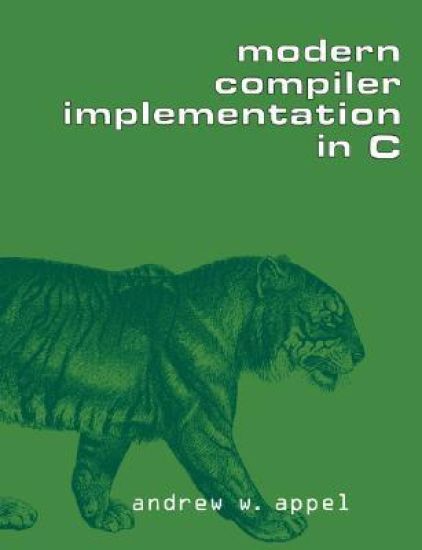
Modern Compiler Implementation in C

Modern Compiler Implementation in C

Andrew W. Appel

Cambridge University Press
2004
pokkari
This new, expanded textbook describes all phases of a modern compiler: lexical analysis, parsing, abstract syntax, semantic actions, intermediate representations, instruction selection via tree matching, dataflow analysis, graph-coloring register allocation, and runtime systems. It includes good coverage of current techniques in code generation and register allocation, as well as functional and object-oriented languages, that are missing from most books. In addition, more advanced chapters are now included so that it can be used as the basis for a two-semester or graduate course. The most accepted and successful techniques are described in a concise way, rather than as an exhaustive catalog of every possible variant. Detailed descriptions of the interfaces between modules of a compiler are illustrated with actual C header files. The first part of the book, Fundamentals of Compilation, is suitable for a one-semester first course in compiler design. The second part, Advanced Topics, which includes the advanced chapters, covers the compilation of object-oriented and functional languages, garbage collection, loop optimizations, SSA form, loop scheduling, and optimization for cache-memory hierarchies.
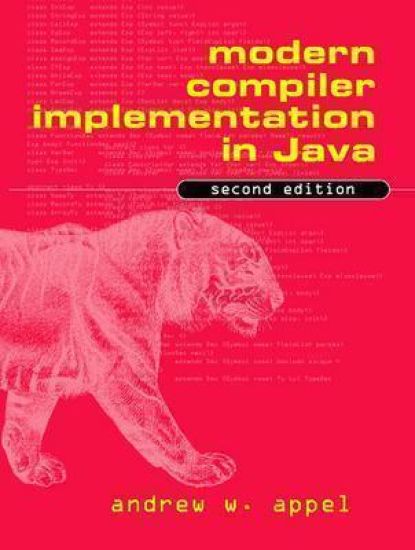
Modern Compiler Implementation in Java

Modern Compiler Implementation in Java

Andrew W. Appel

Cambridge University Press
2002
sidottu
This textbook describes all phases of a compiler: lexical analysis, parsing, abstract syntax, semantic actions, intermediate representations, instruction selection via tree matching, dataflow analysis, graph-coloring register allocation, and runtime systems. It includes good coverage of current techniques in code generation and register allocation, as well as the compilation of functional and object-oriented languages, that is missing from most books. The most accepted and successful techniques are described concisely, rather than as an exhaustive catalog of every possible variant, and illustrated with actual Java classes. The first part of the book, Fundamentals of Compilation, is suitable for a one-semester first course in compiler design. The second part, Advanced Topics, which includes the compilation of object-oriented and functional languages, garbage collection, loop optimization, SSA form, instruction scheduling, and optimization for cache-memory hierarchies, can be used for a second-semester or graduate course. This new edition has been extensively rewritten to include more discussion of Java and object-oriented programming concepts, such as visitor patterns. A unique feature is the newly redesigned compiler project in Java, for a subset of Java itself. The project includes both front-end and back-end phases, so that students can build a complete working compiler in one semester.
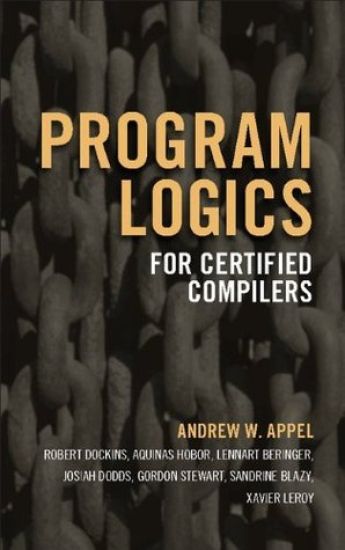
Program Logics for Certified Compilers

Program Logics for Certified Compilers

Andrew W. Appel

Cambridge University Press
2014
sidottu
Separation Logic is the twenty-first-century variant of Hoare Logic that permits verification of pointer-manipulating programs. This book covers practical and theoretical aspects of Separation Logic at a level accessible to beginning graduate students interested in software verification. On the practical side it offers an introduction to verification in Hoare and Separation logics, simple case studies for toy languages, and the Verifiable C program logic for the C programming language. On the theoretical side it presents separation algebras as models of separation logics; step-indexed models of higher-order logical features for higher-order programs; indirection theory for constructing step-indexed separation algebras; tree-shares as models for shared ownership; and the semantic construction (and soundness proof) of Verifiable C. In addition, the book covers several aspects of the CompCert verified C compiler, and its connection to foundationally verified software analysis tools. All constructions and proofs are made rigorous and accessible in the Coq developments of the open-source Verified Software Toolchain.