Kirjojen hintavertailu. Mukana 11 610 848 kirjaa ja 12 kauppaa.

Kirjahaku

Etsi kirjoja tekijän nimen, kirjan nimen tai ISBN:n perusteella.

3 kirjaa tekijältä Andrew W. Lo

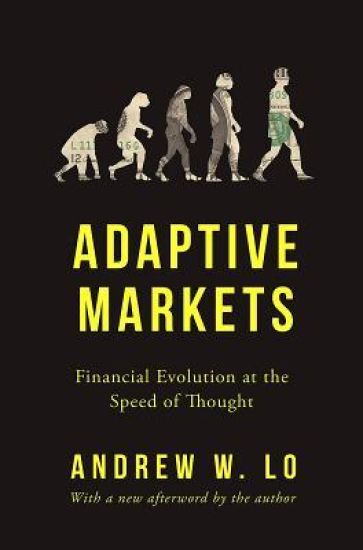
Adaptive Markets: Financial Evolution at the Speed of Thought
A new, evolutionary explanation of markets and investor behavior Half of all Americans have money in the stock market, yet economists can't agree on whether investors and markets are rational and efficient, as modern financial theory assumes, or irrational and inefficient, as behavioral economists believe--and as financial bubbles, crashes, and crises suggest. This is one of the biggest debates in economics and the value or futility of investment management and financial regulation hang on the outcome. In this groundbreaking book, Andrew Lo cuts through this debate with a new framework, the Adaptive Markets Hypothesis, in which rationality and irrationality coexist. Drawing on psychology, evolutionary biology, neuroscience, artificial intelligence, and other fields, Adaptive Markets shows that the theory of market efficiency isn't wrong but merely incomplete. When markets are unstable, investors react instinctively, creating inefficiencies for others to exploit. Lo's new paradigm explains how financial evolution shapes behavior and markets at the speed of thought--a fact revealed by swings between stability and crisis, profit and loss, and innovation and regulation. A fascinating intellectual journey filled with compelling stories, Adaptive Markets starts with the origins of market efficiency and its failures, turns to the foundations of investor behavior, and concludes with practical implications--including how hedge funds have become the Gal pagos Islands of finance, what really happened in the 2008 meltdown, and how we might avoid future crises. An ambitious new answer to fundamental questions in economics, Adaptive Markets is essential reading for anyone who wants to know how markets really work.
Hedge Funds

Hedge Funds

Andrew W. Lo

Princeton University Press
2010
pokkari
The hedge fund industry has grown dramatically over the last two decades, with more than eight thousand funds now controlling close to two trillion dollars. Originally intended for the wealthy, these private investments have now attracted a much broader following that includes pension funds and retail investors. Because hedge funds are largely unregulated and shrouded in secrecy, they have developed a mystique and allure that can beguile even the most experienced investor. In Hedge Funds, Andrew Lo--one of the world's most respected financial economists--addresses the pressing need for a systematic framework for managing hedge fund investments. Arguing that hedge funds have very different risk and return characteristics than traditional investments, Lo constructs new tools for analyzing their dynamics, including measures of illiquidity exposure and performance smoothing, linear and nonlinear risk models that capture alternative betas, econometric models of hedge fund failure rates, and integrated investment processes for alternative investments. In a new chapter, he looks at how the strategies for and regulation of hedge funds have changed in the aftermath of the financial crisis.
Adaptive Markets

Adaptive Markets

Andrew W. Lo

Princeton University Press
2019
pokkari
A new, evolutionary explanation of markets and investor behaviorHalf of all Americans have money in the stock market, yet economists can’t agree on whether investors and markets are rational and efficient, as modern financial theory assumes, or irrational and inefficient, as behavioral economists believe. The debate is one of the biggest in economics, and the value or futility of investment management and financial regulation hangs on the answer. In this groundbreaking book, Andrew Lo transforms the debate with a powerful new framework in which rationality and irrationality coexist—the Adaptive Markets Hypothesis. Drawing on psychology, evolutionary biology, neuroscience, artificial intelligence, and other fields, Adaptive Markets shows that the theory of market efficiency is incomplete. When markets are unstable, investors react instinctively, creating inefficiencies for others to exploit. Lo’s new paradigm explains how financial evolution shapes behavior and markets at the speed of thought—a fact revealed by swings between stability and crisis, profit and loss, and innovation and regulation. An ambitious new answer to fundamental questions about economics and investing, Adaptive Markets is essential reading for anyone who wants to understand how markets really work.