Kirjojen hintavertailu. Mukana 12 016 292 kirjaa ja 12 kauppaa.

Kirjahaku

Etsi kirjoja tekijän nimen, kirjan nimen tai ISBN:n perusteella.

2 kirjaa tekijältä Andrey Itkin

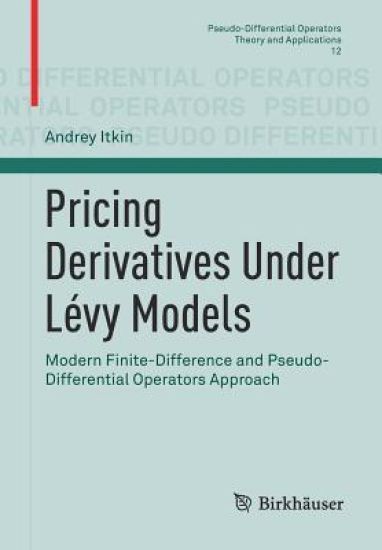
Pricing Derivatives Under Lévy Models

Pricing Derivatives Under Lévy Models

Andrey Itkin

Springer-Verlag New York Inc.
2017
nidottu
This monograph presents a novel numerical approach to solving partial integro-differential equations arising in asset pricing models with jumps, which greatly exceeds the efficiency of existing approaches. The method, based on pseudo-differential operators and several original contributions to the theory of finite-difference schemes, is new as applied to the Lévy processes in finance, and is herein presented for the first time in a single volume. The results within, developed in a series of research papers, are collected and arranged together with the necessary background material from Lévy processes, the modern theory of finite-difference schemes, the theory of M-matrices and EM-matrices, etc., thus forming a self-contained work that gives the reader a smooth introduction to the subject. For readers with no knowledge of finance, a short explanation of the main financial terms and notions used in the book is given in the glossary.The latter part of the book demonstrates the efficacy of the method by solving some typical problems encountered in computational finance, including structural default models with jumps, and local stochastic volatility models with stochastic interest rates and jumps. The author also adds extra complexity to the traditional statements of these problems by taking into account jumps in each stochastic component while all jumps are fully correlated, and shows how this setting can be efficiently addressed within the framework of the new method.Written for non-mathematicians, this book will appeal to financial engineers and analysts, econophysicists, and researchers in applied numerical analysis. It can also be used as an advance course on modern finite-difference methods or computational finance.
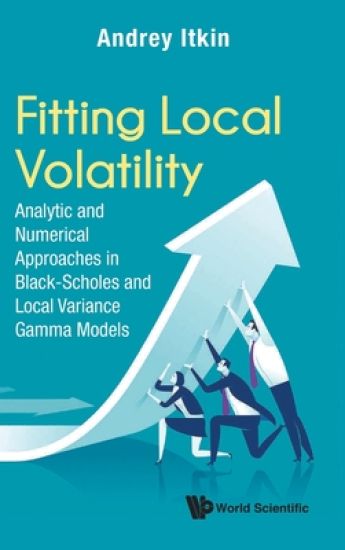
Fitting Local Volatility: Analytic And Numerical Approaches In Black-scholes And Local Variance Gamma Models
The concept of local volatility as well as the local volatility model are one of the classical topics of mathematical finance. Although the existing literature is wide, there still exist various problems that have not drawn sufficient attention so far, for example: a) construction of analytical solutions of the Dupire equation for an arbitrary shape of the local volatility function; b) construction of parametric or non-parametric regression of the local volatility surface suitable for fast calibration; c) no-arbitrage interpolation and extrapolation of the local and implied volatility surfaces; d) extension of the local volatility concept beyond the Black-Scholes model, etc. Also, recent progresses in deep learning and artificial neural networks as applied to financial engineering have made it reasonable to look again at various classical problems of mathematical finance including that of building a no-arbitrage local/implied volatility surface and calibrating it to the option market data.This book was written with the purpose of presenting new results previously developed in a series of papers and explaining them consistently, starting from the general concept of Dupire, Derman and Kani and then concentrating on various extensions proposed by the author and his co-authors. This volume collects all the results in one place, and provides some typical examples of the problems that can be efficiently solved using the proposed methods. This also results in a faster calibration of the local and implied volatility surfaces as compared to standard approaches.The methods and solutions presented in this volume are new and recently published, and are accompanied by various additional comments and considerations. Since from the mathematical point of view, the level of details is closer to the applied rather than to the abstract or pure theoretical mathematics, the book could also be recommended to graduate students with majors in computational or quantitative finance, financial engineering or even applied mathematics. In particular, the author used to teach some topics of this book as a part of his special course on computational finance at the Tandon School of Engineering, New York University.