Kirjojen hintavertailu. Mukana 11 699 587 kirjaa ja 12 kauppaa.

Kirjahaku

Etsi kirjoja tekijän nimen, kirjan nimen tai ISBN:n perusteella.

6 kirjaa tekijältä Ann Cooper Albright

How to Land

How to Land

Ann Cooper Albright

Oxford University Press Inc
2019
sidottu
How to Land: Finding Ground in an Unstable World presents a new look at embodiment that treats gravity as the organizing force for thinking and moving through our twenty-first century world. Author Ann Cooper Albright argues that a renewed attention to gravity as both a metaphoric sensibility and a physical experience can help transform moments of personal disorientation into an opportunity to reflect on the important relationship between individual resiliency and communal responsibility. Long one of the nation's preeminent thinkers in dance improvisation, Albright asks how dancers are affected by repeated images of falling bodies, bombed-out buildings, and displaced peoples, as well as recurring evocations of global economies and governments in discursive free fall or dissolution. What kind of fear gets lodged in connective tissue when there is an underlying anxiety that certain aspects of our world are in danger of falling apart? To answer this question, she draws on analyses of perception from cognitive studies, tracing the discussions of meaning, body and language through the work of Mark Johnson, Thomas Csordas, and George Lakoff, among others. In addition, she follows the past decade of debate in contemporary media concerning the implications of the weightless and two-dimensional social media exchanges on structures of attention and learning, as well as their effect on the personal growth and socialization of a generation of young adults. Each chapter interweaves discussions of movement actions with their cultural implications, documenting specific bodily experiences and then tracing their ideological ripples out through the world.

How to Land

How to Land

Ann Cooper Albright

Oxford University Press Inc
2019
nidottu
How to Land: Finding Ground in an Unstable World presents a new look at embodiment that treats gravity as the organizing force for thinking and moving through our twenty-first century world. Author Ann Cooper Albright argues that a renewed attention to gravity as both a metaphoric sensibility and a physical experience can help transform moments of personal disorientation into an opportunity to reflect on the important relationship between individual resiliency and communal responsibility. Long one of the nation's preeminent thinkers in dance improvisation, Albright asks how dancers are affected by repeated images of falling bodies, bombed-out buildings, and displaced peoples, as well as recurring evocations of global economies and governments in discursive free fall or dissolution. What kind of fear gets lodged in connective tissue when there is an underlying anxiety that certain aspects of our world are in danger of falling apart? To answer this question, she draws on analyses of perception from cognitive studies, tracing the discussions of meaning, body and language through the work of Mark Johnson, Thomas Csordas, and George Lakoff, among others. In addition, she follows the past decade of debate in contemporary media concerning the implications of the weightless and two-dimensional social media exchanges on structures of attention and learning, as well as their effect on the personal growth and socialization of a generation of young adults. Each chapter interweaves discussions of movement actions with their cultural implications, documenting specific bodily experiences and then tracing their ideological ripples out through the world.

Simone Forti

Simone Forti

Ann Cooper Albright

WESLEYAN UNIVERSITY PRESS
2024
sidottu
First critical biography of this visionary artist written by a dance scholar. Simone Forti, groundbreaking improvisor, has spent a lifetime weaving together the movement of her mind with the movement of her body to create a unique oeuvre situated at the intersection of dancing and art practices. Her seminal Dance Constructions from the 1960s crafted a new approach to dance composition and helped inspire the investigations of Judson Dance Theater. In the 1970s, Forti's explorations of animal movements expanded that legacy to launch improvisation as a valuable artform in its own right. From her early forays into vocal accompaniment to her News Animations, Forti has long integrated gesture and text into compelling performances that consistently stretched the boundaries of dance to layer abstract movement with story-telling and political commentary. Her "Land Portraits" series brought an immersive ecological experience to New York City stages in the 1980s, and she is a beloved teacher and mentor whose Body, Mind, World workshops have inspired dancers around the world. In this beautifully written book, author Ann Cooper Albright braids archival research, extensive interviews, and detailed movement analyses of Forti's performances to provide the first kinesthetically-informed and critically-nuanced history of Forti's multifaceted and extensive career.
Simone Forti

Simone Forti

Ann Cooper Albright

WESLEYAN UNIVERSITY PRESS
2025
nidottu
New in paperback edition of the first critical biography of this visionary artist written by a dance scholar. Simone Forti, groundbreaking improvisor, has spent a lifetime weaving together the movement of her mind with the movement of her body to create a unique oeuvre situated at the intersection of dancing and art practices. Her seminal Dance Constructions from the 1960s crafted a new approach to dance composition and helped inspire the investigations of Judson Dance Theater. In the 1970s, Forti's explorations of animal movements expanded that legacy to launch improvisation as a valuable artform in its own right. From her early forays into vocal accompaniment to her News Animations, Forti has long integrated gesture and text into compelling performances that consistently stretched the boundaries of dance to layer abstract movement with story-telling and political commentary. Her "Land Portraits" series brought an immersive ecological experience to New York City stages in the 1980s, and she is a beloved teacher and mentor whose Body, Mind, World workshops have inspired dancers around the world. In this beautifully written book, author Ann Cooper Albright braids archival research, extensive interviews, and detailed movement analyses of Forti's performances to provide the first kinesthetically-informed and critically-nuanced history of Forti's multifaceted and extensive career.
Choreographing Difference

Choreographing Difference

Ann Cooper Albright

Wesleyan University Press
1997
nidottu
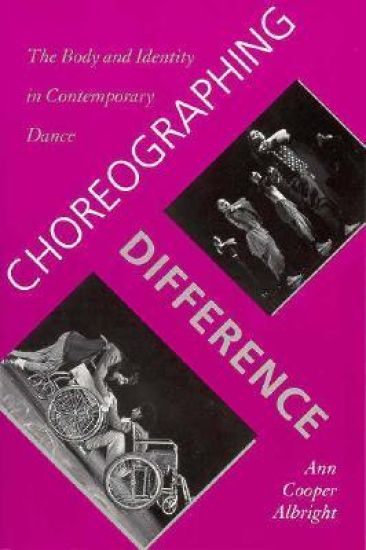
The choreographies of Bill T. Jones, Cleveland Ballet Dancing Wheels, Zab Maboungou, David Dorfman, Marie Chouinard, Jawole Willa Jo Zollar, and others, have helped establish dance as a crucial discourse of the 90s. These dancers, Ann Cooper Albright argues, are asking the audience to see the body as a source of cultural identity - a physical presence that moves with and through its gendered, racial, and social meanings. Through her articulate and nuanced analysis of contemporary choreography, Albright shows how the dancing body shifts conventions of representation and provides a critical example of the dialectical relationship between cultures and the bodies that inhabit them. As a dancer, feminist, and philosopher, Albright turns to the material experience of bodies, not just the body as a figure or metaphor, to understand how cultural representation becomes embedded in the body. In arguing for the intelligence of bodies, Choreographing Difference is itself a testimonial, giving voice to some important political, moral, and artistic questions of our time.
Engaging Bodies

Engaging Bodies

Ann Cooper Albright

Wesleyan University Press
2013
nidottu
For twenty-five years, Ann Cooper Albright has been exploring the intersection of cultural representation and somatic identity in dance. For Albright, dancing is a physical inquiry, a way of experiencing and participating in the world, and her writing reflects an interdisciplinary approach to seeing and thinking about dance. In her engagement as both a dancer and a scholar, Albright draws on her kinesthetic sensibilities as well as her intellectual knowledge to articulate how movement creates meaning. Throughout Engaging Bodies movement and ideas lean on one another to produce a critical theory anchored in the material reality of dancing bodies. This blend of cultural theory and personal circumstance will be useful and inspiring for emerging scholars and dancers looking for a model of writing about dance that thrives on the interconnectedness of watching and doing, gesture and thought.