Kirjojen hintavertailu. Mukana 12 444 606 kirjaa ja 12 kauppaa.

Kirjahaku

Etsi kirjoja tekijän nimen, kirjan nimen tai ISBN:n perusteella.

7 kirjaa tekijältä Anthony Vidler

The Architectural Uncanny

The Architectural Uncanny

Anthony Vidler

MIT Press
1994
pokkari
Anthony Vidler interprets contemporary buildings and projects in light of the resurgent interest in the uncanny as a metaphor for a fundamentally "unhomely" modern condition.The Architectural Uncanny presents an engaging and original series of meditations on issues and figures that are at the heart of the most pressing debates surrounding architecture today. Anthony Vidler interprets contemporary buildings and projects in light of the resurgent interest in the uncanny as a metaphor for a fundamentally "unhomely" modern condition. The essays are at once historical-serving to situate contemporary discourse in its own intellectual tradition and theoretical-opening up the complex and difficult relationships between politics, social thought, and architectural design in an era when the reality of homelessness and the idealism of the neo-avant-garde have never seemed so far apart.Vidler, one of the deftest and surest critics of the contemporary scene, explores aspects of architecture through notions of the uncanny as they have been developed in literature, philosophy, and psychology from the beginning of the nineteenth century to the present. He interprets the unsettling qualities of today's architecture-its fragmented neo-constructivist forms reminiscent of dismembered bodies, its "seeing walls" replicating the passive gaze of domestic cyborgs, its historical monuments indistinguishable from glossy reproductions - in the light of modern reflection on questions of social and individual estrangement, alienation, exile, and homelessness.Focusing on the work of architects such as Bernard Tschumi, Rem Koolhaas, Peter Eisenman, Coop Himmelblau, John Hejduk, Elizabeth Diller, and Ricardo Scofidio, as well as theorists of the urban condition, Vidler delineates the problems and paradoxes associated with the subject of domesticity.
Warped Space

Warped Space

Anthony Vidler

MIT Press
2002
pokkari
How psychological ideas of space have profoundly affected architectural and artistic expression in the twentieth century.Beginning with agoraphobia and claustrophobia in the late nineteenth century, followed by shell shock and panic fear after World War I, phobias and anxiety came to be seen as the mental condition of modern life. They became incorporated into the media and arts, in particular the spatial arts of architecture, urbanism, and film. This "spatial warping" is now being reshaped by digitalization and virtual reality. Anthony Vidler is concerned with two forms of warped space. The first, a psychological space, is the repository of neuroses and phobias. This space is not empty but full of disturbing forms, including those of architecture and the city. The second kind of warping is produced when artists break the boundaries of genre to depict space in new ways. Vidler traces the emergence of a psychological idea of space from Pascal and Freud to the identification of agoraphobia and claustrophobia in the nineteenth century to twentieth-century theories of spatial alienation and estrangement in the writings of Georg Simmel, Siegfried Kracauer, and Walter Benjamin. Focusing on current conditions of displacement and placelessness, he examines ways in which contemporary artists and architects have produced new forms of spatial warping. The discussion ranges from theorists such as Jacques Lacan and Gilles Deleuze to artists such as Vito Acconci, Mike Kelley, Martha Rosler, and Rachel Whiteread. Finally, Vidler looks at the architectural experiments of Frank Gehry, Coop Himmelblau, Daniel Libeskind, Greg Lynn, Morphosis, and Eric Owen Moss in the light of new digital techniques that, while relying on traditional perspective, have radically transformed the composition, production, and experience-perhaps even the subject itself-of architecture.
James Frazer Stirling

James Frazer Stirling

Anthony Vidler

Yale University Press
2010
sidottu
An in-depth exploration of the design process and teaching methods of the remarkable British architect as revealed by the archives of the Canadian Centre for Architecture, Montreal The British architect James Frazer Stirling (1924–1992) stimulated impassioned responses among both supporters and detractors, and he continues to be the subject of fierce debate. He earned international renown through such innovative—and frequently controversial—projects as the Leicester University Engineering Building (1959–63); the History Faculty building at Cambridge University (1964–67); the Neue Staatsgalerie, Stuttgart (1977–84); the Clore Gallery at Tate Britain (1984); and the Arthur M. Sackler Museum at Harvard University (1979–84). Stirling was also a visiting professor at the Yale School of Architecture, where he trained and influenced many of the current leaders in the field.Fully illustrated with previously unpublished documents and new photography from the James Stirling/Michael Wilford Archive at the Canadian Centre for Architecture, Montreal, this book allows for a close examination of design drawings, photographs, and models spanning Stirling’s entire career. These materials deepen our understanding of the influences, early formation, approach, and process of an architect whose work resists labeling. Filled with in-depth analytical and critical presentations of exemplary projects and their reception, the volume reveals Stirling to be a remarkably informed and consistent thinker and writer on architecture.Published in association with the Yale Center for British Art and the Canadian Centre for ArchitectureExhibition Schedule:Yale Center for British Art 10/14/2010 – 01/02/2011Canadian Centre for Architecture, Montreal Spring 2012
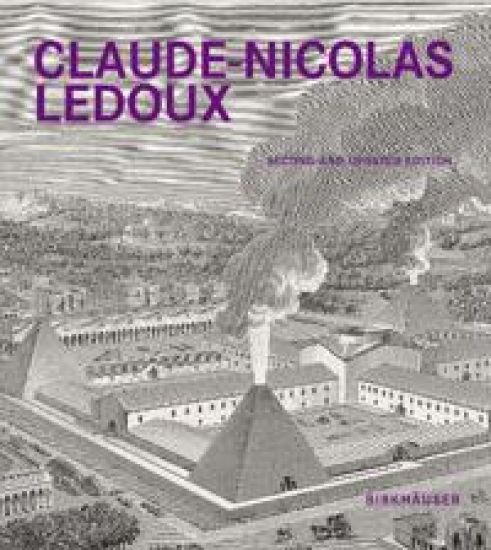
Claude-Nicolas Ledoux

Claude-Nicolas Ledoux

Anthony Vidler

Birkhauser
2021
sidottu
Claude-Nicolas Ledoux (1736-1806) is today regarded as chief representative of French revolutionary architecture. With his extraordinary inventiveness he projected the architectural ideals of his era. Ledoux’s influential buildings and projects are presented and interpreted both aesthetically and historically in this book. His best-known projects – the Royal Saltwords of Arc-et-Senans, the tollgates of Paris, the ideal city of Chaux – reveal the architect’s allegiance to the principles of antiquity and Renaissance but also illustrate the evolution of his own utopian language. With the French Revolution, Ledoux ceased building as his contemporaries perceived him as a royal architect. He focused on the development of his architectural theory and redefined the vision of the modern architect.
Claude-Nicolas Ledoux

Claude-Nicolas Ledoux

Anthony Vidler

Birkhauser
2021
sidottu
Claude-Nicolas Ledoux (1736-1806) is today regarded as chief representative of French revolutionary architecture. With his extraordinary inventiveness he projected the architectural ideals of his era. Ledoux’s influential buildings and projects are presented and interpreted both aesthetically and historically in this book. His best-known projects – the Royal Saltwords of Arc-et-Senans, the tollgates of Paris, the ideal city of Chaux – reveal the architect’s allegiance to the principles of antiquity and Renaissance but also illustrate the evolution of his own utopian language. With the French Revolution, Ledoux ceased building as his contemporaries perceived him as a royal architect. He focused on the development of his architectural theory and redefined the vision of the modern architect.
Arkhitekturnoe zhutkoe. Opyty o sovremennoj besprijutnosti

Arkhitekturnoe zhutkoe. Opyty o sovremennoj besprijutnosti

Anthony Vidler

Novoe literaturnoe obozrenie
2025
sidottu
Pochemu sovremennyj gorod my chasche vosprinimaem kak trevozhnoe, a ne ujutnoe prostranstvo? Za chto arkhitektory kontsa XX veka poljubili uglovatye i ostrye formy, zachem proektirujut zdanija, kotorye slovno razvalivajutsja na kuski? Entoni Vidler pokazyvaet, kak v arkhitekture projavljaetsja vytesnennyj strakh pered buduschim, "nedovolstvo kulturoj", frustratsija ot chuvstva politicheskogo bessilija. Obektami issledovanija v knige stanovjatsja lidery arkhitekturnogo avangarda kontsa 1980 kh i 1990 kh godov, segodnja uzhe priznannye klassiki: Piter Ajzenman, Rem Kolkhas, Liz Diller i Rikardo Skofidio, Bernar Chumi, Dzhon Khejduk, bjuro Coop Himmelb(l)au. V tsentre vnimanija avtora - ponjatie zhutkogo, vvedennoe Frejdom i voskhodjaschee k traditsii goticheskogo romana i literature uzhasov XIX veka. Vidler proslezhivaet, kak motivy trevozhnosti, razdvoenija, utraty domashnego uklada i raspada samoj identichnosti cheloveka postepenno perekhodjat iz literatury i psikhoanaliza v arkhitekturnuju formu. Kazhdaja glava knigi - otdelnoe esse, issledujuschee raznye aspekty chuvstvitelnosti sovremennogo gorodskogo cheloveka. Entoni Vidler (1941-2023) - teoretik i istorik arkhitektury.
Histories of Ecological Design

Histories of Ecological Design

Lydia Kallipoliti; Anthony Vidler

Actar Publishers
2024
pokkari
This book documents the intersection of architecture and design with ecology, environmental history, policy, governance and law from the 19th century to today. It presents conflicting definitions and concepts of architects and designers and the parallel histories of their intellectual positions toward environmental throughout time. There have been many accounts on the history of ecology and others on the migration of ecological thought to design and architecture practice. Yet, the work of a focused and expanded history of ecological design is much needed. This book presents conflicting definitions and concepts of architects and designers and the parallel histories of their intellectual positions toward environmental thought from the 19th century to today.To survey the formation of this field, the history of ecological design will be not be exclusively examined chronologically, but also in connected worldviews, each rendering evolving perceptions of nature, its relation to culture, and the occupation of the natural world by human and non-human subjects.