Kirjojen hintavertailu. Mukana 11 244 527 kirjaa ja 12 kauppaa.

Kirjahaku

Etsi kirjoja tekijän nimen, kirjan nimen tai ISBN:n perusteella.

18 kirjaa tekijältä April Carter

Success and Failure in Arms Control Negotiations

Success and Failure in Arms Control Negotiations

April Carter

Oxford University Press
1989
sidottu
Governments have been negotiating about disarmament, or more limited forms of arms control, for forty years. Despite these negotiations, weapons of increasing deadliness and sophistication continue to be developed. Through the use of case studies of particular negotiations (Partial and Comprehensive Test Ban, SALT I and II, INF and START, and MBFR/CFE), the book explores both the reasons for success and the obstacles leading to failure, and assesses the importance of different types of explanation. Dr Carter not only analyses the reasons why negotiations fail, she also examines the conditions under which they are likely to succeed. The result is a balanced comprehensive treatment of the problems and prospects for arms control.
The Political Theory of Global Citizenship
This book provides a comprehensive overview of the meaning of cosmopolitanism and world citizenship in the history of Western political thought, and in the evolution of international politics since 1500. Providing an invaluable overview of earlier political thought, recent theoretical literature and current debates, this book also discusses recent developments in international politics and transnational protest. It will be of great interest to those specialising in political theory, International Relations and peace/conflict studies. It will also interest those already acting as global citizens.
The Political Theory of Global Citizenship
This book provides a comprehensive overview of the meaning of cosmopolitanism and world citizenship in the history of Western political thought, and in the evolution of international politics since 1500.Providing an invaluable overview of earlier political thought, recent theoretical literature and current debates, this book also discusses recent developments in international politics and transnational protest. It will be of great interest to those specialising in political theory, International Relations and peace/conflict studies. It will also interest those already acting as global citizens.
Authority and Democracy

Authority and Democracy

April Carter

Routledge
2009
sidottu
This book debates the nature and functions of authority: it examines how far our inherited images of authority derive from an aristocratic and traditional order and considers which models of authority are still relevant in a democratic and rationalist society. It discusses the characteristics of the authority relationship, whether political authority differs from other kinds of authority, how authority relates to power and whether authority should be distinguished from the concept of legitimate rule. The latter part of the book explores the relevance or irrelevance of authority in contemporary society. In particular it examines recent libertarian arguments for the rejection of all forms of authority and the special problems of creating and maintaining authority after revolution.
Direct Action and Liberal Democracy (Routledge Library Editions:Political Science Volume 6)
This study focuses primarily on the nature of "direct action" in relation to contemporary movements, and considers the role of direct action methods in past campaigns for constitutional and social rights. Boycotts, sit-ins, obstructions, civil disobedience and other unconstitutional forms of protest are examined to see whether they necessarily lead to violence. The political conditions which encourage violence and the effects of various type of violent action are also discussed. The theoretical issues raised by direct action in a parliamentary system are also discussed.
The Political Theory of Anarchism
Anarchism is a significant but relatively neglected of political thought. April Carter examines the anarchist critique of the state, of bureaucracy, of democratic government and contrasts this attitude with more orthodox political theory. She also considers anarchist theories and social and economic organization, the relevance of anarchism to contemporary conditions and the problems of idealism in politics.
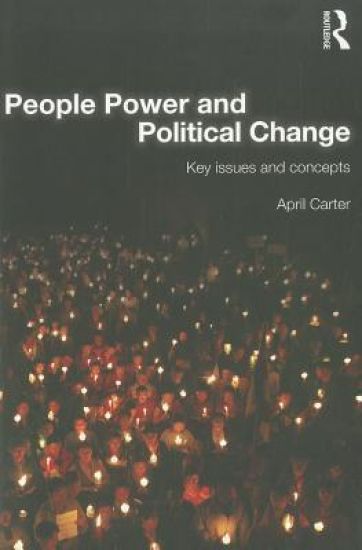
People Power and Political Change
This book examines the upsurge in mass popular protest against undemocratic regimes. Relating early revolutions to recent global trends and protests, it examines the significance of ‘people power’ to democracy.Taking a comparative approach, this text analyses unarmed uprisings in Iran 1977-79, Latin America and Asia in the 1980s, Africa from 1989-1992, 1989 in Eastern Europe and ex-Soviet states after 2000, right up to the 2011 ‘Arab Spring’. The author assesses the influence on people power of global politics and trends, such as the growth of international governmental organizations and international law, citizen networks operating across borders, and emerging media (like Twitter and Wikileaks). Although stressing the positive potential of people power, this text also examines crucial problems of repression, examples of failure and potential political problems, disintegration of empires and the role of power rivalries. Drawing from contemporary debates about democratization and literatures on power, violence and nonviolence, from both academic sources and media perspectives, this text builds an incisive analytical argument about the changing nature of power itself.People Power and Political Change is a must read for students and scholars of democratic theory, international politics and current affairs.
People Power and Political Change
This book examines the upsurge in mass popular protest against undemocratic regimes. Relating early revolutions to recent global trends and protests, it examines the significance of ‘people power’ to democracy.Taking a comparative approach, this text analyses unarmed uprisings in Iran 1977-79, Latin America and Asia in the 1980s, Africa from 1989-1992, 1989 in Eastern Europe and ex-Soviet states after 2000, right up to the 2011 ‘Arab Spring’. The author assesses the influence on people power of global politics and trends, such as the growth of international governmental organizations and international law, citizen networks operating across borders, and emerging media (like Twitter and Wikileaks). Although stressing the positive potential of people power, this text also examines crucial problems of repression, examples of failure and potential political problems, disintegration of empires and the role of power rivalries. Drawing from contemporary debates about democratization and literatures on power, violence and nonviolence, from both academic sources and media perspectives, this text builds an incisive analytical argument about the changing nature of power itself.People Power and Political Change is a must read for students and scholars of democratic theory, international politics and current affairs.
Direct Action and Liberal Democracy (Routledge Library Editions:Political Science Volume 6)
This study focuses primarily on the nature of "direct action" in relation to contemporary movements, and considers the role of direct action methods in past campaigns for constitutional and social rights. Boycotts, sit-ins, obstructions, civil disobedience and other unconstitutional forms of protest are examined to see whether they necessarily lead to violence. The political conditions which encourage violence and the effects of various type of violent action are also discussed. The theoretical issues raised by direct action in a parliamentary system are also discussed.
The Political Theory of Anarchism
Anarchism is a significant but relatively neglected of political thought. April Carter examines the anarchist critique of the state, of bureaucracy, of democratic government and contrasts this attitude with more orthodox political theory. She also considers anarchist theories and social and economic organization, the relevance of anarchism to contemporary conditions and the problems of idealism in politics.
Authority and Democracy

Authority and Democracy

April Carter

Routledge
2012
nidottu
This book debates the nature and functions of authority: it examines how far our inherited images of authority derive from an aristocratic and traditional order and considers which models of authority are still relevant in a democratic and rationalist society. It discusses the characteristics of the authority relationship, whether political authority differs from other kinds of authority, how authority relates to power and whether authority should be distinguished from the concept of legitimate rule. The latter part of the book explores the relevance or irrelevance of authority in contemporary society. In particular it examines recent libertarian arguments for the rejection of all forms of authority and the special problems of creating and maintaining authority after revolution.
Peace Movements: International Protest and World Politics Since 1945
There is a long tradition of opposition to war and organized peace campaigns date from 1815. Since 1945, however, modern weapons technology has threatened world wide destruction and has stimulated widespread protests. This book sketches in the background of thinking about peace and resistance to war before 1945, and then examines how public opposition to nuclear weapons and testing grew in the 1950s and early 1960s. Later chapters cover the major ressurgence of nuclear disarmament campaigns in the 1980s. The book also looks at how peace protest has spread from its origins in North America and North West Europe to embrace many parts of the world; opposition to nuclear testing has indeed been particularly strong in Japan, Australia, New Zealand and the Pacific islands. The period 1945 to 1990 was dominated by the Cold War between the USA and USSR, and the role of the Soviet-sponsored World Peace Council caused difficulties for indeptendent peace groups in the West. During the 1980s the emergence of autonomous peace activity in a number of East European countries, and even on a very small scale in the USSR itself, transformed the possibilities for East-West co-operation between citizens to urge disarmament and political change. A chapter examines these developments. Opposition to all forms of militarism has spread in the last 30 years. This book charts the struggles to extend the right to conscientious objection to military service, and draft resistance to particular wars - for example in Southern Africa and Israel. It also looks in some detail at the growing opposition to the war in the Vietnam. The recent protests against the Gulf War are surveyed briefly in an epilogue.
Direct Action and Democracy Today

Direct Action and Democracy Today

April Carter

Polity Press
2004
sidottu
More and more people around the world are protesting to defend their rights, resist injustice or oppose undemocratic rule. In this book, April Carter debates the nature and meaning of such protest and discusses the relationship between direct action and people’s claims for greater democratic control, not only against repressive regimes but also in liberal parliamentary states. The book begins by looking at non-violent direct action in historical context, tracing its evolution from the end of the Second World War to the present day. It examines the association between direct action and the social movements of recent decades and charts its role in the new global movement against neo-liberal economic policies. The second part of the book relates direct action to political theory to ascertain how it fits with theories of liberal, republican and deliberative democracy. It goes on to consider socialist and cosmopolitan approaches to democracy and popular resistance and concludes by looking at the implications of protest politics for current democratic thinking and contemporary world events. This book will be a valuable resource for students and scholars of international politics and political theory.
Direct Action and Democracy Today

Direct Action and Democracy Today

April Carter

Polity Press
2004
nidottu
More and more people around the world are protesting to defend their rights, resist injustice or oppose undemocratic rule. In this book, April Carter debates the nature and meaning of such protest and discusses the relationship between direct action and people’s claims for greater democratic control, not only against repressive regimes but also in liberal parliamentary states. The book begins by looking at non-violent direct action in historical context, tracing its evolution from the end of the Second World War to the present day. It examines the association between direct action and the social movements of recent decades and charts its role in the new global movement against neo-liberal economic policies. The second part of the book relates direct action to political theory to ascertain how it fits with theories of liberal, republican and deliberative democracy. It goes on to consider socialist and cosmopolitan approaches to democracy and popular resistance and concludes by looking at the implications of protest politics for current democratic thinking and contemporary world events. This book will be a valuable resource for students and scholars of international politics and political theory.
Camp Funhouse

Camp Funhouse

April Carter

Friesenpress
2023
pokkari
When thirteen seniors from Heaven's Ridge Retirement Home sign up for a weeklong getaway at Mystic Senior Camp, they have no idea what they're in for They may be wise in years, but these seniors still have a thing or two to learn about life. At first, they make the counselor's lives miserable with their hijinks and big personalities. When they overhear a conversation between three counselors about a nearby funhouse, a group of the seniors decides to sneak off on their own and experience the adventure for themselves. They have no idea what awaits them at the Funhouse Challenges will be faced, romances will begin and end, and secrets will come out. But what exactly is the Funhouse, and what will they find if they can make it to the final adventure?At Mystic Senior Camp, the fun isn't just for kids-it's for the young of heart, too
Camp Funhouse

Camp Funhouse

April Carter

Friesenpress
2023
sidottu
When thirteen seniors from Heaven's Ridge Retirement Home sign up for a weeklong getaway at Mystic Senior Camp, they have no idea what they're in for They may be wise in years, but these seniors still have a thing or two to learn about life. At first, they make the counselor's lives miserable with their hijinks and big personalities. When they overhear a conversation between three counselors about a nearby funhouse, a group of the seniors decides to sneak off on their own and experience the adventure for themselves. They have no idea what awaits them at the Funhouse Challenges will be faced, romances will begin and end, and secrets will come out. But what exactly is the Funhouse, and what will they find if they can make it to the final adventure?At Mystic Senior Camp, the fun isn't just for kids-it's for the young of heart, too
Peace Movements: International Protest and World Politics Since 1945
There is a long tradition of opposition to war and organized peace campaigns date from 1815. Since 1945, however, modern weapons technology has threatened world wide destruction and has stimulated widespread protests. This book sketches in the background of thinking about peace and resistance to war before 1945, and then examines how public opposition to nuclear weapons and testing grew in the 1950s and early 1960s. Later chapters cover the major ressurgence of nuclear disarmament campaigns in the 1980s. The book also looks at how peace protest has spread from its origins in North America and North West Europe to embrace many parts of the world; opposition to nuclear testing has indeed been particularly strong in Japan, Australia, New Zealand and the Pacific islands. The period 1945 to 1990 was dominated by the Cold War between the USA and USSR, and the role of the Soviet-sponsored World Peace Council caused difficulties for indeptendent peace groups in the West. During the 1980s the emergence of autonomous peace activity in a number of East European countries, and even on a very small scale in the USSR itself, transformed the possibilities for East-West co-operation between citizens to urge disarmament and political change. A chapter examines these developments. Opposition to all forms of militarism has spread in the last 30 years. This book charts the struggles to extend the right to conscientious objection to military service, and draft resistance to particular wars - for example in Southern Africa and Israel. It also looks in some detail at the growing opposition to the war in the Vietnam. The recent protests against the Gulf War are surveyed briefly in an epilogue.