Kirjojen hintavertailu. Mukana 11 244 527 kirjaa ja 12 kauppaa.

Kirjahaku

Etsi kirjoja tekijän nimen, kirjan nimen tai ISBN:n perusteella.

15 kirjaa tekijältä Arkady Plotnitsky

Epistemology and Probability

Epistemology and Probability

Arkady Plotnitsky

Springer-Verlag New York Inc.
2009
sidottu
This book offers an exploration of the relationships between epistemology and probability in the work of Niels Bohr, Werner Heisenberg, and Erwin Schro- ¨ dinger, and in quantum mechanics and in modern physics as a whole. It also considers the implications of these relationships and of quantum theory itself for our understanding of the nature of human thinking and knowledge in general, or the ‘‘epistemological lesson of quantum mechanics,’’ as Bohr liked 1 to say. These implications are radical and controversial. While they have been seen as scientifically productive and intellectually liberating to some, Bohr and Heisenberg among them, they have been troublesome to many others, such as Schro¨ dinger and, most prominently, Albert Einstein. Einstein famously refused to believe that God would resort to playing dice or rather to playing with nature in the way quantum mechanics appeared to suggest, which is indeed quite different from playing dice. According to his later (sometime around 1953) remark, a lesser known or commented upon but arguably more important one: ‘‘That the Lord should play [dice], all right; but that He should gamble according to definite rules [i. e. , according to the rules of quantum mechanics, rather than 2 by merely throwing dice], that is beyond me. ’’ Although Einstein’s invocation of God is taken literally sometimes, he was not talking about God but about the way nature works. Bohr’s reply on an earlier occasion to Einstein’s question 1 Cf.
The Knowable and the Unknowable

The Knowable and the Unknowable

Arkady Plotnitsky

The University of Michigan Press
2002
nidottu
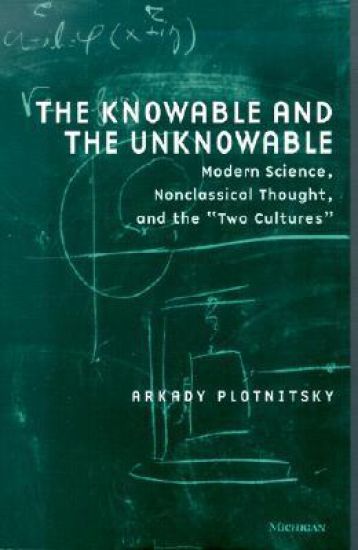
This book investigates the relationships between modern mathematics and science (in particular, quantum mechanics) and the mode of theorizing that Arkady Plotnitsky defines as "nonclassical" and identifies in the work of Bohr, Heisenberg, Lacan, and Derrida. Plotinsky argues that their scientific and philosophical works radically redefined the nature and scope of our knowledge. Building upon their ideas, the book finds a new, nonclassical character in the "dream of great interconnections" Bohr described, thereby engaging with recent debates about the "two cultures" (the humanities and the sciences).Plotnitsky highlights those points at which the known gives way to the unknown (and unknowable). These points are significant, he argues, because they push the boundaries of thought and challenge the boundaries of disciplinarity. One of the book's most interesting observations is that key figures in science, in order to push toward a framing of the unknown, actually retreated into a conservative disciplinarity. Plotnitsky's informed, interdisciplinary approach is more productive than the disparaging attacks on postmodernism or scientism that have hitherto characterized this discourse.Arkady Plotnitsky is Professor of English and Director, Theory and Cultural Studies Program, Purdue University. Trained in both mathematics and literary theory, he is author of several books, including In the Shadow of Hegel: Complementarity, History and the Unconscious and Reconfigurations: Critical Theory and General Economy.
The Knowable and the Unknowable

The Knowable and the Unknowable

Arkady Plotnitsky

The University of Michigan Press
2002
sidottu
This book investigates the relationships between modern mathematics and science (in particular, quantum mechanics) and the mode of theorizing that Arkady Plotnitsky defines as "nonclassical" and identifies in the work of Bohr, Heisenberg, Lacan, and Derrida. Plotinsky argues that their scientific and philosophical works radically redefined the nature and scope of our knowledge. Building upon their ideas, the book finds a new, nonclassical character in the "dream of great interconnections" Bohr described, thereby engaging with recent debates about the "two cultures" (the humanities and the sciences).Plotnitsky highlights those points at which the known gives way to the unknown (and unknowable). These points are significant, he argues, because they push the boundaries of thought and challenge the boundaries of disciplinarity. One of the book's most interesting observations is that key figures in science, in order to push toward a framing of the unknown, actually retreated into a conservative disciplinarity. Plotnitsky's informed, interdisciplinary approach is more productive than the disparaging attacks on postmodernism or scientism that have hitherto characterized this discourse.Arkady Plotnitsky is Professor of English and Director, Theory and Cultural Studies Program, Purdue University. Trained in both mathematics and literary theory, he is author of several books, including In the Shadow of Hegel: Complementarity, History and the Unconscious and Reconfigurations: Critical Theory and General Economy.
Complementarity

Complementarity

Arkady Plotnitsky

Duke University Press
1994
sidottu
Many commentators have remarked in passing on the resonance between deconstructionist theory and certain ideas of quantum physics. In this book, Arkady Plotnitsky rigorously elaborates the similarities and differences between the two by focusing on the work of Niels Bohr and Jacques Derrida. In detailed considerations of Bohr’s notion of complementarity and his debates with Einstein, and in analysis of Derrida’s work via Georges Bataille’s concept of general economy, Plotnitsky demonstrates the value of exploring these theories in relation to each other. Bohr’s term complementarity describes a situation, unavoidable in quantum physics, in which two theories thought to be mutually exclusive are required to explain a single phenomenon. Light, for example, can only be explained as both wave and particle, but no synthesis of the two is possible. This theoretical transformation is then examined in relation to the ways that Derrida sets his work against or outside of Hegel, also resisting a similar kind of synthesis and enacting a transformation of its own. Though concerned primarily with Bohr and Derrida, Plotnitsky also considers a wide range of anti-epistemological endeavors including the work of Nietzsche, Bataille, and the mathematician Kurt Gödel. Under the rubric of complementarity he develops a theoretical framework that raises new possiblilities for students and scholars of literary theory, philosophy, and philosophy of science.
Complementarity

Complementarity

Arkady Plotnitsky

Duke University Press
1994
pokkari
Many commentators have remarked in passing on the resonance between deconstructionist theory and certain ideas of quantum physics. In this book, Arkady Plotnitsky rigorously elaborates the similarities and differences between the two by focusing on the work of Niels Bohr and Jacques Derrida. In detailed considerations of Bohr’s notion of complementarity and his debates with Einstein, and in analysis of Derrida’s work via Georges Bataille’s concept of general economy, Plotnitsky demonstrates the value of exploring these theories in relation to each other. Bohr’s term complementarity describes a situation, unavoidable in quantum physics, in which two theories thought to be mutually exclusive are required to explain a single phenomenon. Light, for example, can only be explained as both wave and particle, but no synthesis of the two is possible. This theoretical transformation is then examined in relation to the ways that Derrida sets his work against or outside of Hegel, also resisting a similar kind of synthesis and enacting a transformation of its own. Though concerned primarily with Bohr and Derrida, Plotnitsky also considers a wide range of anti-epistemological endeavors including the work of Nietzsche, Bataille, and the mathematician Kurt Gödel. Under the rubric of complementarity he develops a theoretical framework that raises new possiblilities for students and scholars of literary theory, philosophy, and philosophy of science.
Reading Bohr: Physics and Philosophy

Reading Bohr: Physics and Philosophy

Arkady Plotnitsky

Springer-Verlag New York Inc.
2006
sidottu
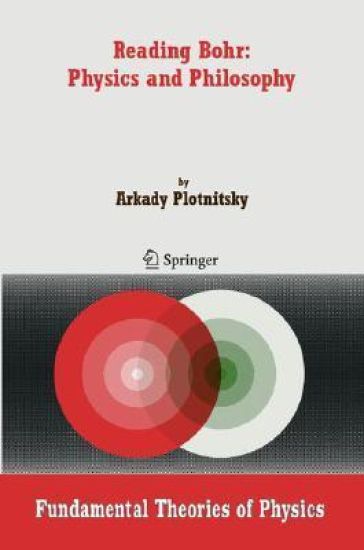
Reading Bohr: Physics and Philosophy offers a new perspective on Niels Bohr's interpretation of quantum mechanics as complementarity, and on the relationships between physics and philosophy in Bohr's work, which has had momentous significance for our understanding of quantum theory and of the nature of knowledge in general. Philosophically, the book reassesses Bohr's place in the Western philosophical tradition, from Kant and Hegel on. Physically, it reconsiders the main issues at stake in the Bohr-Einstein confrontation and in the ongoing debates concerning quantum physics. It also devotes greater attention than in most commentaries on Bohr to the key developments and transformations of his thinking concerning complementarity. Most significant among them were those that occurred, first, under the impact of Bohr's exchanges with Einstein and, second, under the impact of developments in quantum theory itself, both quantum mechanics and quantum field theory. The importance of quantum field theory for Bohr's thinking has not been adequately addressed in the literature on Bohr, to the considerable detriment to our understanding of the history of quantum physics. Filling this lacuna is one of the main contributions of the book, which also enables us to show why quantum field theory compels us to move beyond Bohr without, however, simply leaving him behind.
Epistemology and Probability

Epistemology and Probability

Arkady Plotnitsky

Springer-Verlag New York Inc.
2012
nidottu
This book offers an exploration of the relationships between epistemology and probability in the work of Niels Bohr, Werner Heisenberg, and Erwin Schro- ¨ dinger, and in quantum mechanics and in modern physics as a whole. It also considers the implications of these relationships and of quantum theory itself for our understanding of the nature of human thinking and knowledge in general, or the ‘‘epistemological lesson of quantum mechanics,’’ as Bohr liked 1 to say. These implications are radical and controversial. While they have been seen as scientifically productive and intellectually liberating to some, Bohr and Heisenberg among them, they have been troublesome to many others, such as Schro¨ dinger and, most prominently, Albert Einstein. Einstein famously refused to believe that God would resort to playing dice or rather to playing with nature in the way quantum mechanics appeared to suggest, which is indeed quite different from playing dice. According to his later (sometime around 1953) remark, a lesser known or commented upon but arguably more important one: ‘‘That the Lord should play [dice], all right; but that He should gamble according to definite rules [i. e. , according to the rules of quantum mechanics, rather than 2 by merely throwing dice], that is beyond me. ’’ Although Einstein’s invocation of God is taken literally sometimes, he was not talking about God but about the way nature works. Bohr’s reply on an earlier occasion to Einstein’s question 1 Cf.

Niels Bohr and Complementarity

Niels Bohr and Complementarity

Arkady Plotnitsky

Springer-Verlag New York Inc.
2012
nidottu
This book offers a discussion of Niels Bohr’s conception of “complementarity,” arguably his greatest contribution to physics and philosophy. By tracing Bohr’s work from his 1913 atomic theory to the introduction and then refinement of the idea of complementarity, and by explicating different meanings of “complementarity” in Bohr and the relationships between it and Bohr’s other concepts, the book aims to offer a contained and accessible, and yet sufficiently comprehensive account of Bohr’s work on complementarity and its significance.
Reality Without Realism

Reality Without Realism

Arkady Plotnitsky

Springer Nature Switzerland AG
2021
sidottu
This book presents quantum theory as a theory based on new relationships among matter, thought, and experimental technology, as against those previously found in physics, relationships that also redefine those between mathematics and physics in quantum theory. The argument of the book is based on its title concept, reality without realism (RWR), and in the corresponding view, the RWR view, of quantum theory. The book considers, from this perspective, the thinking of Bohr, Heisenberg, Schrödinger, and Dirac, with the aim of bringing together the philosophy and history of quantum theory. With quantum theory, the book argues, the architecture of thought in theoretical physics was radically changed by the irreducible role of experimental technology in the constitution of physical phenomena, accordingly, no longer defined independently by matter alone, as they were in classical physics or relativity. Or so it appeared. For, quantum theory, the book further argues, made us realize that experimental technology, beginning with that of our bodies, irreducibly shapes all physical phenomena, and thus makes us rethink the relationships among matter, thought, and technology in all of physics.
Reality Without Realism

Reality Without Realism

Arkady Plotnitsky

Springer Nature Switzerland AG
2022
nidottu
This book presents quantum theory as a theory based on new relationships among matter, thought, and experimental technology, as against those previously found in physics, relationships that also redefine those between mathematics and physics in quantum theory. The argument of the book is based on its title concept, reality without realism (RWR), and in the corresponding view, the RWR view, of quantum theory. The book considers, from this perspective, the thinking of Bohr, Heisenberg, Schrödinger, and Dirac, with the aim of bringing together the philosophy and history of quantum theory. With quantum theory, the book argues, the architecture of thought in theoretical physics was radically changed by the irreducible role of experimental technology in the constitution of physical phenomena, accordingly, no longer defined independently by matter alone, as they were in classical physics or relativity. Or so it appeared. For, quantum theory, the book further argues, made us realize that experimental technology, beginning with that of our bodies, irreducibly shapes all physical phenomena, and thus makes us rethink the relationships among matter, thought, and technology in all of physics.
Logos and Alogon

Logos and Alogon

Arkady Plotnitsky

Springer International Publishing AG
2023
sidottu
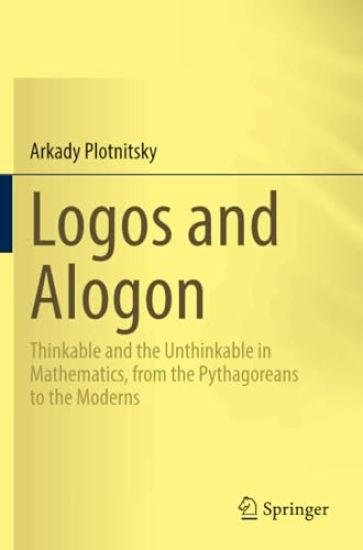
This book is a philosophical study of mathematics, pursued by considering and relating two aspects of mathematical thinking and practice, especially in modern mathematics, which, having emerged around 1800, consolidated around 1900 and extends to our own time, while also tracing both aspects to earlier periods, beginning with the ancient Greek mathematics. The first aspect is conceptual, which characterizes mathematics as the invention of and working with concepts, rather than only by its logical nature. The second, Pythagorean, aspect is grounded, first, in the interplay of geometry and algebra in modern mathematics, and secondly, in the epistemologically most radical form of modern mathematics, designated in this study as radical Pythagorean mathematics. This form of mathematics is defined by the role of that which beyond the limits of thought in mathematical thinking, or in ancient Greek terms, used in the book’s title, an alogon in the logos of mathematics. The outcomeof this investigation is a new philosophical and historical understanding of the nature of modern mathematics and mathematics in general. The book is addressed to mathematicians, mathematical physicists, and philosophers and historians of mathematics, and graduate students in these fields.
Logos and Alogon

Logos and Alogon

Arkady Plotnitsky

Springer International Publishing AG
2024
nidottu
This book is a philosophical study of mathematics, pursued by considering and relating two aspects of mathematical thinking and practice, especially in modern mathematics, which, having emerged around 1800, consolidated around 1900 and extends to our own time, while also tracing both aspects to earlier periods, beginning with the ancient Greek mathematics. The first aspect is conceptual, which characterizes mathematics as the invention of and working with concepts, rather than only by its logical nature. The second, Pythagorean, aspect is grounded, first, in the interplay of geometry and algebra in modern mathematics, and secondly, in the epistemologically most radical form of modern mathematics, designated in this study as radical Pythagorean mathematics. This form of mathematics is defined by the role of that which beyond the limits of thought in mathematical thinking, or in ancient Greek terms, used in the book’s title, an alogon in the logos of mathematics. The outcomeof this investigation is a new philosophical and historical understanding of the nature of modern mathematics and mathematics in general. The book is addressed to mathematicians, mathematical physicists, and philosophers and historians of mathematics, and graduate students in these fields.
The Principles of Quantum Theory, From Planck's Quanta to the Higgs Boson

The Principles of Quantum Theory, From Planck's Quanta to the Higgs Boson

Arkady Plotnitsky

Springer International Publishing AG
2016
sidottu
The book considers foundational thinking in quantum theory, focusing on the role the fundamental principles and principle thinking there, including thinking that leads to the invention of new principles, which is, the book contends, one of the ultimate achievements of theoretical thinking in physics and beyond. The focus on principles, prominent during the rise and in the immediate aftermath of quantum theory, has been uncommon in more recent discussions and debates concerning it. The book argues, however, that exploring the fundamental principles and principle thinking is exceptionally helpful in addressing the key issues at stake in quantum foundations and the seemingly interminable debates concerning them. Principle thinking led to major breakthroughs throughout the history of quantum theory, beginning with the old quantum theory and quantum mechanics, the first definitive quantum theory, which it remains within its proper (nonrelativistic) scope. It has, the book also argues, beenequally important in quantum field theory, which has been the frontier of quantum theory for quite a while now, and more recently, in quantum information theory, where principle thinking was given new prominence. The approach allows the book to develop a new understanding of both the history and philosophy of quantum theory, from Planck’s quantum to the Higgs boson, and beyond, and of the thinking the key founding figures, such as Einstein, Bohr, Heisenberg, Schrödinger, and Dirac, as well as some among more recent theorists. The book also extensively considers the nature of quantum probability, and contains a new interpretation of quantum mechanics, “the statistical Copenhagen interpretation.” Overall, the book’s argument is guided by what Heisenberg called “the spirit of Copenhagen,” which is defined by three great divorces from the preceding foundational thinking in physics—reality from realism, probability from causality, and locality from relativity—and defined the fundamental principles of quantum theory accordingly.
The Principles of Quantum Theory, From Planck's Quanta to the Higgs Boson

The Principles of Quantum Theory, From Planck's Quanta to the Higgs Boson

Arkady Plotnitsky

Springer International Publishing AG
2018
nidottu
The book considers foundational thinking in quantum theory, focusing on the role the fundamental principles and principle thinking there, including thinking that leads to the invention of new principles, which is, the book contends, one of the ultimate achievements of theoretical thinking in physics and beyond. The focus on principles, prominent during the rise and in the immediate aftermath of quantum theory, has been uncommon in more recent discussions and debates concerning it. The book argues, however, that exploring the fundamental principles and principle thinking is exceptionally helpful in addressing the key issues at stake in quantum foundations and the seemingly interminable debates concerning them. Principle thinking led to major breakthroughs throughout the history of quantum theory, beginning with the old quantum theory and quantum mechanics, the first definitive quantum theory, which it remains within its proper (nonrelativistic) scope. It has, the book also argues, beenequally important in quantum field theory, which has been the frontier of quantum theory for quite a while now, and more recently, in quantum information theory, where principle thinking was given new prominence. The approach allows the book to develop a new understanding of both the history and philosophy of quantum theory, from Planck’s quantum to the Higgs boson, and beyond, and of the thinking the key founding figures, such as Einstein, Bohr, Heisenberg, Schrödinger, and Dirac, as well as some among more recent theorists. The book also extensively considers the nature of quantum probability, and contains a new interpretation of quantum mechanics, “the statistical Copenhagen interpretation.” Overall, the book’s argument is guided by what Heisenberg called “the spirit of Copenhagen,” which is defined by three great divorces from the preceding foundational thinking in physics—reality from realism, probability from causality, and locality from relativity—and defined the fundamental principles of quantum theory accordingly.
Reading Bohr: Physics and Philosophy

Reading Bohr: Physics and Philosophy

Arkady Plotnitsky

Springer
2010
nidottu
Reading Bohr: Physics and Philosophy offers a new perspective on Niels Bohr's interpretation of quantum mechanics as complementarity, and on the relationships between physics and philosophy in Bohr's work, which has had momentous significance for our understanding of quantum theory and of the nature of knowledge in general. Philosophically, the book reassesses Bohr's place in the Western philosophical tradition, from Kant and Hegel on. Physically, it reconsiders the main issues at stake in the Bohr-Einstein confrontation and in the ongoing debates concerning quantum physics. It also devotes greater attention than in most commentaries on Bohr to the key developments and transformations of his thinking concerning complementarity. Most significant among them were those that occurred, first, under the impact of Bohr's exchanges with Einstein and, second, under the impact of developments in quantum theory itself, both quantum mechanics and quantum field theory. The importance of quantum field theory for Bohr's thinking has not been adequately addressed in the literature on Bohr, to the considerable detriment to our understanding of the history of quantum physics. Filling this lacuna is one of the main contributions of the book, which also enables us to show why quantum field theory compels us to move beyond Bohr without, however, simply leaving him behind.