
Kirjahaku
Etsi kirjoja tekijän nimen, kirjan nimen tai ISBN:n perusteella.
350 kirjaa tekijältä Arthur Machen
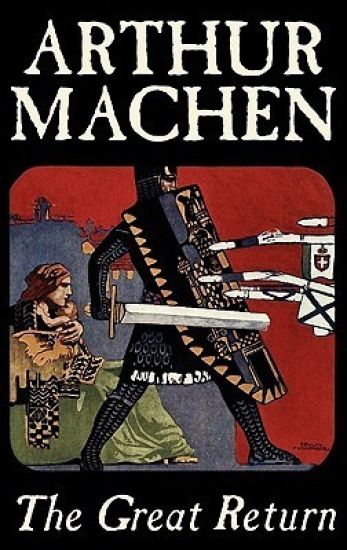
THEY FOUND THE HOLY GRAIL IN WALES DURING WORLD WAR I"And then, from what they do tell me, all the people did go mad, crying and weeping and calling out all manner of things at the top of their voices. And at last nothing would do but they must all go up to the churchyard, and there Philip James and Lewis Prothero they swear friendship to one another for a long age before the old cross, and everyone sings praises. And my cousin he do declare to me that there were men standing in that crowd that he did never see before in Llantrisant in all his life, and his heart was shaken within him as if it had been in a whirl-wind."I had listened to all this in silence. I said then: "What does your cousin mean by that? Men that he had never seen in Llantrisant? What men?""The people," he said very slowly, "call them the Fishermen."And suddenly there came into my mind the "Rich Fisherman" who in the old legend guards the holy mystery of the Graal.
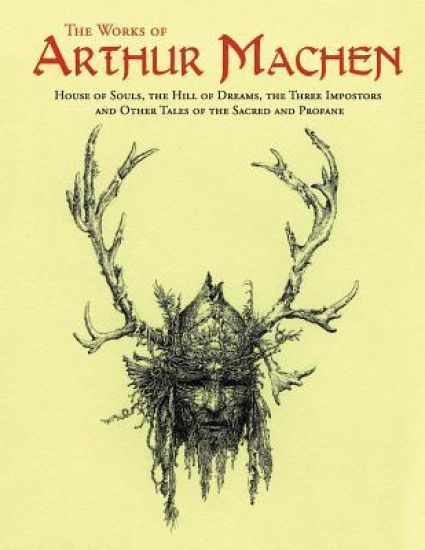
The Works of Arthur Machen: House of Souls, The Hill of Dreams, The Three Impostors and Other Tales of the Sacred and Profane
Arthur Machen
Createspace Independent Publishing Platform
2012
nidottu
Decadent, perverse and unreal, the strange stories of Arthur Machen uncover a lingering, ancestral horror, distantly remembered in the language of fairy tales, pagan lore, and in the secret old games that nurses teach to children. Deeply controversial in their own time, some of Machen's stories had to wait decades to for changing social mores to permit their publication.This new collection by Lowood Press combines all of Machen's most celebrated works in one volume. Herein are his greatest short stories, including The White People, The Great God Pan, The Bowmen and The Shining Pyramid; his semi-autobiographical novel, Hill of Dreams; and the original, complete version of The Three Impostors, with its interconnecting tales of occult intrigue.An unrivaled master of sacred terror and pioneer of the weird fiction genre, Machen's work has directly influenced such notable horror writers as H. P. Lovecraft, Peter Straub, and Stephen King-but it has yet to be surpassed.
Far Off Things by Arthur Machen, History, Biography & Autobiography, Literary
Arthur Machen
Aegypan
2011
pokkari
Well, as I say, I found myself on a certain night a partaker of all this cheerfulness. I was one guest among many; there were explorers and ambassadors and great scientific personages and judges, and the author who has given the world the best laughter that it has enjoyed since Dickens died: in a word, I was in much more distinguished company than that to which I am accustomed. And after dinner the Persians (as I will call them) have a kindly and courteous custom of praising their guests; and to my astonishment and delight the speaker brought me into his oration and said the kindest and most glowing things imaginable about a translation I once made of the "Heptameron" of Margaret of Navarre. I was heartily pleased; I hold with Foker in "Pendennis" that every fellow likes a hand. Praise is grateful, especially when there has not been too much of it.
They were purged as if they had passed through the Furnace of the Sages governed with Wisdom that the alchemists know. They spoke without much difficulty of what they had seen, or had seemed to see, with their eyes, but hardly at all of what their hearts had known when for a moment the glory of the fiery rose had been about them.
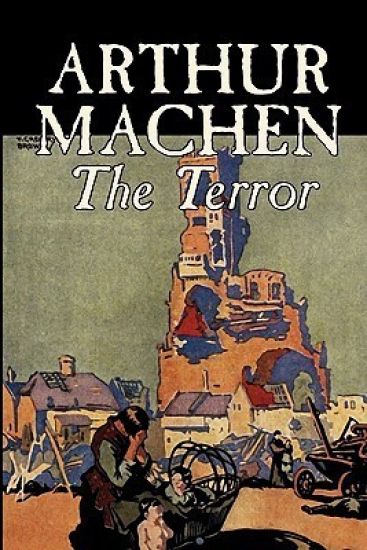
The Terror by Arthur Machen, Fiction, Fantasy, Classics, Mystery & Detective
Arthur Machen
Aegypan
2011
pokkari
"Explosion at Munition Works in the Northern District: Many Fatalities."The working man told about it, and added some dreadful details. Corpses so terribly maimed that coffins had been kept covered; faces mutilated as if by some gnawing animal. . . . we took a tram to the location of the disaster; a raw and hideous shed with a walled yard about it, and a shut gate. The roof was quite undamaged -- this had had been a strange accident. There had been an explosion of sufficient violence to kill work-people in the building, but the building itself showed no wounds or scars.
The three impostors or The transmutations (1895). By: Arthur Machen: A novel incorporating several short stories.
Arthur Machen
Createspace Independent Publishing Platform
2018
nidottu
The Three Impostors; or, The Transmutations is an episodic horror novel by British writer Arthur Machen, first published in 1895 in The Bodley Head's Keynote Series. It was revived in paperback by Ballantine Books as the forty-eighth volume of the Ballantine Adult Fantasy series in June 1972........... Arthur Machen (3 March 1863 - 15 December 1947) was a Welsh author and mystic of the 1890s and early 20th century. He is best known for his influential supernatural, fantasy, and horror fiction. His novella The Great God Pan (1890; 1894) has garnered a reputation as a classic of horror, with Stephen King describing it as "Maybe the best horror story] in the English language." He is also well known for his leading role in creating the legend of the Angels of Mons. Early years: Machen was born Arthur Llewelyn Jones in Caerleon, Monmouthshire, though he usually referred to the area by the name of the medieval Welsh kingdom, Gwent. The house of his birth, opposite the Olde Bull Inn in The Square at Caerleon, is adjacent to the Priory Hotel and is today marked with a commemorative blue plaque. The beautiful landscape of Monmouthshire, with its associations of Celtic, Roman, and medieval history, made a powerful impression on him, and his love of it is at the heart of many of his works. Machen was descended from a long line of clergymen, the family having originated in Carmarthenshire. In 1864, when Machen was two, his father John Edward Jones, became vicar of the parish of Llanddewi Fach with Llandegveth, about five miles north of Caerleon, and Machen was brought up at the rectory there. Jones had adopted his wife's maiden name, Machen, to inherit a legacy, legally becoming "Jones-Machen"; his son was baptised under that name and later used a shortened version of his full name, Arthur Machen, as a pen name. Local historian and folklorist Fred Hando traces Machen's interest in the occult to a volume of Household Words in his father's Rectory library, in which he read, at the age of eight, an entrancing article on alchemy. Hando recounts Machen's other early reading: He bought De Quincey's Confessions of an English Opium Eater at Pontypool Road Railway Station, The Arabian Nights at Hereford Railway Station, and borrowed Don Quixote from Mrs. Gwyn, of Llanfrechfa Rectory. In his father's library he found also the Waverley Novels, a three-volume edition of the Glossary of Gothic Architecture, and an early volume of Tennyson At the age of eleven, Machen boarded at Hereford Cathedral School, where he received an excellent classical education. Family poverty ruled out attendance at university, and Machen was sent to London, where he sat exams to attend medical school but failed to get in. Machen, however, showed literary promise, publishing in 1881 a long poem "Eleusinia" on the subject of the Eleusinian Mysteries. Returning to London, he lived in relative poverty, attempting to work as a journalist, as a publisher's clerk, and as a children's tutor while writing in the evening and going on long rambling walks across London..................
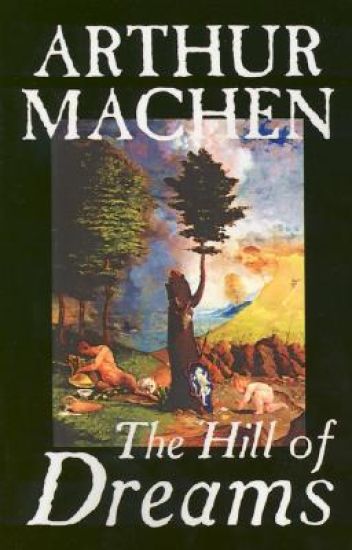
The hill of dreams. By: Arthur Machen: The Hill of Dreams is a semi-autobiographical novel written by Arthur Machen.
Arthur Machen
Createspace Independent Publishing Platform
2018
nidottu
The Hill of Dreams is a semi-autobiographical novel written by Arthur Machen. Plot summary: The novel recounts the life of a young man, Lucian Taylor, focusing on his dreamy childhood in rural Wales, in a town based on Caerleon. The Hill of Dreams of the title is an old Roman fort where Lucian has strange sensual visions, including ones of the town in the time of Roman Britain. Later, the novel describes Lucian's attempts to make a living as an author in London, enduring poverty and suffering in the pursuit of art and history............. Arthur Machen (3 March 1863 - 15 December 1947) was a Welsh author and mystic of the 1890s and early 20th century. He is best known for his influential supernatural, fantasy, and horror fiction. His novella The Great God Pan (1890; 1894) has garnered a reputation as a classic of horror, with Stephen King describing it as "Maybe the best horror story] in the English language." He is also well known for his leading role in creating the legend of the Angels of Mons. Early years: Machen was born Arthur Llewelyn Jones in Caerleon, Monmouthshire, though he usually referred to the area by the name of the medieval Welsh kingdom, Gwent. The house of his birth, opposite the Olde Bull Inn in The Square at Caerleon, is adjacent to the Priory Hotel and is today marked with a commemorative blue plaque. The beautiful landscape of Monmouthshire, with its associations of Celtic, Roman, and medieval history, made a powerful impression on him, and his love of it is at the heart of many of his works. Machen was descended from a long line of clergymen, the family having originated in Carmarthenshire. In 1864, when Machen was two, his father John Edward Jones, became vicar of the parish of Llanddewi Fach with Llandegveth, about five miles north of Caerleon, and Machen was brought up at the rectory there. Jones had adopted his wife's maiden name, Machen, to inherit a legacy, legally becoming "Jones-Machen"; his son was baptised under that name and later used a shortened version of his full name, Arthur Machen, as a pen name. Local historian and folklorist Fred Hando traces Machen's interest in the occult to a volume of Household Words in his father's Rectory library, in which he read, at the age of eight, an entrancing article on alchemy. Hando recounts Machen's other early reading: He bought De Quincey's Confessions of an English Opium Eater at Pontypool Road Railway Station, The Arabian Nights at Hereford Railway Station, and borrowed Don Quixote from Mrs. Gwyn, of Llanfrechfa Rectory. In his father's library he found also the Waverley Novels, a three-volume edition of the Glossary of Gothic Architecture, and an early volume of Tennyson At the age of eleven, Machen boarded at Hereford Cathedral School, where he received an excellent classical education. Family poverty ruled out attendance at university, and Machen was sent to London, where he sat exams to attend medical school but failed to get in. Machen, however, showed literary promise, publishing in 1881 a long poem "Eleusinia" on the subject of the Eleusinian Mysteries. Returning to London, he lived in relative poverty, attempting to work as a journalist, as a publisher's clerk, and as a children's tutor while writing in the evening and going on long rambling walks across London........................
The terror: a mystery. By: Arthur Machen: Arthur Machen (3 March 1863 - 15 December 1947) was a Welsh author and mystic of the 1890s and early 20th ce
Arthur Machen
Createspace Independent Publishing Platform
2018
nidottu
Arthur Machen (3 March 1863 - 15 December 1947) was a Welsh author and mystic of the 1890s and early 20th century. He is best known for his influential supernatural, fantasy, and horror fiction. His novella The Great God Pan (1890; 1894) has garnered a reputation as a classic of horror, with Stephen King describing it as "Maybe the best horror story] in the English language." He is also well known for his leading role in creating the legend of the Angels of Mons. Early years: Machen was born Arthur Llewelyn Jones in Caerleon, Monmouthshire, though he usually referred to the area by the name of the medieval Welsh kingdom, Gwent. The house of his birth, opposite the Olde Bull Inn in The Square at Caerleon, is adjacent to the Priory Hotel and is today marked with a commemorative blue plaque. The beautiful landscape of Monmouthshire, with its associations of Celtic, Roman, and medieval history, made a powerful impression on him, and his love of it is at the heart of many of his works. Machen was descended from a long line of clergymen, the family having originated in Carmarthenshire. In 1864, when Machen was two, his father John Edward Jones, became vicar of the parish of Llanddewi Fach with Llandegveth, about five miles north of Caerleon, and Machen was brought up at the rectory there. Jones had adopted his wife's maiden name, Machen, to inherit a legacy, legally becoming "Jones-Machen"; his son was baptised under that name and later used a shortened version of his full name, Arthur Machen, as a pen name. Local historian and folklorist Fred Hando traces Machen's interest in the occult to a volume of Household Words in his father's Rectory library, in which he read, at the age of eight, an entrancing article on alchemy. Hando recounts Machen's other early reading: He bought De Quincey's Confessions of an English Opium Eater at Pontypool Road Railway Station, The Arabian Nights at Hereford Railway Station, and borrowed Don Quixote from Mrs. Gwyn, of Llanfrechfa Rectory. In his father's library he found also the Waverley Novels, a three-volume edition of the Glossary of Gothic Architecture, and an early volume of Tennyson At the age of eleven, Machen boarded at Hereford Cathedral School, where he received an excellent classical education. Family poverty ruled out attendance at university, and Machen was sent to London, where he sat exams to attend medical school but failed to get in. Machen, however, showed literary promise, publishing in 1881 a long poem "Eleusinia" on the subject of the Eleusinian Mysteries. Returning to London, he lived in relative poverty, attempting to work as a journalist, as a publisher's clerk, and as a children's tutor while writing in the evening and going on long rambling walks across London........................
The secret glory (1922). By: Arthur Machen: (Original Classics)
Arthur Machen
Createspace Independent Publishing Platform
2018
nidottu
It is probable that all through those early years Ambrose's father had been charming his son's heart, drawing him forth from the gehenna-valley of this life into which he had fallen, as one draws forth a beast that has fallen into some deep and dreadful place. Various are the methods recommended. There is the way of what is called moral teaching, the way of physiology and the way of a masterly silence; but Mr. Meyrick's was the strange way of incantation. He had, in a certain manner, drawn the boy aside from that evil traffic of the valley, from the stench of the turmoil, from the blows and the black lechery, from the ugly fight in the poisonous smoke, from all the amazing and hideous folly that practical men call life, and had set him in that endless procession that forever and forever sings its litanies in the mountains, going from height to height on its great quest. Ambrose's soul had been caught in the sweet thickets of the woods; it had been bathed in the pure water of blessed fountains; it had knelt before the altars of the old saints, till all the earth was become a sanctuary, all life was a rite and ceremony, the end of which was the attainment of the mystic sanctity -- the achieving of the Graal. For this -- for what else? -- were all things made. It was this that the little bird sang of in the bush, piping a few feeble, plaintive notes of dusky evenings, as if his tiny heart were sad that it could utter nothing better than such sorry praises. This also celebrated the awe of the white morning on the hills, the breath of the woods at dawn. This was figured in the red ceremony of sunset, when flames shone over the dome of the great mountain, and roses blossomed in the far plains of the sky. This was the secret of the dark places in the heart of the woods. This the mystery of the sunlight on the height; and every little flower, every delicate fern, and every reed and rush was entrusted with the hidden declaration of this sacrament. For this end, final and perfect rites had been given to men to execute; and these were all the arts, all the far-lifted splendor of the great cathedral; all rich carven work and all glowing colors; all magical utterance of word and tones: all these things were the witnesses that consented in the One Offering, in the high service of the Graal.............. Arthur Machen (3 March 1863 - 15 December 1947) was a Welsh author and mystic of the 1890s and early 20th century. He is best known for his influential supernatural, fantasy, and horror fiction. His novella The Great God Pan (1890; 1894) has garnered a reputation as a classic of horror, with Stephen King describing it as "Maybe the best horror story] in the English language." He is also well known for his leading role in creating the legend of the Angels of Mons. Early years: Machen was born Arthur Llewelyn Jones in Caerleon, Monmouthshire, though he usually referred to the area by the name of the medieval Welsh kingdom, Gwent. The house of his birth, opposite the Olde Bull Inn in The Square at Caerleon, is adjacent to the Priory Hotel and is today marked with a commemorative blue plaque. The beautiful landscape of Monmouthshire, with its associations of Celtic, Roman, and medieval history, made a powerful impression on him, and his love of it is at the heart of many of his works. Machen was descended from a long line of clergymen, the family having originated in Carmarthenshire. In 1864, when Machen was two, his father John Edward Jones, became vicar of the parish of Llanddewi Fach with Llandegveth, about five miles north of Caerleon, and Machen was brought up at the rectory there. Jones had adopted his wife's maiden name, Machen, to inherit a legacy, legally becoming "Jones-Machen"; his son was baptised under that name and later used a shortened version of his full name, Arthur Machen, as a pen name.....................
Far off things (1922). By: Arthur Machen, dedication By: Alfred Turner: Major-General Sir Alfred Edward Turner, KCB (3 March 1842 - 20 November 1
Arthur Machen
Createspace Independent Publishing Platform
2018
nidottu
"Well, as I say, I found myself on a certain night a partaker of all this cheerfulness. I was one guest among many; there were explorers and ambassadors and great scientific personages and judges, and the author who has given the world the best laughter that it has enjoyed since Dickens died: in a word, I was in much more distinguished company than that to which I am accustomed. And after dinner the Persians (as I will call them) have a kindly and courteous custom of praising their guests; and to my astonishment and delight the speaker brought me into his oration and said the kindest and most glowing things imaginable about a translation I once made of the "Heptameron" of Margaret of Navarre. I was heartily pleased; I hold with Foker in "Pendennis" that every fellow likes a hand. Praise is grateful, especially when there has not been too much of it." "Far Off Things" is a series of autobiographical sketches by the great Arthur Machen; notice how even in fairly mundane prose from nearly the beginning, there's a haunting quality to the words themselves............. Arthur Machen (3 March 1863 - 15 December 1947) was a Welsh author and mystic of the 1890s and early 20th century. He is best known for his influential supernatural, fantasy, and horror fiction. His novella The Great God Pan (1890; 1894) has garnered a reputation as a classic of horror, with Stephen King describing it as "Maybe the best horror story] in the English language." He is also well known for his leading role in creating the legend of the Angels of Mons. Early years: Machen was born Arthur Llewelyn Jones in Caerleon, Monmouthshire, though he usually referred to the area by the name of the medieval Welsh kingdom, Gwent. The house of his birth, opposite the Olde Bull Inn in The Square at Caerleon, is adjacent to the Priory Hotel and is today marked with a commemorative blue plaque. The beautiful landscape of Monmouthshire, with its associations of Celtic, Roman, and medieval history, made a powerful impression on him, and his love of it is at the heart of many of his works. Machen was descended from a long line of clergymen, the family having originated in Carmarthenshire. In 1864, when Machen was two, his father John Edward Jones, became vicar of the parish of Llanddewi Fach with Llandegveth, about five miles north of Caerleon, and Machen was brought up at the rectory there. Jones had adopted his wife's maiden name, Machen, to inherit a legacy, legally becoming "Jones-Machen"; his son was baptised under that name and later used a shortened version of his full name, Arthur Machen, as a pen name. Local historian and folklorist Fred Hando traces Machen's interest in the occult to a volume of Household Words in his father's Rectory library, in which he read, at the age of eight, an entrancing article on alchemy. Hando recounts Machen's other early reading: He bought De Quincey's Confessions of an English Opium Eater at Pontypool Road Railway Station, The Arabian Nights at Hereford Railway Station, and borrowed Don Quixote from Mrs. Gwyn, of Llanfrechfa Rectory. In his father's library he found also the Waverley Novels, a three-volume edition of the Glossary of Gothic Architecture, and an early volume of Tennyson At the age of eleven, Machen boarded at Hereford Cathedral School, where he received an excellent classical education. Family poverty ruled out attendance at university, and Machen was sent to London, where he sat exams to attend medical school but failed to get in. Machen, however, showed literary promise, publishing in 1881 a long poem "Eleusinia" on the subject of the Eleusinian Mysteries. Returning to London, he lived in relative poverty, attempting to work as a journalist, as a publisher's clerk, and as a children's tutor while writing in the evening and going on long rambling walks across London.................

Dr. Stiggins; his views and principles, a series of interviews (1906). By: Arthur Machen: Arthur Machen (3 March 1863 - 15 December 1947) was a Welsh
Arthur Machen
Createspace Independent Publishing Platform
2018
nidottu
Arthur Machen (3 March 1863 - 15 December 1947) was a Welsh author and mystic of the 1890s and early 20th century. He is best known for his influential supernatural, fantasy, and horror fiction. His novella The Great God Pan (1890; 1894) has garnered a reputation as a classic of horror, with Stephen King describing it as "Maybe the best horror story] in the English language." He is also well known for his leading role in creating the legend of the Angels of Mons. Early years: Machen was born Arthur Llewelyn Jones in Caerleon, Monmouthshire, though he usually referred to the area by the name of the medieval Welsh kingdom, Gwent. The house of his birth, opposite the Olde Bull Inn in The Square at Caerleon, is adjacent to the Priory Hotel and is today marked with a commemorative blue plaque. The beautiful landscape of Monmouthshire, with its associations of Celtic, Roman, and medieval history, made a powerful impression on him, and his love of it is at the heart of many of his works. Machen was descended from a long line of clergymen, the family having originated in Carmarthenshire. In 1864, when Machen was two, his father John Edward Jones, became vicar of the parish of Llanddewi Fach with Llandegveth, about five miles north of Caerleon, and Machen was brought up at the rectory there. Jones had adopted his wife's maiden name, Machen, to inherit a legacy, legally becoming "Jones-Machen"; his son was baptised under that name and later used a shortened version of his full name, Arthur Machen, as a pen name. Local historian and folklorist Fred Hando traces Machen's interest in the occult to a volume of Household Words in his father's Rectory library, in which he read, at the age of eight, an entrancing article on alchemy. Hando recounts Machen's other early reading: He bought De Quincey's Confessions of an English Opium Eater at Pontypool Road Railway Station, The Arabian Nights at Hereford Railway Station, and borrowed Don Quixote from Mrs. Gwyn, of Llanfrechfa Rectory. In his father's library he found also the Waverley Novels, a three-volume edition of the Glossary of Gothic Architecture, and an early volume of Tennyson At the age of eleven, Machen boarded at Hereford Cathedral School, where he received an excellent classical education. Family poverty ruled out attendance at university, and Machen was sent to London, where he sat exams to attend medical school but failed to get in. Machen, however, showed literary promise, publishing in 1881 a long poem "Eleusinia" on the subject of the Eleusinian Mysteries. Returning to London, he lived in relative poverty, attempting to work as a journalist, as a publisher's clerk, and as a children's tutor while writing in the evening and going on long rambling walks across London......................
The great god Pan, and, The inmost light. By: Arthur Machen: (Short story collections)
Arthur Machen
Createspace Independent Publishing Platform
2018
nidottu
The Great God Pan is a novella by Welsh writer Arthur Machen. A version of the story was published in the magazine The Whirlwind in 1890, and Machen revised and extended it for its book publication (together with another story, "The Inmost Light") in 1894. On publication it was widely denounced by the press as degenerate and horrific because of its decadent style and sexual content, but it has since garnered a reputation as a classic of horror. 1] Machen's story was only one of many at the time to focus on the Greek God Pan as a useful symbol for the power of nature and paganism. The title was possibly inspired by the poem "A Musical Instrument" published in 1862 by Elizabeth Barrett Browning, in which the first line of every stanza ends "... the great god Pan".Synopsis edit] Clarke agrees, somewhat unwillingly, to bear witness to a strange experiment performed by his friend, Dr. Raymond. The ultimate goal of the doctor is to open the mind of man so that he may experience the spiritual world, an experience he calls "seeing the great god Pan". He performs the experiment, which involves minor brain surgery, on a young woman named Mary. She awakens from the operation awed and terrified but quickly becomes "a hopeless idiot". Years later, Clarke learns of a beautiful but sinister girl named Helen Vaughan, who is reported to have caused a series of mysterious happenings in her town. She spends much of her time in the woods near her house, and takes other children on prolonged twilight rambles in the countryside that disturb the parents of the town. One day, a young boy stumbles across her "playing on the grass with a 'strange naked man, '"; the boy becomes hysterical and later, after seeing a Roman statue of a satyr's head, becomes permanently feeble-minded. Helen also forms an unusually close friendship with a neighbour girl, Rachel, whom she leads several times into the woods. On one occasion Rachel returns home distraught, half-naked and rambling. Shortly after explaining what happened to her mother (never revealed in the story), she returns to the woods and disappears forever. Years later, Villiers happens across his old friend Herbert, who has become a vagrant since they last met. When asked how he has fallen so low, Herbert replies that he has been "corrupted body and soul" by his wife. After some investigation with Clarke and another character, Austin, it is revealed that Helen was Herbert's wife, and that the two had been involved rather suspiciously in the death of a well-to-do man. Herbert is later found dead. Helen disappears for some time, supposedly taking part in disturbing orgies somewhere in the Americas. She eventually returns to London under the pseudonym Mrs. Beaumont, her appearance followed by a series of suicides. Villiers and Clarke, each learning of Mrs. Beaumont's true identity, band together and confront Helen in her house. They persuade her to hang herself, and Helen has a very abnormal death, transforming between human and beast before finally dying. It is finally revealed that Helen is the child of Mary and the great god Pan, who was let in when Dr. Raymond opened her mind up to him....... Arthur Machen (3 March 1863 - 15 December 1947) was a Welsh author and mystic of the 1890s and early 20th century. ...............
Hieroglyphics; a note upon ecstasy in literature. By: Arthur Machen: Arthur Machen (3 March 1863 - 15 December 1947) was a Welsh author and mystic of
Arthur Machen
Createspace Independent Publishing Platform
2018
nidottu
Arthur Machen (3 March 1863 - 15 December 1947) was a Welsh author and mystic of the 1890s and early 20th century. He is best known for his influential supernatural, fantasy, and horror fiction. His novella The Great God Pan (1890; 1894) has garnered a reputation as a classic of horror, with Stephen King describing it as "Maybe the best horror story] in the English language." He is also well known for his leading role in creating the legend of the Angels of Mons. Early years: Machen was born Arthur Llewelyn Jones in Caerleon, Monmouthshire, though he usually referred to the area by the name of the medieval Welsh kingdom, Gwent. The house of his birth, opposite the Olde Bull Inn in The Square at Caerleon, is adjacent to the Priory Hotel and is today marked with a commemorative blue plaque. The beautiful landscape of Monmouthshire, with its associations of Celtic, Roman, and medieval history, made a powerful impression on him, and his love of it is at the heart of many of his works. Machen was descended from a long line of clergymen, the family having originated in Carmarthenshire. In 1864, when Machen was two, his father John Edward Jones, became vicar of the parish of Llanddewi Fach with Llandegveth, about five miles north of Caerleon, and Machen was brought up at the rectory there. Jones had adopted his wife's maiden name, Machen, to inherit a legacy, legally becoming "Jones-Machen"; his son was baptised under that name and later used a shortened version of his full name, Arthur Machen, as a pen name. Local historian and folklorist Fred Hando traces Machen's interest in the occult to a volume of Household Words in his father's Rectory library, in which he read, at the age of eight, an entrancing article on alchemy. Hando recounts Machen's other early reading: He bought De Quincey's Confessions of an English Opium Eater at Pontypool Road Railway Station, The Arabian Nights at Hereford Railway Station, and borrowed Don Quixote from Mrs. Gwyn, of Llanfrechfa Rectory. In his father's library he found also the Waverley Novels, a three-volume edition of the Glossary of Gothic Architecture, and an early volume of Tennyson At the age of eleven, Machen boarded at Hereford Cathedral School, where he received an excellent classical education. Family poverty ruled out attendance at university, and Machen was sent to London, where he sat exams to attend medical school but failed to get in. Machen, however, showed literary promise, publishing in 1881 a long poem "Eleusinia" on the subject of the Eleusinian Mysteries. Returning to London, he lived in relative poverty, attempting to work as a journalist, as a publisher's clerk, and as a children's tutor while writing in the evening and going on long rambling walks across London..................
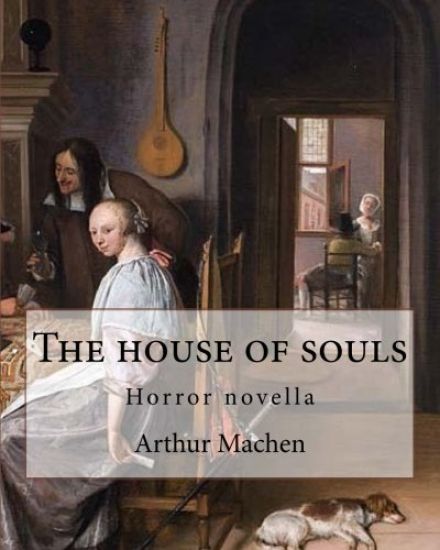
The house of souls. By: Arthur Machen: Horror novella
Arthur Machen
Createspace Independent Publishing Platform
2018
nidottu
Arthur Machen (3 March 1863 - 15 December 1947) was a Welsh author and mystic of the 1890s and early 20th century. He is best known for his influential supernatural, fantasy, and horror fiction. His novella The Great God Pan (1890; 1894) has garnered a reputation as a classic of horror, with Stephen King describing it as "Maybe the best horror story] in the English language." He is also well known for his leading role in creating the legend of the Angels of Mons. Early years: Machen was born Arthur Llewelyn Jones in Caerleon, Monmouthshire, though he usually referred to the area by the name of the medieval Welsh kingdom, Gwent. The house of his birth, opposite the Olde Bull Inn in The Square at Caerleon, is adjacent to the Priory Hotel and is today marked with a commemorative blue plaque. The beautiful landscape of Monmouthshire, with its associations of Celtic, Roman, and medieval history, made a powerful impression on him, and his love of it is at the heart of many of his works. Machen was descended from a long line of clergymen, the family having originated in Carmarthenshire. In 1864, when Machen was two, his father John Edward Jones, became vicar of the parish of Llanddewi Fach with Llandegveth, about five miles north of Caerleon, and Machen was brought up at the rectory there. Jones had adopted his wife's maiden name, Machen, to inherit a legacy, legally becoming "Jones-Machen"; his son was baptised under that name and later used a shortened version of his full name, Arthur Machen, as a pen name. Local historian and folklorist Fred Hando traces Machen's interest in the occult to a volume of Household Words in his father's Rectory library, in which he read, at the age of eight, an entrancing article on alchemy. Hando recounts Machen's other early reading: He bought De Quincey's Confessions of an English Opium Eater at Pontypool Road Railway Station, The Arabian Nights at Hereford Railway Station, and borrowed Don Quixote from Mrs. Gwyn, of Llanfrechfa Rectory. In his father's library he found also the Waverley Novels, a three-volume edition of the Glossary of Gothic Architecture, and an early volume of Tennyson At the age of eleven, Machen boarded at Hereford Cathedral School, where he received an excellent classical education. Family poverty ruled out attendance at university, and Machen was sent to London, where he sat exams to attend medical school but failed to get in. Machen, however, showed literary promise, publishing in 1881 a long poem "Eleusinia" on the subject of the Eleusinian Mysteries. Returning to London, he lived in relative poverty, attempting to work as a journalist, as a publisher's clerk, and as a children's tutor while writing in the evening and going on long rambling walks across London.......................................
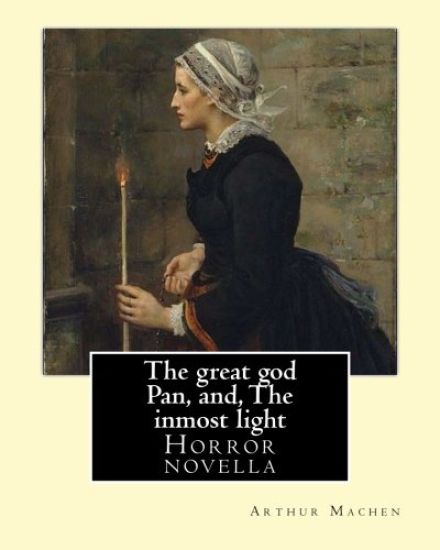
The great god Pan, and, The inmost light. By: Arthur Machen: Novella (World's classic's)
Arthur Machen
Createspace Independent Publishing Platform
2018
nidottu
The Great God Pan is a novella by Welsh writer Arthur Machen. A version of the story was published in the magazine The Whirlwind in 1890, and Machen revised and extended it for its book publication (together with another story, "The Inmost Light") in 1894. On publication it was widely denounced by the press as degenerate and horrific because of its decadent style and sexual content, but it has since garnered a reputation as a classic of horror. 1] Machen's story was only one of many at the time to focus on the Greek God Pan as a useful symbol for the power of nature and paganism. The title was possibly inspired by the poem "A Musical Instrument" published in 1862 by Elizabeth Barrett Browning, in which the first line of every stanza ends "... the great god Pan". Synopsis edit] Clarke agrees, somewhat unwillingly, to bear witness to a strange experiment performed by his friend, Dr. Raymond. The ultimate goal of the doctor is to open the mind of man so that he may experience the spiritual world, an experience he calls "seeing the great god Pan". He performs the experiment, which involves minor brain surgery, on a young woman named Mary. She awakens from the operation awed and terrified but quickly becomes "a hopeless idiot". Years later, Clarke learns of a beautiful but sinister girl named Helen Vaughan, who is reported to have caused a series of mysterious happenings in her town. She spends much of her time in the woods near her house, and takes other children on prolonged twilight rambles in the countryside that disturb the parents of the town. One day, a young boy stumbles across her "playing on the grass with a 'strange naked man, '"; the boy becomes hysterical and later, after seeing a Roman statue of a satyr's head, becomes permanently feeble-minded. Helen also forms an unusually close friendship with a neighbour girl, Rachel, whom she leads several times into the woods. On one occasion Rachel returns home distraught, half-naked and rambling. Shortly after explaining what happened to her mother (never revealed in the story), she returns to the woods and disappears forever. Years later, Villiers happens across his old friend Herbert, who has become a vagrant since they last met. When asked how he has fallen so low, Herbert replies that he has been "corrupted body and soul" by his wife. After some investigation with Clarke and another character, Austin, it is revealed that Helen was Herbert's wife, and that the two had been involved rather suspiciously in the death of a well-to-do man. Herbert is later found dead. Helen disappears for some time, supposedly taking part in disturbing orgies somewhere in the Americas. She eventually returns to London under the pseudonym Mrs. Beaumont, her appearance followed by a series of suicides. Villiers and Clarke, each learning of Mrs. Beaumont's true identity, band together and confront Helen in her house. They persuade her to hang herself, and Helen has a very abnormal death, transforming between human and beast before finally dying. It is finally revealed that Helen is the child of Mary and the great god Pan, who was let in when Dr. Raymond opened her mind up to him.... Arthur Machen (3 March 1863 - 15 December 1947) was a Welsh author and mystic of the 1890s and early 20th century. ...............
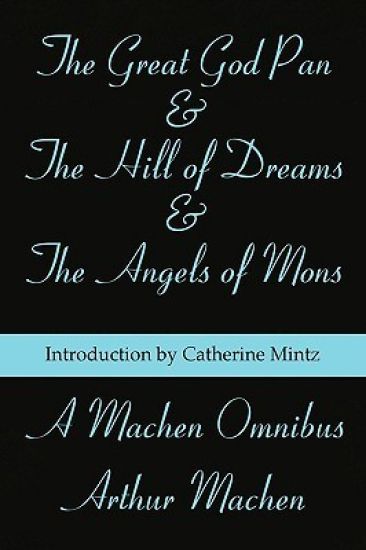
Three famous works by Arthur Machen-The Great God Pan, The Hill of Dreams, and the Angels of Mons-in one volume with an introduction by Catherine Mintz. Copper Penny Press books are in an easy to read and easy to read aloud sixteen point type format.