William Hazlitt (10 April 1778 - 18 September 1830) was an English writer, drama and literary critic, painter, social commentator, and philosopher. He is now considered one of the greatest critics and essayists in the history of the English language, placed in the company of Samuel Johnson and George Orwell.He is also acknowledged as the finest art critic of his age. Despite his high standing among historians of literature and art, his work is currently little read and mostly out of print. During his lifetime he befriended many people who are now part of the 19th-century literary canon, including Charles and Mary Lamb, Stendhal, Samuel Taylor Coleridge, William Wordsworth, and John Keats....... Sir Arthur Thomas Quiller-Couch ( 21 November 1863 - 12 May 1944) was a Cornish writer who published using the pseudonym Q. Although a prolific novelist, he is remembered mainly for the monumental publication The Oxford Book Of English Verse 1250-1900 (later extended to 1918) and for his literary criticism. He influenced many who never met him, including American writer Helene Hanff, author of 84, Charing Cross Road and its sequel, Q's Legacy. His Oxford Book of English Verse was a favourite of John Mortimer's fictional character Horace Rumpole....... William Shakespeare ( 26 April 1564 (baptised) - 23 April 1616) nb 1] was an English poet, playwright, and actor, widely regarded as the greatest writer in the English language and the world's pre-eminent dramatist. 154 sonnets, two long narrative poems, and a few other verses, some of uncertain authorship. His plays have been translated into every major living language and are performed more often than those of any other playwright. Shakespeare was born and brought up in Stratford-upon-Avon, Warwickshire. At the age of 18, he married Anne Hathaway, with whom he had three children: Susanna, and twins Hamnet and Judith. Sometime between 1585 and 1592, he began a successful career in London as an actor, writer, and part-owner of a playing company called the Lord Chamberlain's Men, later known as the King's Men. He appears to have retired to Stratford around 1613, at age 49, where he died three years later. Few records of Shakespeare's private life survive, which has stimulated considerable speculation about such matters as his physical appearance, sexuality, and religious beliefs and whether the works attributed to him were written by others. Shakespeare produced most of his known work between 1589 and 1613. His early plays were primarily comedies and histories, which are regarded as some of the best work ever produced in these genres. He then wrote mainly tragedies until about 1608, including Hamlet, Othello, King Lear, and Macbeth, considered some of the finest works in the English language.In his last phase, he wrote tragicomedies, also known as romances, and collaborated with other playwrights. Many of his plays were published in editions of varying quality and accuracy during his lifetime. In 1623, however, John Heminges and Henry Condell, two friends and fellow actors of Shakespeare, published a more definitive text known as the First Folio, a posthumous collected edition of his dramatic works that included all but two of the plays now recognised as Shakespeare's.It was prefaced with a poem by Ben Jonson, in which Shakespeare is hailed, presciently, as "not of an age, but for all time". In the 20th and 21st centuries, his works have been repeatedly adapted and rediscovered by new movements in scholarship and performance. His plays remain highly popular and are constantly studied, performed, and reinterpreted in diverse cultural and political contexts throughout the world.
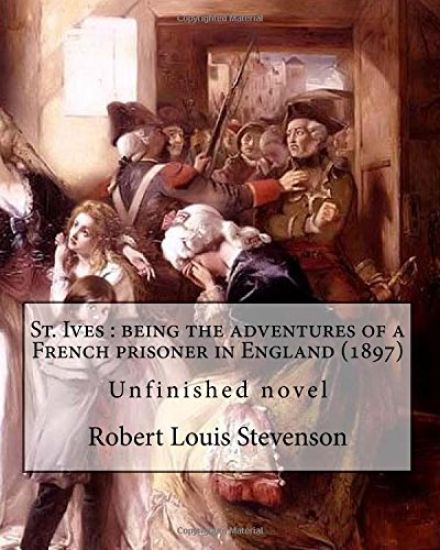
St. Ives: Being The Adventures of a French Prisoner in England (1897) is an unfinished novel by Robert Louis Stevenson. It was completed in 1898 by Arthur Quiller-Couch. The book plot concerns the adventures of the dashing Viscomte Anne de Keroual de St. Ives, a Napoleonic soldier enlisted as a private under the name Champdivers, after his capture by the British. The book is available on Project Gutenberg in both its incomplete and complete form (for the story as completed by Arthur Quiller-Couch look for "The Works of Robert Louis Stevenson volume twenty."). Sir Arthur Thomas Quiller-Couch (21 November 1863 - 12 May 1944) was a Cornish writer who published using the pseudonym Q. Although a prolific novelist, he is remembered mainly for the monumental publication The Oxford Book Of English Verse 1250-1900 (later extended to 1918) and for his literary criticism. He influenced many who never met him, including American writer Helene Hanff, author of 84, Charing Cross Road and its sequel, Q's Legacy. His Oxford Book of English Verse was a favourite of John Mortimer's fictional character Horace Rumpole.... Robert Louis Balfour Stevenson (13 November 1850 - 3 December 1894) was a Scottish novelist, poet, essayist, and travel writer. His most famous works are Treasure Island, Kidnapped, Strange Case of Dr Jekyll and Mr Hyde, and A Child's Garden of Verses. A literary celebrity during his lifetime, Stevenson now ranks as the 26th most translated author in the world. His works have been admired by many other writers, including Jorge Luis Borges, Bertolt Brecht, Marcel Proust, Arthur Conan Doyle, Henry James, Cesare Pavese, Emilio Salgari, Ernest Hemingway, Rudyard Kipling, Jack London, Vladimir Nabokov, J. M. Barrie, and G. K. Chesterton, who said of him that he "seemed to pick the right word up on the point of his pen, like a man playing spillikins" Stevenson was born at 8 Howard Place, Edinburgh, Scotland, on 13 November 1850, to Thomas Stevenson (1818-87), a leading lighthouse engineer, and his wife Margaret Isabella (born Balfour; 1829-97). He was christened Robert Lewis Balfour Stevenson. At about age 18, Stevenson was to change the spelling of "Lewis" to "Louis", and in 1873, he dropped "Balfour". Lighthouse design was the family's profession: Thomas's father (Robert's grandfather) was the famous Robert Stevenson, and both of Thomas's brothers (Robert's uncles) Alan and David, were in the same field. 9] Indeed, even Thomas's maternal grandfather, Thomas Smith, had been in the same profession. However, Robert's mother's family were not of the same profession. Margaret's natal family, the Balfours, were gentry, tracing their lineage back to a certain Alexander Balfour who had held the lands of Inchyra in Fife in the fifteenth century. Margaret's father, Lewis Balfour (1777-1860), was a minister of the Church of Scotland at nearby Colinton, and her siblings included the physician George William Balfour and the marine engineer James Balfour. Stevenson spent the greater part of his boyhood holidays in his maternal grandfather's house. "Now I often wonder," wrote Stevenson, "what I inherited from this old minister. I must suppose, indeed, that he was fond of preaching sermons, and so am I, though I never heard it maintained that either of us loved to hear them."
Sir Arthur Quiller-Couch (1863–1944), who often published under the pen-name of 'Q', was one of the giants of early twentieth-century literature and literary criticism. A novelist and poet who was also a Professor of English, he helped to form the literary tastes of generations of literary students and scholars who came after him. The freshness, enthusiasm and intellectual insight of his work is still evident in his writings nearly a century on. Cambridge University Press is delighted to reissue some of his key texts in this new edition.
Sir Arthur Quiller-Couch (1863–1944), who often published under the pen-name of 'Q', was one of the giants of early twentieth-century literature and literary criticism. A novelist and poet who was also a Professor of English, he helped to form the literary tastes of generations of literary students and scholars who came after him. The freshness, enthusiasm and intellectual insight of his work is still evident in his writings nearly a century on. Cambridge University Press is delighted to reissue some of his key texts in this new edition. Quiller-Couch was born in Cornwall and educated at Newton Abbot College, Clifton College and Trinity College Oxford. These autobiographical writings, first published shortly after his death in 1944, describe his early years in Polperro and his educational experiences, ending with his choice of an academic career and the publication of his first novel.
Sir Arthur Quiller-Couch (1863–1944), who often published under the pen-name of 'Q', was one of the giants of early twentieth-century literature and literary criticism. A novelist and poet who was also a Professor of English, he helped to form the literary tastes of generations of literary students and scholars who came after him. The freshness, enthusiasm and intellectual insight of his work is still evident in his writings nearly a century on. Cambridge University Press is delighted to reissue some of his key texts in this new edition.
Sir Arthur Quillen-Couch (1863–1944), who often published under the pen-name of 'Q', was one of the giants of early twentieth-century literature and literary criticism. A novelist and poet who was also a Professor of English, he helped to form the literary tastes of generations of literary students and scholars who came after him. The freshness, enthusiasm and intellectual insight of his work is still evident in his writings nearly a century on. Cambridge University Press is delighted to reissue some of his key texts in this new edition.
Sir Arthur Quiller-Couch (1863–1944), who often published under the pen-name of 'Q', was one of the giants of early twentieth-century literature and literary criticism. A novelist and poet who was also a Professor of English, he helped to form the literary tastes of generations of literary students and scholars who came after him. The freshness, enthusiasm and intellectual insight of his work is still evident in his writings nearly a century on. Cambridge University Press is delighted to reissue some of his key texts in this new edition.
Sir Arthur Quiller-Couch (1863–1944), who often published under the pen-name of 'Q', was one of the giants of early twentieth-century literature and literary criticism. A novelist and poet who was also a Professor of English, he helped to form the literary tastes of generations of literary students and scholars who came after him. The freshness, enthusiasm and intellectual insight of his work is still evident in his writings nearly a century on. Cambridge University Press is delighted to reissue some of his key texts in this new edition. Early in his career Quiller-Couch made many short contributions to the periodical The Speaker. The articles collected here address subjects as diverse as 'Robinson Crusoe' and Robert Louis Stevenson, 'The Popular Conception of a Poet' and 'Who wrote the Odyssey?"
Sir Arthur Quiller-Couch (18631–1944), who often published under the pen-name of 'Q', was one of the giants of early twentieth-century literature and literary criticism. A novelist and poet who was also a Professor of English, he helped to form the literary tastes of generations of literary students and scholars who came after him. The freshness, enthusiasm and intellectual insight of his work is still evident in his writings nearly a century on. Cambridge University Press is delighted to reissue some of his key texts in this new edition. Taken from a series of articles for the Pall Mall magazine, this month-by-month series of observations on life and thought shows, in Quiller-Couch's own words, 'that beneath some apparent and purposed frivolities ... the author, from month to month, writing casually, had a sense of the beauty and seriousness of life as well as of its humours'.

![Poems and Ballads by 'q.' [I.E. Arthur Thomas Quiller-Couch.]](/covers/9781241052706.jpg)



![The Blue Pavilions. [A Tale.] by Q. [I.E. A. T. Quiller-Couch.]](/covers/9781241188726.jpg)
![Ia. [A Novel.] by Q. [I.E. A. T. Quiller-Couch. with Illustrations.]](/covers/9781241207861.jpg)