Arthur Rackham (1867 - 1939) remains one of the most celebrated artists of the early twentieth century. His ethereal paintings and illustrations for books like Rip Van Winkle, Peter Pan, and The Fairytales of the Brothers Grimm bring viewers into the magical land of faery, evoking the sense that we are surrounded by enchanting creatures at all times of the day. This breathtaking tarot deck features the most stunning illustrations from Rackham's body of work, inviting you to make a whimsical journey into the realm of the wee folk where unexpected insights and inspiration await. The companion booklets for most Lo Scarabeo decks are in five languages: English, Spanish, French, Italian, and German.
Featuring the art of the great British illustrator Arthur Rackham, the Fairy Oracle invites you into a mysterious and mesmerizing world. The companion booklets for most Lo Scarabeo decks are in five languages: English, Spanish, French, Italian, and German.
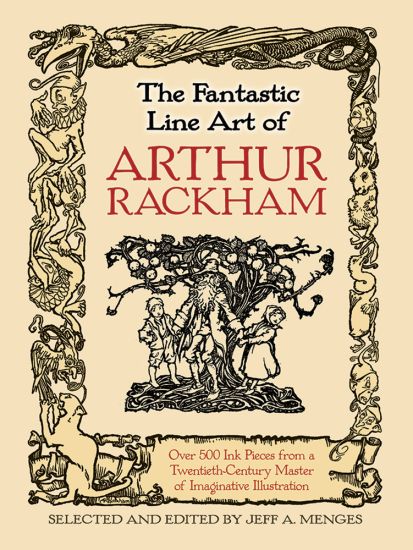
Arthur Rackham is widely regarded as one of the leading illustrators from the golden age of British book illustration, which encompassed the years 1890 until the end of World War I. The acclaim for the artist's wealth of color illustrations has overshadowed the merit of his first-rate ink work, a genre richly deserving of individual attention. This original volume, the first available collection of Rackham's line art, features images from throughout his career, including illustrations for Alice in Wonderland, Peter Pan in Kensington Gardens, A Midsummer Night's Dream, and some rare periodical work.In addition, this compilation presents two seldom-seen magazine features on the artist: "Arthur Rackham: The Wizard at Home," a 1905 article from The International Studio, and "Arthur Rackham: A Painter of Fantasies," a 1914 article from St. Nicholas Magazine. These articles, not reprinted in over a century, contain pictures of Rackham's studio and residence as well as some stories of his own commentary. Together with scores of strange and wonderful illustrations, they provide fresh insights into the work of the artist known as "the Beloved Enchanter."
Travels into Several Remote Nations of the World. In Four Parts. By Lemuel Gulliver, First a Surgeon, and then a Captain of Several Ships, commonly known as Gulliver's Travels (1726, amended 1735), is a prose satire by Irish writer and clergyman Jonathan Swift, that is both a satire on human nature and the "travellers' tales" literary subgenre. It is Swift's best known full-length work, and a classic of English literature.The book became popular as soon as it was published. John Gay wrote in a 1726 letter to Swift that "It is universally read, from the cabinet council to the nursery."The book begins with a short preamble in which Lemuel Gulliver, in the literary style of the time, gives a brief outline of his life and history before his voyages.Part I: A Voyage to Lilliput-- During his first voyage, Gulliver is washed ashore after a shipwreck and finds himself a prisoner of a race of tiny people, less than 6 inches (15 cm) tall, who are inhabitants of the island country of Lilliput. After giving assurances of his good behaviour, he is given a residence in Lilliput and becomes a favourite of the court. From there, the book follows Gulliver's observations on the Court of Lilliput. He is also given permission to go around the city on condition that he must not harm their subjects. Gulliver assists the Lilliputians to subdue their neighbours, the Blefuscudians, by stealing their fleet. However, he refuses to reduce the island nation of Blefuscu to a province of Lilliput, displeasing the King and the court. Gulliver is charged with treason for, among other crimes, "making water" in the capital, though he was putting out a fire and saving countless lives. He is convicted and sentenced to be blinded, but with the assistance of a kind friend, he escapes to Blefuscu. Here he spots and retrieves an abandoned boat and sails out to be rescued by a passing ship, which safely takes him back home.Part II: A Voyage to Brobdingnag, Part III: A Voyage to Laputa, Balnibarbi, Luggnagg, and Glubbdubdrib, Part IV: A Voyage to the Country of the Houyhnhnms. Arthur Rackham (19 September 1867 - 6 September 1939) was an English book illustrator. Rackham was born in Lewisham, then still part of Kent as one of 12 children. In 1884, at the age of 17, he was sent on an ocean voyage to Australia to improve his fragile health, accompanied by two aunts.At the age of 18, he worked as a clerk at the Westminster Fire Office and began studying part-time at the Lambeth School of Art. Jonathan Swift (30 November 1667 - 19 October 1745) was an Anglo-Irish satirist, essayist, political pamphleteer (first for the Whigs, then for the Tories), poet and cleric who became Dean of St Patrick's Cathedral, Dublin.Swift is remembered for works such as Gulliver's Travels, A Modest Proposal, A Journal to Stella, Drapier's Letters, The Battle of the Books, An Argument Against Abolishing Christianity and A Tale of a Tub. He is regarded by the Encyclop dia Britannica as the foremost prose satirist in the English language, and is less well known for his poetry. He originally published all of his works under pseudonyms - such as Lemuel Gulliver, Isaac Bickerstaff, Drapier's Letters as MB Drapier - or anonymously. He is also known for being a master of two styles of satire, the Horatian and Juvenalian styles.His deadpan, ironic writing style, particularly in A Modest Proposal, has led to such satire being subsequently termed "Swiftian"...............
Gulliver's Travels, whose full title is Travels into Several Remote Nations of the World. In Four Parts. By Lemuel Gulliver, First a Surgeon, and then a Captain of Several Ships, (1726, amended 1735), is a prose satire 1] 2] by Irish writer and clergyman Jonathan Swift, that is both a satire on human nature and the "travellers' tales" literary subgenre. It is Swift's best known full-length work, and a classic of English literature. He himself claimed that he wrote Gulliver's Travels "to vex the world rather than divert it". The book became popular as soon as it was published. John Gay wrote in a 1726 letter to Swift that "It is universally read, from the cabinet council to the nursery.The travel begins with a short preamble in which Lemuel Gulliver gives a brief outline of his life and history before his voyages. During his first voyage, Gulliver is washed ashore after a shipwreck and finds himself a prisoner of a race of tiny people, less than 6 inches (0.50 ft) tall, who are inhabitants of the island country of Lilliput. After giving assurances of his good behavior, he is given a residence in Lilliput and becomes a favorite of the Lilliput Royal Court. He is also given permission by the King of Lilliput to go around the city on condition that he must not harm their subjects.
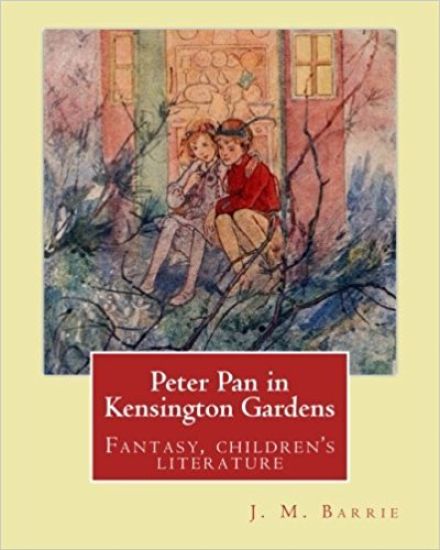
Peter Pan in Kensington Gardens is a novel by J. M. Barrie, illustrated by Arthur Rackham, and published by Hodder & Stoughton in late November or early December 1906; it is one of four major literary works by Barrie featuring the widely known literary character he created, Peter Pan.Peter is a seven-day-old infant who, "like all infants", used to be part bird. Peter has complete faith in his flying abilities, so, upon hearing a discussion of his adult life, he is able to escape out of the window of his London home and return to Kensington Gardens. Upon returning to the Gardens, Peter is shocked to learn from the crow Solomon Caw that he is not still a bird, but more like a human - Solomon says he is crossed between them as a "Betwixt-and-Between". Unfortunately, Peter now knows he cannot fly, so he is stranded in Kensington Gardens.
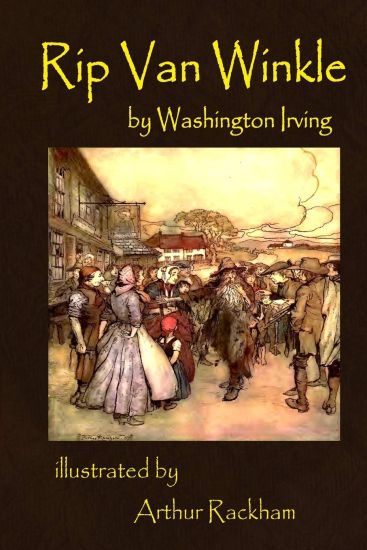
"Rip Van Winkle" is a short story by American author Washington Irving first published in 1819. It tells the story of a Dutch-American villager in colonial America named Rip Van Winkle who falls asleep in the Catskill Mountains and wakes up 20 years later, having missed the American Revolution. Irving wrote it while living in Birmingham, England as part of the collection The Sketch Book of Geoffrey Crayon, Gent. The story is set in New York's Catskill Mountains.
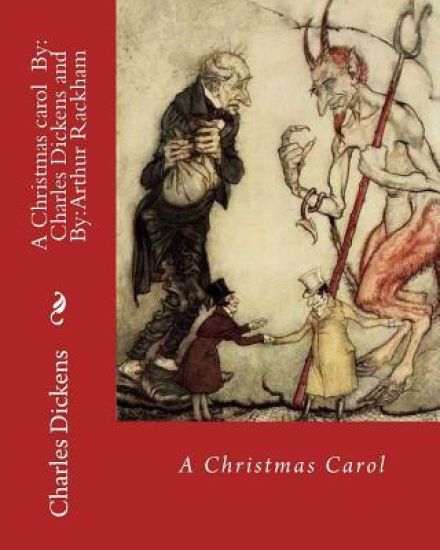
A Christmas Carol in Prose, Being a Ghost-Story of Christmas, commonly known as A Christmas Carol, is a novella by Charles Dickens, first published in London by Chapman & Hall in 1843; the first edition was illustrated by John Leech. A Christmas Carol tells the story of Ebenezer Scrooge, an old miser who is visited by the ghost of his former business partner Jacob Marley and the Ghosts of Christmas Past, Present and Yet to Come. After their visits Scrooge is transformed into a kinder, gentler man. Dickens wrote A Christmas Carol at a time when the British were examining and exploring Christmas traditions from the past, such as carols, as well as new customs such as Christmas trees. He was influenced by experiences from his own past, and from the Christmas stories of other authors, including Washington Irving and Douglas Jerrold. Dickens had written three Christmas stories prior to the novella, and was inspired to write the story following a visit to the Field Lane Ragged school, one of several establishments for London's half-starved, illiterate street children. The treatment of the poor and the ability of a self-interested man redeeming himself by transforming into a more sympathetic character are the key themes of the story. There is discussion among academics as to whether this was a fully secular story, or if it is a Christian allegory. Published on 19 December, the first edition sold out by Christmas Eve; by the end of 1844 thirteen editions had been released. Most critics reviewed the novella positively. The story was illicitly copied in January 1844; Dickens took action against the publishers, who went bankrupt, reducing further Dickens's small profits from the publication. He went on to write four other Christmas stories in subsequent years. In 1849 he began public readings of the story which proved so successful he undertook 127 further performances until 1870, the year of his death. A Christmas Carol has never been out of print and has been translated into several languages; the story has been adapted many times for film, stage, opera and other media. With A Christmas Carol, Dickens captured the zeitgeist of the mid-Victorian revival of the Christmas holiday. He has been acknowledged as an influence on the modern Western observance of Christmas and inspired several aspects of Christmas, such as family gatherings, seasonal food and drink, dancing, games and a festive generosity of spirit............ Arthur Rackham (19 September 1867 - 6 September 1939) was an English book illustrator. .......... Charles John Huffam Dickens ( 7 February 1812 - 9 June 1870) was an English writer and social critic. He created some of the world's best-known fictional characters and is regarded by many as the greatest novelist of the Victorian era. His works enjoyed unprecedented popularity during his lifetime, and by the 20th century critics and scholars had recognised him as a literary genius. His novels and short stories enjoy lasting popularity. Born in Portsmouth, Dickens left school to work in a factory when his father was incarcerated in a debtors' prison. Despite his lack of formal education, he edited a weekly journal for 20 years, wrote 15 novels, five novellas, hundreds of short stories and non-fiction articles, lectured and performed extensively, was an indefatigable letter writer, and campaigned vigorously for children's rights, education, and other social reforms...............
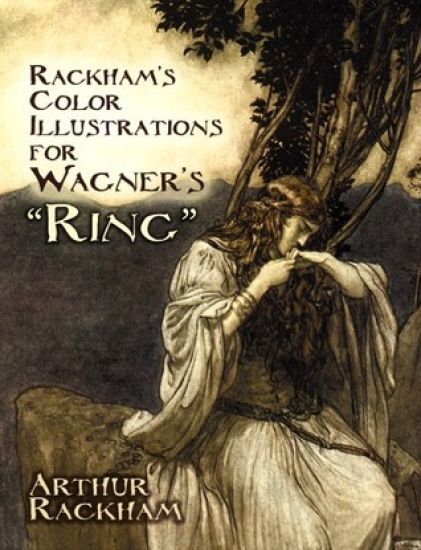
By the time he created these images, Rackham was England's leading illustrator, famous throughout the world for his interpretations of fairy tales and myths. These illustrations from the original 1911 and 1912 editions, widely regarded as the greatest representations of Wagner's drama, constitute Rackham's masterworks. 64 full-page color images and 9 vignettes.
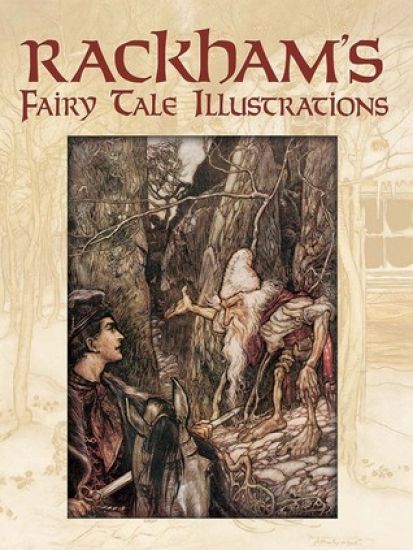
Superb collection of 55 lovely plates, reproduced from rare, early editions, includes a rich selection of fairy tale images by one of England's leading illustrators of the early 20th century. Includes scenes from "Irish Fairy Tales, English Fairy Tales, Hansel and Gretel, Snowdrop and Other Tales, Little Brother & Little Sister, " and more.
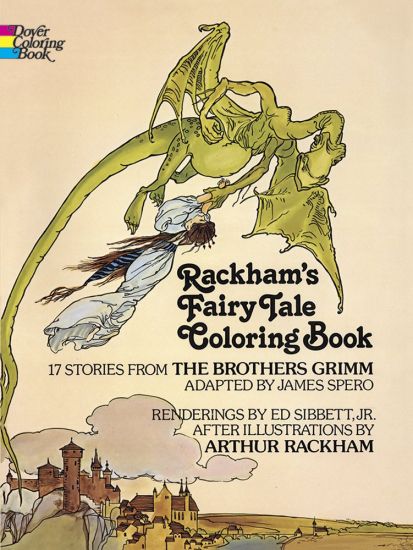
Arthur Rackham was one of the most popular early 20th-century illustrators of children's books. Ed Sibbett, Jr., has expertly rendered 30 Rackham drawings and watercolor illustrations for coloring -- preserving all the characteristic elegance and charm of Rackham's original illustrations. James Spero's story adaptations of 17 Grimm fairy tales retain the folk flavor of the originals. There are well-known favorites such as "Hansel and Gretel," "Snow White," "Rumpelstiltskin," "Rapunzel," "Sleeping Beauty," and lesser-known tales such as "The Four Clever Brothers," "King Thrushbeard," "Doctor Know-All," and nine others.
""A Fairy Book"" by Arthur Rackham is a collection of fairy tales from different cultures and regions, including stories from the Brothers Grimm, Hans Christian Andersen, and Charles Perrault. The book features Rackham's distinctive illustrations, which bring these classic tales to life with his signature blend of whimsy and darkness. The stories included in the book range from well-known tales like ""Cinderella"" and ""Little Red Riding Hood"" to lesser-known tales like ""The Three Little Men in the Wood"" and ""The Golden Crab."" Rackham's illustrations capture the magic and enchantment of these stories, making this book a must-read for anyone who loves fairy tales and beautiful illustrations.This is a new release of the original 1923 edition.This scarce antiquarian book is a facsimile reprint of the old original and may contain some imperfections such as library marks and notations. Because we believe this work is culturally important, we have made it available as part of our commitment for protecting, preserving, and promoting the world's literature in affordable, high quality, modern editions, that are true to their original work.