Kirjojen hintavertailu. Mukana 12 039 528 kirjaa ja 12 kauppaa.

Kirjahaku

Etsi kirjoja tekijän nimen, kirjan nimen tai ISBN:n perusteella.

4 kirjaa tekijältä Arun Agrawal

Greener Pastures

Greener Pastures

Arun Agrawal

Duke University Press
1999
pokkari
In this text, the author, Arun Agrawal uses the story of the Raikas, a little-known group of migrant shepherds in western India, to re-examine scholarship on markets and exchange, local and state politics, and community and hierarchy.
Greener Pastures

Greener Pastures

Arun Agrawal

Duke University Press
1999
sidottu
Social scientists theorizing about political economy and the allocation of resources have usually omitted migrant communities from their studies. In Greener Pastures Arun Agrawal uses the story of the Raikas, a little-known group of migrant shepherds in western India, to reexamine current scholarship on markets and exchange, local and state politics, and community and hierarchy. The Raikas are virtually invisible in the regions through which they travel, as well as to the wider Indian society, yet they must operate as part of these larger spheres for their economic survival.Agrawal analyzes the institutions developed by the shepherds to solve livelihood problems. First, by focusing on the relations of the shepherds with their landholder neighbors, he explains why the shepherds migrate. He shows that struggles between these two groups led to a sociopolitical squeeze on the access of shepherds to the fodder resources they need to feed their sheep. Then, in an examination of why the shepherds migrate in groups, he demonstrates how their migratory lives depend on market exchanges and points to the social and political forces that influence prices and determine profits. Finally, he looks at decision-making processes such as division of labor and the delegation of power. Politics is ubiquitous in the interactions of the shepherds with their neighbors and with state officials, in their exchanges in markets and with farmers, and in their internal relations as a community. Interspersing the words of the Raikas themselves with a sophisticated deployment of political theory, Agrawal has produced a volume that will interest scholars in a broad range of academic disciplines, including Asian studies, political science, human ecology, anthropology, comparative politics, rural sociology, and environmental studies and policy.
Environmentality

Environmentality

Arun Agrawal

Duke University Press
2005
sidottu
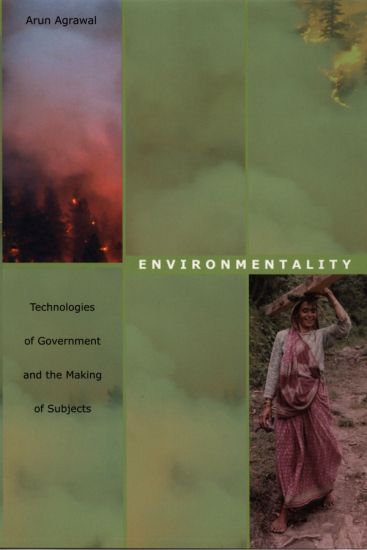
In Kumaon in northern India, villagers set hundreds of forest fires in the early 1920s, protesting the colonial British state’s regulations to protect the environment. Yet by the 1990s, they had begun to conserve their forests carefully. In his innovative historical and political study, Arun Agrawal analyzes this striking transformation. He describes and explains the emergence of environmental identities and changes in state-locality relations and shows how the two are related. In so doing, he demonstrates that scholarship on common property, political ecology, and feminist environmentalism can be combined-in an approach he calls environmentality-to better understand changes in conservation efforts. Such an understanding is relevant far beyond Kumaon: local populations in more than fifty countries are engaged in similar efforts to protect their environmental resources.Agrawal brings environment and development studies, new institutional economics, and Foucauldian theories of power and subjectivity to bear on his ethnographical and historical research. He visited nearly forty villages in Kumaon, where he assessed the state of village forests, interviewed hundreds of Kumaonis, and examined local records. Drawing on his extensive fieldwork and archival research, he shows how decentralization strategies change relations between states and localities, community decision makers and common residents, and individuals and the environment. In exploring these changes and their significance, Agrawal establishes that theories of environmental politics are enriched by attention to the interconnections between power, knowledge, institutions, and subjectivities.
Environmentality

Environmentality

Arun Agrawal

Duke University Press
2005
pokkari
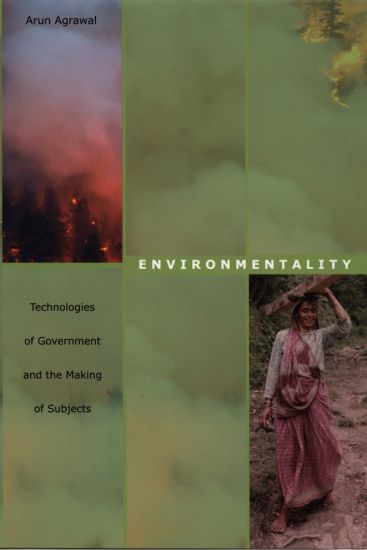
In Kumaon in northern India, villagers set hundreds of forest fires in the early 1920s, protesting the colonial British state’s regulations to protect the environment. Yet by the 1990s, they had begun to conserve their forests carefully. In his innovative historical and political study, Arun Agrawal analyzes this striking transformation. He describes and explains the emergence of environmental identities and changes in state-locality relations and shows how the two are related. In so doing, he demonstrates that scholarship on common property, political ecology, and feminist environmentalism can be combined-in an approach he calls environmentality-to better understand changes in conservation efforts. Such an understanding is relevant far beyond Kumaon: local populations in more than fifty countries are engaged in similar efforts to protect their environmental resources.Agrawal brings environment and development studies, new institutional economics, and Foucauldian theories of power and subjectivity to bear on his ethnographical and historical research. He visited nearly forty villages in Kumaon, where he assessed the state of village forests, interviewed hundreds of Kumaonis, and examined local records. Drawing on his extensive fieldwork and archival research, he shows how decentralization strategies change relations between states and localities, community decision makers and common residents, and individuals and the environment. In exploring these changes and their significance, Agrawal establishes that theories of environmental politics are enriched by attention to the interconnections between power, knowledge, institutions, and subjectivities.