Kirjojen hintavertailu. Mukana 11 699 587 kirjaa ja 12 kauppaa.

Kirjahaku

Etsi kirjoja tekijän nimen, kirjan nimen tai ISBN:n perusteella.

41 kirjaa tekijältä Augustin-Louis Cauchy

Oeuvres complètes

Oeuvres complètes

Augustin-Louis Cauchy

Cambridge University Press
2009
pokkari
Augustin-Louis, Baron Cauchy (1789–1857) was the pre-eminent French mathematician of the nineteenth century. He began his career as a military engineer during the Napoleonic Wars, but even then was publishing significant mathematical papers, and was persuaded by Lagrange and Laplace to devote himself entirely to mathematics. His greatest contributions are considered to be the Cours d'analyse de l'École Royale Polytechnique (1821), Résumé des leçons sur le calcul infinitésimal (1823) and Leçons sur les applications du calcul infinitésimal à la géométrie (1826–8), and his pioneering work encompassed a huge range of topics, most significantly real analysis, the theory of functions of a complex variable, and theoretical mechanics. Twenty-six volumes of his collected papers were published between 1882 and 1958. The first series (volumes 1-12) consists of papers published by the Académie des Sciences de l'Institut de France; the second series (volumes 13-26) of papers published elsewhere.
Oeuvres complètes

Oeuvres complètes

Augustin-Louis Cauchy

Cambridge University Press
2009
pokkari
Augustin-Louis, Baron Cauchy (1789–1857) was the pre-eminent French mathematician of the nineteenth century. He began his career as a military engineer during the Napoleonic Wars, but even then was publishing significant mathematical papers, and was persuaded by Lagrange and Laplace to devote himself entirely to mathematics. His greatest contributions are considered to be the Cours d'analyse de l'École Royale Polytechnique (1821), Résumé des leçons sur le calcul infinitésimal (1823) and Leçons sur les applications du calcul infinitésimal à la géométrie (1826–8), and his pioneering work encompassed a huge range of topics, most significantly real analysis, the theory of functions of a complex variable, and theoretical mechanics. Twenty-six volumes of his collected papers were published between 1882 and 1958. The first series (volumes 1-12) consists of papers published by the Académie des Sciences de l'Institut de France; the second series (volumes 13-26) of papers published elsewhere.
Oeuvres complètes

Oeuvres complètes

Augustin-Louis Cauchy

Cambridge University Press
2009
pokkari
Augustin-Louis, Baron Cauchy (1789–1857) was the pre-eminent French mathematician of the nineteenth century. He began his career as a military engineer during the Napoleonic Wars, but even then was publishing significant mathematical papers, and was persuaded by Lagrange and Laplace to devote himself entirely to mathematics. His greatest contributions are considered to be the Cours d'analyse de l'École Royale Polytechnique (1821), Résumé des leçons sur le calcul infinitésimal (1823) and Leçons sur les applications du calcul infinitésimal à la géométrie (1826–8), and his pioneering work encompassed a huge range of topics, most significantly real analysis, the theory of functions of a complex variable, and theoretical mechanics. Twenty-six volumes of his collected papers were published between 1882 and 1958. The first series (volumes 1-12) consists of papers published by the Académie des Sciences de l'Institut de France; the second series (volumes 13-26) of papers published elsewhere.
Oeuvres complètes

Oeuvres complètes

Augustin-Louis Cauchy

Cambridge University Press
2009
pokkari
Augustin-Louis, Baron Cauchy (1789–1857) was the pre-eminent French mathematician of the nineteenth century. He began his career as a military engineer during the Napoleonic Wars, but even then was publishing significant mathematical papers, and was persuaded by Lagrange and Laplace to devote himself entirely to mathematics. His greatest contributions are considered to be the Cours d'analyse de l'École Royale Polytechnique (1821), Résumé des leçons sur le calcul infinitésimal (1823) and Leçons sur les applications du calcul infinitésimal à la géométrie (1826–8), and his pioneering work encompassed a huge range of topics, most significantly real analysis, the theory of functions of a complex variable, and theoretical mechanics. Twenty-six volumes of his collected papers were published between 1882 and 1958. The first series (volumes 1-12) consists of papers published by the Académie des Sciences de l'Institut de France; the second series (volumes 13-26) of papers published elsewhere.
Oeuvres complètes

Oeuvres complètes

Augustin-Louis Cauchy

Cambridge University Press
2009
pokkari
Augustin-Louis, Baron Cauchy (1789–1857) was the pre-eminent French mathematician of the nineteenth century. He began his career as a military engineer during the Napoleonic Wars, but even then was publishing significant mathematical papers, and was persuaded by Lagrange and Laplace to devote himself entirely to mathematics. His greatest contributions are considered to be the Cours d'analyse de l'École Royale Polytechnique (1821), Résumé des leçons sur le calcul infinitésimal (1823) and Leçons sur les applications du calcul infinitésimal à la géométrie (1826–8), and his pioneering work encompassed a huge range of topics, most significantly real analysis, the theory of functions of a complex variable, and theoretical mechanics. Twenty-six volumes of his collected papers were published between 1882 and 1958. The first series (volumes 1-12) consists of papers published by the Académie des Sciences de l'Institut de France; the second series (volumes 13-26) of papers published elsewhere.
Oeuvres complètes

Oeuvres complètes

Augustin-Louis Cauchy

Cambridge University Press
2009
pokkari
Augustin-Louis, Baron Cauchy (1789–1857) was the pre-eminent French mathematician of the nineteenth century. He began his career as a military engineer during the Napoleonic Wars, but even then was publishing significant mathematical papers, and was persuaded by Lagrange and Laplace to devote himself entirely to mathematics. His greatest contributions are considered to be the Cours d'analyse de l'École Royale Polytechnique (1821), Résumé des leçons sur le calcul infinitésimal (1823) and Leçons sur les applications du calcul infinitésimal à la géométrie (1826–8), and his pioneering work encompassed a huge range of topics, most significantly real analysis, the theory of functions of a complex variable, and theoretical mechanics. Twenty-six volumes of his collected papers were published between 1882 and 1958. The first series (volumes 1-12) consists of papers published by the Académie des Sciences de l'Institut de France; the second series (volumes 13-26) of papers published elsewhere.
Oeuvres complètes

Oeuvres complètes

Augustin-Louis Cauchy

Cambridge University Press
2009
pokkari
Augustin-Louis, Baron Cauchy (1789–1857) was the pre-eminent French mathematician of the nineteenth century. He began his career as a military engineer during the Napoleonic Wars, but even then was publishing significant mathematical papers, and was persuaded by Lagrange and Laplace to devote himself entirely to mathematics. His greatest contributions are considered to be the Cours d'analyse de l'École Royale Polytechnique (1821), Résumé des leçons sur le calcul infinitésimal (1823) and Leçons sur les applications du calcul infinitésimal à la géométrie (1826–8), and his pioneering work encompassed a huge range of topics, most significantly real analysis, the theory of functions of a complex variable, and theoretical mechanics. Twenty-six volumes of his collected papers were published between 1882 and 1958. The first series (volumes 1-12) consists of papers published by the Académie des Sciences de l'Institut de France; the second series (volumes 13-26) of papers published elsewhere.
Oeuvres complètes

Oeuvres complètes

Augustin-Louis Cauchy

Cambridge University Press
2009
pokkari
Augustin-Louis, Baron Cauchy (1789–1857) was the pre-eminent French mathematician of the nineteenth century. He began his career as a military engineer during the Napoleonic Wars, but even then was publishing significant mathematical papers, and was persuaded by Lagrange and Laplace to devote himself entirely to mathematics. His greatest contributions are considered to be the Cours d'analyse de l'École Royale Polytechnique (1821), Résumé des leçons sur le calcul infinitésimal (1823) and Leçons sur les applications du calcul infinitésimal à la géométrie (1826–8), and his pioneering work encompassed a huge range of topics, most significantly real analysis, the theory of functions of a complex variable, and theoretical mechanics. Twenty-six volumes of his collected papers were published between 1882 and 1958. The first series (volumes 1-12) consists of papers published by the Académie des Sciences de l'Institut de France; the second series (volumes 13-26) of papers published elsewhere.
Oeuvres complètes

Oeuvres complètes

Augustin-Louis Cauchy

Cambridge University Press
2009
pokkari
Augustin-Louis, Baron Cauchy (1789–1857) was the pre-eminent French mathematician of the nineteenth century. He began his career as a military engineer during the Napoleonic Wars, but even then was publishing significant mathematical papers, and was persuaded by Lagrange and Laplace to devote himself entirely to mathematics. His greatest contributions are considered to be the Cours d'analyse de l'École Royale Polytechnique (1821), Résumé des leçons sur le calcul infinitésimal (1823) and Leçons sur les applications du calcul infinitésimal à la géométrie (1826–8), and his pioneering work encompassed a huge range of topics, most significantly real analysis, the theory of functions of a complex variable, and theoretical mechanics. Twenty-six volumes of his collected papers were published between 1882 and 1958. The first series (volumes 1-12) consists of papers published by the Académie des Sciences de l'Institut de France; the second series (volumes 13-26) of papers published elsewhere.
Oeuvres complètes

Oeuvres complètes

Augustin-Louis Cauchy

Cambridge University Press
2009
pokkari
Augustin-Louis, Baron Cauchy (1789–1857) was the pre-eminent French mathematician of the nineteenth century. He began his career as a military engineer during the Napoleonic Wars, but even then was publishing significant mathematical papers, and was persuaded by Lagrange and Laplace to devote himself entirely to mathematics. His greatest contributions are considered to be the Cours d'analyse de l'École Royale Polytechnique (1821), Résumé des leçons sur le calcul infinitésimal (1823) and Leçons sur les applications du calcul infinitésimal à la géométrie (1826–8), and his pioneering work encompassed a huge range of topics, most significantly real analysis, the theory of functions of a complex variable, and theoretical mechanics. Twenty-six volumes of his collected papers were published between 1882 and 1958. The first series (volumes 1-12) consists of papers published by the Académie des Sciences de l'Institut de France; the second series (volumes 13-26) of papers published elsewhere.
Oeuvres complètes

Oeuvres complètes

Augustin-Louis Cauchy

Cambridge University Press
2009
pokkari
Augustin-Louis, Baron Cauchy (1789–1857) was the pre-eminent French mathematician of the nineteenth century. He began his career as a military engineer during the Napoleonic Wars, but even then was publishing significant mathematical papers, and was persuaded by Lagrange and Laplace to devote himself entirely to mathematics. His greatest contributions are considered to be the Cours d'analyse de l'École Royale Polytechnique (1821), Résumé des leçons sur le calcul infinitésimal (1823) and Leçons sur les applications du calcul infinitésimal à la géométrie (1826–8), and his pioneering work encompassed a huge range of topics, most significantly real analysis, the theory of functions of a complex variable, and theoretical mechanics. Twenty-six volumes of his collected papers were published between 1882 and 1958. The first series (volumes 1-12) consists of papers published by the Académie des Sciences de l'Institut de France; the second series (volumes 13-26) of papers published elsewhere.
Oeuvres complètes

Oeuvres complètes

Augustin-Louis Cauchy

Cambridge University Press
2009
pokkari
Augustin-Louis, Baron Cauchy (1789–1857) was the pre-eminent French mathematician of the nineteenth century. He began his career as a military engineer during the Napoleonic Wars, but even then was publishing significant mathematical papers, and was persuaded by Lagrange and Laplace to devote himself entirely to mathematics. His greatest contributions are considered to be the Cours d'analyse de l'École Royale Polytechnique (1821), Résumé des leçons sur le calcul infinitésimal (1823) and Leçons sur les applications du calcul infinitésimal à la géométrie (1826–8), and his pioneering work encompassed a huge range of topics, most significantly real analysis, the theory of functions of a complex variable, and theoretical mechanics. Twenty-six volumes of his collected papers were published between 1882 and 1958. The first series (volumes 1-12) consists of papers published by the Académie des Sciences de l'Institut de France; the second series (volumes 13-26) of papers published elsewhere.
Oeuvres complètes

Oeuvres complètes

Augustin-Louis Cauchy

Cambridge University Press
2009
pokkari
Augustin-Louis, Baron Cauchy (1789–1857) was the pre-eminent French mathematician of the nineteenth century. He began his career as a military engineer during the Napoleonic Wars, but even then was publishing significant mathematical papers, and was persuaded by Lagrange and Laplace to devote himself entirely to mathematics. His greatest contributions are considered to be the Cours d'analyse de l'École Royale Polytechnique (1821), Résumé des leçons sur le calcul infinitésimal (1823) and Leçons sur les applications du calcul infinitésimal à la géométrie (1826–8), and his pioneering work encompassed a huge range of topics, most significantly real analysis, the theory of functions of a complex variable, and theoretical mechanics. Twenty-six volumes of his collected papers were published between 1882 and 1958. The first series (volumes 1-12) consists of papers published by the Académie des Sciences de l'Institut de France; the second series (volumes 13-26) of papers published elsewhere.
Oeuvres complètes

Oeuvres complètes

Augustin-Louis Cauchy

Cambridge University Press
2009
pokkari
Augustin-Louis, Baron Cauchy (1789–1857) was the pre-eminent French mathematician of the nineteenth century. He began his career as a military engineer during the Napoleonic Wars, but even then was publishing significant mathematical papers, and was persuaded by Lagrange and Laplace to devote himself entirely to mathematics. His greatest contributions are considered to be the Cours d'analyse de l'École Royale Polytechnique (1821), Résumé des leçons sur le calcul infinitésimal (1823) and Leçons sur les applications du calcul infinitésimal à la géométrie (1826–8), and his pioneering work encompassed a huge range of topics, most significantly real analysis, the theory of functions of a complex variable, and theoretical mechanics. Twenty-six volumes of his collected papers were published between 1882 and 1958. The first series (volumes 1-12) consists of papers published by the Académie des Sciences de l'Institut de France; the second series (volumes 13-26) of papers published elsewhere.
Oeuvres complètes

Oeuvres complètes

Augustin-Louis Cauchy

Cambridge University Press
2009
pokkari
Augustin-Louis, Baron Cauchy (1789–1857) was the pre-eminent French mathematician of the nineteenth century. He began his career as a military engineer during the Napoleonic Wars, but even then was publishing significant mathematical papers, and was persuaded by Lagrange and Laplace to devote himself entirely to mathematics. His greatest contributions are considered to be the Cours d'analyse de l'École Royale Polytechnique (1821), Résumé des leçons sur le calcul infinitésimal (1823) and Leçons sur les applications du calcul infinitésimal à la géométrie (1826–8), and his pioneering work encompassed a huge range of topics, most significantly real analysis, the theory of functions of a complex variable, and theoretical mechanics. Twenty-six volumes of his collected papers were published between 1882 and 1958. The first series (volumes 1-12) consists of papers published by the Académie des Sciences de l'Institut de France; the second series (volumes 13-26) of papers published elsewhere.
Oeuvres complètes

Oeuvres complètes

Augustin-Louis Cauchy

Cambridge University Press
2009
pokkari
Augustin-Louis, Baron Cauchy (1789–1857) was the pre-eminent French mathematician of the nineteenth century. He began his career as a military engineer during the Napoleonic Wars, but even then was publishing significant mathematical papers, and was persuaded by Lagrange and Laplace to devote himself entirely to mathematics. His greatest contributions are considered to be the Cours d'analyse de l'École Royale Polytechnique (1821), Résumé des leçons sur le calcul infinitésimal (1823) and Leçons sur les applications du calcul infinitésimal à la géométrie (1826–8), and his pioneering work encompassed a huge range of topics, most significantly real analysis, the theory of functions of a complex variable, and theoretical mechanics. Twenty-six volumes of his collected papers were published between 1882 and 1958. The first series (volumes 1-12) consists of papers published by the Académie des Sciences de l'Institut de France; the second series (volumes 13-26) of papers published elsewhere.
Oeuvres complètes

Oeuvres complètes

Augustin-Louis Cauchy

Cambridge University Press
2009
pokkari
Augustin-Louis, Baron Cauchy (1789–1857) was the pre-eminent French mathematician of the nineteenth century. He began his career as a military engineer during the Napoleonic Wars, but even then was publishing significant mathematical papers, and was persuaded by Lagrange and Laplace to devote himself entirely to mathematics. His greatest contributions are considered to be the Cours d'analyse de l'École Royale Polytechnique (1821), Résumé des leçons sur le calcul infinitésimal (1823) and Leçons sur les applications du calcul infinitésimal à la géométrie (1826–8), and his pioneering work encompassed a huge range of topics, most significantly real analysis, the theory of functions of a complex variable, and theoretical mechanics. Twenty-six volumes of his collected papers were published between 1882 and 1958. The first series (volumes 1-12) consists of papers published by the Académie des Sciences de l'Institut de France; the second series (volumes 13-26) of papers published elsewhere.
Oeuvres complètes

Oeuvres complètes

Augustin-Louis Cauchy

Cambridge University Press
2009
pokkari
Augustin-Louis, Baron Cauchy (1789–1857) was the pre-eminent French mathematician of the nineteenth century. He began his career as a military engineer during the Napoleonic Wars, but even then was publishing significant mathematical papers, and was persuaded by Lagrange and Laplace to devote himself entirely to mathematics. His greatest contributions are considered to be the Cours d'analyse de l'École Royale Polytechnique (1821), Résumé des leçons sur le calcul infinitésimal (1823) and Leçons sur les applications du calcul infinitésimal à la géométrie (1826–8), and his pioneering work encompassed a huge range of topics, most significantly real analysis, the theory of functions of a complex variable, and theoretical mechanics. Twenty-six volumes of his collected papers were published between 1882 and 1958. The first series (volumes 1-12) consists of papers published by the Académie des Sciences de l'Institut de France; the second series (volumes 13-26) of papers published elsewhere.
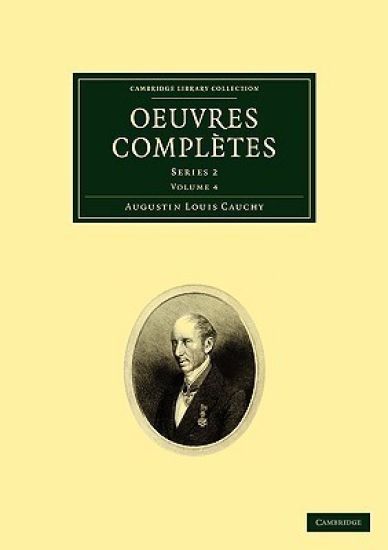
Oeuvres complètes

Oeuvres complètes

Augustin-Louis Cauchy

Cambridge University Press
2009
pokkari
Augustin-Louis, Baron Cauchy (1789–1857) was the pre-eminent French mathematician of the nineteenth century. He began his career as a military engineer during the Napoleonic Wars, but even then was publishing significant mathematical papers, and was persuaded by Lagrange and Laplace to devote himself entirely to mathematics. His greatest contributions are considered to be the Cours d'analyse de l'École Royale Polytechnique (1821), Résumé des leçons sur le calcul infinitésimal (1823) and Leçons sur les applications du calcul infinitésimal à la géométrie (1826–8), and his pioneering work encompassed a huge range of topics, most significantly real analysis, the theory of functions of a complex variable, and theoretical mechanics. Twenty-six volumes of his collected papers were published between 1882 and 1958. The first series (volumes 1-12) consists of papers published by the Académie des Sciences de l'Institut de France; the second series (volumes 13-26) of papers published elsewhere.