Kirjojen hintavertailu. Mukana 12 084 111 kirjaa ja 12 kauppaa.

Kirjahaku

Etsi kirjoja tekijän nimen, kirjan nimen tai ISBN:n perusteella.

27 kirjaa tekijältä Avner Friedman

Mathematics in Industrial Problems

Mathematics in Industrial Problems

Avner Friedman

Springer-Verlag New York Inc.
1996
sidottu
This is the eighth volume in the series "Mathematics in Industrial Prob­ lems." The motivation for these volumes is to foster interaction between Industry and Mathematics at the "grass roots level"; that is, at the level of specific problems. These problems come from Industry: they arise from models developed by the industrial scientists in ventures directed at the manufacture of new or improved products. At the same time, these prob­ lems have the potential for mathematical challenge and novelty. To identify such problems, I have visited industries and had discussions with their scientists. Some of the scientists have subsequently presented their problems in the IMA Seminar on Industrial Problems. The book is based on the seminar presentations and on questions raised in subsequent discussions. Each chapter is devoted to one of the talks and is self-contained. The chapters usually provide references to the mathematical literature and a list of open problems that are of interest to industrial scientists. For some problems, a partial solution is indicated briefly. The last chapter of the book contains a short description of solutions to some of the problems raised in the previous volume, as well as references to papers in which such solutions have been published.

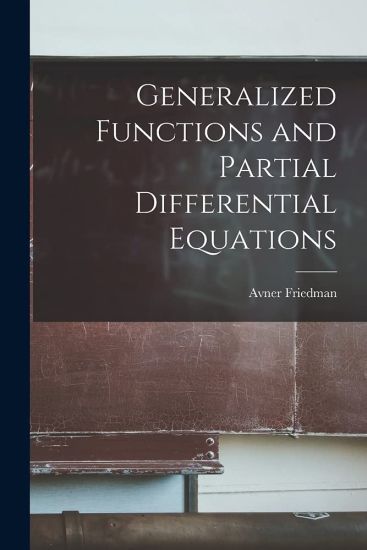
Generalized Functions and Partial Differential Equations

Generalized Functions and Partial Differential Equations

Avner Friedman

Dover Publications Inc.
2006
pokkari
This self-contained treatment develops the theory of generalized functions and the theory of distributions, and it systematically applies them to a variety of problems in partial differential equations. Based on material included in the books of L. Schwartz, who developed the theory of distributions, and of Gelfand and Shilov, who deal with generalized functions and their use in solving the Cauchy problem, the text incorporates the author's own research. Geared toward upper-level undergraduates and graduate students, it covers the Cauchy and Goursat problems, fundamental solutions, existence and differentiality of solutions of equations with constants, coefficients, and related topics. 1963 ed.
Generalized Functions and Partial Differential Equations
This work has been selected by scholars as being culturally important and is part of the knowledge base of civilization as we know it.This work is in the public domain in the United States of America, and possibly other nations. Within the United States, you may freely copy and distribute this work, as no entity (individual or corporate) has a copyright on the body of the work.Scholars believe, and we concur, that this work is important enough to be preserved, reproduced, and made generally available to the public. To ensure a quality reading experience, this work has been proofread and republished using a format that seamlessly blends the original graphical elements with text in an easy-to-read typeface.We appreciate your support of the preservation process, and thank you for being an important part of keeping this knowledge alive and relevant.
Generalized Functions and Partial Differential Equations
This work has been selected by scholars as being culturally important and is part of the knowledge base of civilization as we know it.This work is in the public domain in the United States of America, and possibly other nations. Within the United States, you may freely copy and distribute this work, as no entity (individual or corporate) has a copyright on the body of the work.Scholars believe, and we concur, that this work is important enough to be preserved, reproduced, and made generally available to the public. To ensure a quality reading experience, this work has been proofread and republished using a format that seamlessly blends the original graphical elements with text in an easy-to-read typeface.We appreciate your support of the preservation process, and thank you for being an important part of keeping this knowledge alive and relevant.
Mathematics in Industrial Problems

Mathematics in Industrial Problems

Avner Friedman

Springer-Verlag New York Inc.
2012
nidottu
This is the eighth volume in the series "Mathematics in Industrial Prob­ lems." The motivation for these volumes is to foster interaction between Industry and Mathematics at the "grass roots level"; that is, at the level of specific problems. These problems come from Industry: they arise from models developed by the industrial scientists in ventures directed at the manufacture of new or improved products. At the same time, these prob­ lems have the potential for mathematical challenge and novelty. To identify such problems, I have visited industries and had discussions with their scientists. Some of the scientists have subsequently presented their problems in the IMA Seminar on Industrial Problems. The book is based on the seminar presentations and on questions raised in subsequent discussions. Each chapter is devoted to one of the talks and is self-contained. The chapters usually provide references to the mathematical literature and a list of open problems that are of interest to industrial scientists. For some problems, a partial solution is indicated briefly. The last chapter of the book contains a short description of solutions to some of the problems raised in the previous volume, as well as references to papers in which such solutions have been published.
Mathematics in Industrial Problems

Mathematics in Industrial Problems

Avner Friedman

Springer-Verlag New York Inc.
2011
nidottu
This is the sixth volume in the series "Mathematics in Industrial Prob­ lems. " The motivation for these volumes is to foster interaction between Industry and Mathematics at the "grass roots level"; that is, at the level of specific problems. These problems come from Industry: they arise from models developed by the industrial scientists in ventures directed at the manufacture of new or improved products. At the same time, these prob­ lems have the potential for mathematical challenge and novelty. To identify such problems, I have visited industries and had discussions with their scientists. Some of the scientists have subsequently presented their problems in the IMA Seminar on Industrial Problems. The book is based on the seminar presentations and on questions raised in subse­ quent discussions. Each chapter is devoted to one of the talks and is self­ contained. The chapters usually provide references to the mathematical literature and a list of open problems which are of interest to the industrial scientists. For some problems a partial solution is indicated briefly. The last chapter of the book contains a short description of solutions to some of the problems raised in previous volumes, as well as references to papers in which such solutions have been published. The speakers in the seminar on Industrial Problems have given us at the IMA hours of delight and discovery. My thanks to Thomas Hoffend (3M), John Spence (Eastman Kodak Company), Marius Orlowski (Mo­ torola, Inc. ), Robert J.
Mathematics in Industrial Problems

Mathematics in Industrial Problems

Avner Friedman

Springer-Verlag New York Inc.
2011
nidottu
This is the seventh volume in the series "Mathematics in Industrial Prob­ lems. " The motivation for these volumes is to foster interaction between Industry and Mathematics at the "grass roots level;" that is, at the level of specific problems. These problems come from Industry: they arise from models developed by the industrial scientists in ventures directed at the manufacture of new or improved products. At the same time, these prob­ lems have the potential for mathematical challenge and novelty. To identify such problems, I have visited industries and had discussions with their scientists. Some of the scientists have subsequently presented their problems in the IMA Seminar on Industrial Problems. The book is based on the seminar presentations and on questions raised in subse­ quent discussions. Each chapter is devoted to one of the talks and is self­ contained. The chapters usually provide references to the mathematical literature and a list of open problems which are of interest to the industrial scientists. For some problems a partial solution is indicated briefly. The last chapter of the book contains a short description of solutions to some of the problems raised in previous volumes, as well as references to papers in which such solutions have been published. The speakers in the Seminar on Industrial Problems have given us at the IMA hours of delight and discovery. My thanks to David K. Lambert (Gen­ eral Motors Research and Development), David S.

Mathematics in Industrial Problems

Mathematics in Industrial Problems

Avner Friedman

Springer-Verlag New York Inc.
2011
nidottu
This is the third volume in the series "Mathematics in Industrial Prob­ lems." The motivation for these volumes is to foster interaction between Industry and Mathematics at the "grass roots"; that is, at the level of spe­ cific problems. These problems come from Industry: they arise from models developed by the industrial scientists in ventures directed at the manufac­ ture of new or improved products. At the same time, these problems have the potential for mathematical challenge and novelty. To identify such problems, I have visited industries and had discussions with their scientists. Some of the scientists have subsequently presented their problems in the IMA seminar on Industrial Problems. The book is based on questions raised in the seminar and subsequent discussions. Each chapter is devoted to one of the talks and is self-contained. The chap­ ters usually provide references to the mathematical literature and a list of open problems which are of interest to the industrial scientists. For some problems partial solution is indicated briefly. The last chapter of the book contains a short description of solutions to some of the problems raised in the second volume, as well as references to papers in which such solutions have been published.

Mathematics in Industrial Problems

Mathematics in Industrial Problems

Avner Friedman

Springer-Verlag New York Inc.
2011
nidottu
This is the fourth volume in the series "Mathematics in Industrial Prob­ lems." The motivation for these volumes is to foster interaction between Industry and Mathematics at the "grass roots"; that is, at the level of spe­ cific problems. These problems come from Industry: they arise from models developed by the industrial scientists in ventures directed at the manufac­ ture of new or improved products. At the same time, these problems have the potential for mathematical challenge and novelty. To identify such problems, I have visited industries and had discussions with their scientists. Some of the scientists have subsequently presented their problems in the IMA Seminar on Industrial Problems. The book is based on questions raised in the seminar and subsequent discussions. Each chapter is devoted to one of the talks and is self-contained. The chap­ ters usually provide references to the mathematical literature and a list of open problems which are of interest to the industrial scientists. For some problems partial solution is indicated briefly. The last chapter of the book contains a short description of solutions to some of the problems raised in the third volume, as well as references to papers in which such solutions have been published.
Mathematics in Industrial Problems

Mathematics in Industrial Problems

Avner Friedman

Springer-Verlag New York Inc.
2012
nidottu
Building a bridge between mathematicians and industry is both a chal­ lenging task and a valuable goal for the Institute for Mathematics and its Applications (IMA). The rationale for the existence of the IMA is to en­ courage interaction between mathematicians and scientists who use math­ ematics. Some of this interaction should evolve around industrial problems which mathematicians may be able to solve in "real time." Both Industry and Mathematics benefit: Industry, by increase of mathematical knowledge and ideas brought to bear upon their concerns, and Mathematics, through the infusion of exciting new problems. In the past ten months I have visited numerous industries and national laboratories, and met with several hundred scientists to discuss mathe­ matical questions which arise in specific industrial problems. Many of the problems have special features which existing mathematical theories do not encompass; such problems may open new directions for research. However, I have encountered a substantial number of problems to which mathemati­ cians should be able to contribute by providing either rigorous proofs or formal arguments. The majority of scientists with whom I met were engineers, physicists, chemists, applied mathematicians and computer scientists. I have found them eager to share their problems with the mathematical community. Often their only recourse with a problem is to "put it on the computer." However, further insight could be gained by mathematical analysis.
Mathematics in Industrial Problems

Mathematics in Industrial Problems

Avner Friedman

Springer-Verlag New York Inc.
2012
nidottu
This is the second volume in the series "Mathematics in Industrial Prob­ lems." The motivation for both volumes is to foster inter action between Industry and Mathematics at the "grass roots"; that is at the level of spe­ cific problems. These problems come from Industry: they arise from models developed by the industrial scientists in venture directed at the manufac­ ture of new or improved products. At the same time, these problems have the potential for mathematical challenge and novelty. To identify such problems, I have visited industries and had discussions with their scientists. Some of the scientists have subsequently presented their problems in the IMA seminar on Industrial Problems. The book is based on questions raised in the seminar and subsequent discussions. Each chapter is devoted to one of the talks and is self-contained. The chap­ ters usually provide references to the mathematical literat ure and a list of open problems which are of interest to the industrial scientists. For some problems partial solution is indicated brießy. The last chapter of the book contains a short description of solutions to some of the problems raised in the first volume, as weIl as references to papers in which such solutions have been published. The experience of the last two years demonstrates a growing fruitful interaction between Industry and Mathematics. This interaction benefits Industry by increasing the mathematical knowledge and ideas brought to bear upon its concern, and benefits Mathematics through the infusion of exciting new problems.

Mathematics in Industrial Problems

Mathematics in Industrial Problems

Avner Friedman

Springer-Verlag New York Inc.
2012
nidottu
Developed from the cooperation between mathematicians and industrial scientists on the "grass roots" level of specific problems, this book is the most recent in a collection of self-contained volumes which present industrial problems to mathematicians. Topics include: imaging and visualization, diffusion in glassy and swelling polymers, composite materials, plastic flows, coating of fiber optics, communications, colloidal dispersion, stress in semiconductors, micromagnetics, photobleaching, and machine vision. Many chapters offer open problems and references, while the last chapter contains solutions to problems raised in previous volumes of Mathematics in Industrial Problems, Parts 2, 3, and 4, published in the IMA series as Volumes 24, 31, and 38 respectively.
Foundations of Modern Analysis

Foundations of Modern Analysis

Avner Friedman; Patrick Suppes

Dover Publications Inc.
2008
nidottu
Measure and integration, metric spaces, the elements of functional analysis in Banach spaces, and spectral theory in Hilbert spaces — all in a single study. Only book of its kind. Unusual topics, detailed analyses. Problems. Excellent for first-year graduate students, almost any course on modern analysis. Preface. Bibliography. Index.
Industrial Mathematics a Course in Solving Real-World Problems

Industrial Mathematics a Course in Solving Real-World Problems

Avner Friedman; Walter Littman

Society for Industrial Applied Mathematics,U.S.
1993
pokkari
Are calculus and "post" calculus (such as differential equations) playing an important role in research and development done in industry? Are these mathematical tools indispensable for improving industrial products such as automobiles, airplanes, televisions, and cameras? Do they play a role in understanding air pollution, predicting weather and stock market trends, and building better computers and communication systems? This book was written to convince the reader, by examples, that the answer to all the above questions is YES! Industrial mathematics is a fast growing field within the mathematical sciences. It is characterized by the origin of the problems that it engages; they all come from industry: research and development, finances, and communications. The common feature running through this enterprise is the goal of gaining a better understanding of industrial models and processes through mathematical ideas and computations. The authors of this book have undertaken the approach of presenting real industrial problems and their mathematical modeling as a motivation for developing mathematical methods that are needed for solving the problems.Each chapter presents and studies, by mathematical analysis and computations, one important problem that arises in today's industry. This book introduces the reader to many new ideas and methods from ordinary and partial differential equations, integral equations, and control theory. It brings the excitement of real industrial problems into the undergraduate mathematical curriculum. The problems selected are accessible to students who have taken the first two-year basic calculus sequence. A working knowledge of Fortran, Pascal, or C language is required.
Mathematical Modeling of Biological Processes

Mathematical Modeling of Biological Processes

Avner Friedman; Chiu-Yen Kao

Springer International Publishing AG
2014
nidottu
This book on mathematical modeling of biological processes includes a wide selection of biological topics that demonstrate the power of mathematics and computational codes in setting up biological processes with a rigorous and predictive framework. Topics include: enzyme dynamics, spread of disease, harvesting bacteria, competition among live species, neuronal oscillations, transport of neurofilaments in axon, cancer and cancer therapy, and granulomas. Complete with a description of the biological background and biological question that requires the use of mathematics, this book is developed for graduate students and advanced undergraduate students with only basic knowledge of ordinary differential equations and partial differential equations; background in biology is not required. Students will gain knowledge on how to program with MATLAB without previous programming experience and how to use codes in order to test biological hypothesis.