Kirjojen hintavertailu. Mukana 11 699 587 kirjaa ja 12 kauppaa.

Kirjahaku

Etsi kirjoja tekijän nimen, kirjan nimen tai ISBN:n perusteella.

44 kirjaa tekijältä Axel Honneth

Fiche de lecture La Lutte pour la reconnaissance de Honneth (Analyse philosophique de référence et résumé complet)
La collection Conna tre une oeuvre vous offre la possibilit de tout savoir de La Lutte pour la reconnaissance, de Axel Honneth, gr ce une fiche de lecture aussi compl te que d taill e. La r daction, claire et accessible, a t confi e un sp cialiste universitaire. Cette fiche de lecture r pond une charte qualit mise en place par une quipe d'enseignants. Ce livre contient la biographie de Axel Honneth, la pr sentation de l'oeuvre, le r sum d taill , les raisons du succ s, les th mes principaux et l' tude du courant philosophique de l'auteur.
Pathologies of Reason

Pathologies of Reason

Axel Honneth

Columbia University Press
2009
sidottu
Axel Honneth has been instrumental in advancing the work of the Frankfurt School of critical theorists, rebuilding their effort to combine radical social and political analysis with rigorous philosophical inquiry. These eleven essays published over the past five years reclaim the relevant themes of the Frankfurt School, which counted Theodor W. Adorno, Max Horkheimer, Walter Benjamin, Jurgen Habermas, Franz Neumann, and Albrecht Wellmer as members. They also engage with Kant, Freud, Alexander Mitscherlich, and Michael Walzer, whose work on morality, history, democracy, and individuality intersects with the Frankfurt School's core concerns. Collected here for the first time in English, Honneth's essays pursue the unifying themes and theses that support the methodologies and thematics of critical social theory, and they address the possibilities of continuing this tradition through radically changed theoretical and social conditions. According to Honneth, there is a unity that underlies critical theory's multiple approaches: the way in which reason is both distorted and furthered in contemporary capitalist society. And while much is dead in the social and psychological doctrines of critical social theory, its central inquiries remain vitally relevant. Is social progress still possible after the horrors of the twentieth century? Does capitalism deform reason and, if so, in what respects? Can we justify the relationship between law and violence in secular terms, or is it inextricably bound to divine justice? How can we be free when we're subject to socialization in a highly complex and in many respects unfree society? For Honneth, suffering and moral struggle are departure points for a new "reconstructive" form of social criticism, one that is based solidly in the empirically grounded, interdisciplinary approach of the Frankfurt School.
Pathologies of Reason

Pathologies of Reason

Axel Honneth

Columbia University Press
2023
pokkari
Axel Honneth has been instrumental in advancing the work of the Frankfurt School of critical theorists, rebuilding their effort to combine radical social and political analysis with rigorous philosophical inquiry. These eleven essays reclaim the relevant themes of the Frankfurt School, which counted Theodor W. Adorno, Max Horkheimer, Walter Benjamin, Jürgen Habermas, Franz Neumann, and Albrecht Wellmer as members. They also engage with Kant, Freud, Alexander Mitscherlich, and Michael Walzer, whose work on morality, history, democracy, and individuality intersects with the Frankfurt School's core concerns.Collected here for the first time in English, Honneth's essays pursue the unifying themes and theses that support the methodologies and thematics of critical social theory, and they address the possibilities of continuing this tradition through radically changed theoretical and social conditions. According to Honneth, there is a unity that underlies critical theory's multiple approaches: the way in which reason is both distorted and furthered in contemporary capitalist society. And while much is dead in the social and psychological doctrines of critical social theory, its central inquiries remain vitally relevant. Is social progress still possible after the horrors of the twentieth century? Does capitalism deform reason and, if so, in what respects? Can we justify the relationship between law and violence in secular terms, or is it inextricably bound to divine justice? How can we be free when we're subject to socialization in a highly complex and in many respects unfree society? For Honneth, suffering and moral struggle are departure points for a new "reconstructive" form of social criticism, one that is based solidly in the empirically grounded, interdisciplinary approach of the Frankfurt School.

Freedom's Right: The Social Foundations of Democratic Life
Theories of justice often fixate on purely normative, abstract principles unrelated to real-world situations. The philosopher and theorist Axel Honneth addresses this disconnect, and constructs a theory of justice derived from the normative claims of Western liberal-democratic societies and anchored in morally legitimate laws and institutionally established practices. Honneth's paradigm-which he terms "a democratic ethical life"-draws on the spirit of Hegel's Philosophy of Right and his own theory of recognition, demonstrating how concrete social spheres generate the tenets of individual freedom and a standard for what is just. Using social analysis to re-found a more grounded theory of justice, he argues that all crucial actions in Western civilization, whether in personal relationships, market-induced economic activities, or the public forum of politics, share one defining characteristic: they require the realization of a particular aspect of individual freedom. This fundamental truth informs the guiding principles of justice, enabling a wide-ranging reconsideration of its nature and application.
Freedom's Right

Freedom's Right

Axel Honneth

Columbia University Press
2015
nidottu
Theories of justice often fixate on purely normative, abstract principles unrelated to real-world situations. The philosopher and theorist Axel Honneth addresses this disconnect, and constructs a theory of justice derived from the normative claims of Western liberal-democratic societies and anchored in morally legitimate laws and institutionally established practices. Honneth's paradigm-which he terms "a democratic ethical life"-draws on the spirit of Hegel's Philosophy of Right and his own theory of recognition, demonstrating how concrete social spheres generate the tenets of individual freedom and a standard for what is just. Using social analysis to re-found a more grounded theory of justice, he argues that all crucial actions in Western civilization, whether in personal relationships, market-induced economic activities, or the public forum of politics, share one defining characteristic: they require the realization of a particular aspect of individual freedom. This fundamental truth informs the guiding principles of justice, enabling a wide-ranging reconsideration of its nature and application.
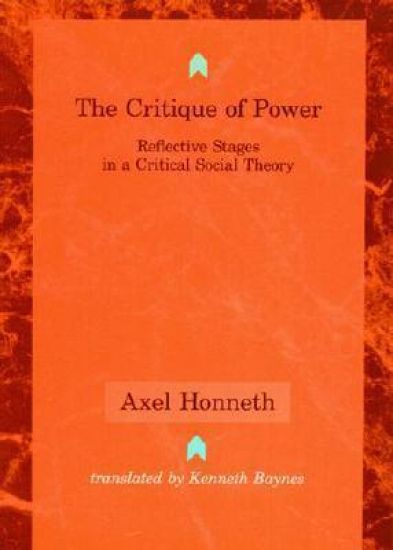
The Critique of Power

The Critique of Power

Axel Honneth

MIT Press
1993
pokkari
In this interpretation of the history of critical theory, the author aims to clarify critical theory's central problems and emphasizes the social factors that should provide it with a normative and practical orientation.
The Pathologies of Individual Freedom

The Pathologies of Individual Freedom

Axel Honneth

Princeton University Press
2010
sidottu
This is a penetrating reinterpretation and defense of Hegel's social theory as an alternative to reigning liberal notions of social justice. The eminent German philosopher Axel Honneth rereads Hegel's Philosophy of Right to show how it diagnoses the pathologies of the overcommitment to individual freedom that Honneth says underlies the ideas of Rawls and Habermas alike. Honneth argues that Hegel's theory contains an account of the psychological damage caused by placing too much emphasis on personal and moral freedom. Although these freedoms are crucial to the achievement of justice, they are insufficient and in themselves leave people vulnerable to loneliness, emptiness, and depression. Hegel argues that people must also find their freedom or "self-realization" through shared projects. Such projects involve the three institutions of ethical life--family, civil society, and the state--and provide the arena of a crucial third kind of freedom, which Honneth calls "communicative" freedom. A society is just only if it gives all of its members sufficient and equal opportunity to realize communicative freedom as well as personal and moral freedom.
The Pathologies of Individual Freedom

The Pathologies of Individual Freedom

Axel Honneth

Princeton University Press
2016
pokkari
This is a penetrating reinterpretation and defense of Hegel's social theory as an alternative to reigning liberal notions of social justice. The eminent German philosopher Axel Honneth rereads Hegel's Philosophy of Right to show how it diagnoses the pathologies of the overcommitment to individual freedom that Honneth says underlies the ideas of Rawls and Habermas alike. Honneth argues that Hegel's theory contains an account of the psychological damage caused by placing too much emphasis on personal and moral freedom. Although these freedoms are crucial to the achievement of justice, they are insufficient and in themselves leave people vulnerable to loneliness, emptiness, and depression. Hegel argues that people must also find their freedom or "self-realization" through shared projects. Such projects involve the three institutions of ethical life--family, civil society, and the state--and provide the arena of a crucial third kind of freedom, which Honneth calls "communicative" freedom. A society is just only if it gives all of its members sufficient and equal opportunity to realize communicative freedom as well as personal and moral freedom.
Disrespect

Disrespect

Axel Honneth

Polity Press
2007
sidottu
Over the last decade, Axel Honneth has established himself as one of the leading social and political philosophers in the world today. Rooted in the tradition of critical theory, his writings have been central to the revitalization of critical theory and have become increasingly influential. His theory of recognition has gained worldwide attention and is seen by some as the principal counterpart to Habermass theory of discourse ethics. In this important new volume, Honneth pursues his path-breaking work on recognition by exploring the moral experiences of disrespect that underpin the conduct of social and political critique. What we might conceive of as a striving for social recognition initially appears in a negative form as the experience of humiliation or disrespect. Honneth argues that disrespect constitutes the systematic key to a comprehensive theory of recognition that seeks to clarify the sense in which institutionalized patterns of social recognition generate justified demands on the way subjects treat each other. This new book by one of the leading social and political philosophers of our time will be of particular interest to students and scholars in social and political theory and philosophy.
Disrespect

Disrespect

Axel Honneth

Polity Press
2007
nidottu
Over the last decade, Axel Honneth has established himself as one of the leading social and political philosophers in the world today. Rooted in the tradition of critical theory, his writings have been central to the revitalization of critical theory and have become increasingly influential. His theory of recognition has gained worldwide attention and is seen by some as the principal counterpart to Habermass theory of discourse ethics. In this important new volume, Honneth pursues his path-breaking work on recognition by exploring the moral experiences of disrespect that underpin the conduct of social and political critique. What we might conceive of as a striving for social recognition initially appears in a negative form as the experience of humiliation or disrespect. Honneth argues that disrespect constitutes the systematic key to a comprehensive theory of recognition that seeks to clarify the sense in which institutionalized patterns of social recognition generate justified demands on the way subjects treat each other. This new book by one of the leading social and political philosophers of our time will be of particular interest to students and scholars in social and political theory and philosophy.
The I in We

The I in We

Axel Honneth

Polity Press
2012
sidottu
In this volume Axel Honneth deepens and develops his highly influential theory of recognition, showing how it enables us both to rethink the concept of justice and to offer a compelling account of the relationship between social reproduction and individual identity formation. Drawing on his reassessment of Hegel’s practical philosophy, Honneth argues that our conception of social justice should be redirected from a preoccupation with the principles of distributing goods to a focus on the measures for creating symmetrical relations of recognition. This theoretical reorientation has far-reaching implications for the theory of justice, as it obliges this theory to engage directly with problems concerning the organization of work and with the ideologies that stabilize relations of domination. In the final part of this volume Honneth shows how the theory of recognition provides a fruitful and illuminating way of exploring the relation between social reproduction and identity formation. Rather than seeing groups as regressive social forms that threaten the autonomy of the individual, Honneth argues that the ‘I’ is dependent on forms of social recognition embodied in groups, since neither self-respect nor self-esteem can be maintained without the supportive experience of practising shared values in the group. This important new book by one of the leading social philosophers of our time will be of great interest to students and scholars in philosophy, sociology, politics and the humanities and social sciences generally.
The I in We

The I in We

Axel Honneth

Polity Press
2012
nidottu
In this volume Axel Honneth deepens and develops his highly influential theory of recognition, showing how it enables us both to rethink the concept of justice and to offer a compelling account of the relationship between social reproduction and individual identity formation. Drawing on his reassessment of Hegel’s practical philosophy, Honneth argues that our conception of social justice should be redirected from a preoccupation with the principles of distributing goods to a focus on the measures for creating symmetrical relations of recognition. This theoretical reorientation has far-reaching implications for the theory of justice, as it obliges this theory to engage directly with problems concerning the organization of work and with the ideologies that stabilize relations of domination. In the final part of this volume Honneth shows how the theory of recognition provides a fruitful and illuminating way of exploring the relation between social reproduction and identity formation. Rather than seeing groups as regressive social forms that threaten the autonomy of the individual, Honneth argues that the ‘I’ is dependent on forms of social recognition embodied in groups, since neither self-respect nor self-esteem can be maintained without the supportive experience of practising shared values in the group. This important new book by one of the leading social philosophers of our time will be of great interest to students and scholars in philosophy, sociology, politics and the humanities and social sciences generally.
Freedom's Right

Freedom's Right

Axel Honneth

Polity Press
2014
sidottu
The theory of justice is one of the most intensely debated areas of contemporary philosophy. Most theories of justice, however, have only attained their high level of justification at great cost. By focusing on purely normative, abstract principles, they become detached from the sphere that constitutes their “field of application” - namely, social reality. Axel Honneth proposes a different approach. He seeks to derive the currently definitive criteria of social justice directly from the normative claims that have developed within Western liberal democratic societies. These criteria and these claims together make up what he terms “democratic ethical life”: a system of morally legitimate norms that are not only legally anchored, but also institutionally established. Honneth justifies this far-reaching endeavour by demonstrating that all essential spheres of action in Western societies share a single feature, as they all claim to realize a specific aspect of individual freedom. In the spirit of Hegel’s Philosophy of Right and guided by the theory of recognition, Honneth shows how principles of individual freedom are generated which constitute the standard of justice in various concrete social spheres: personal relationships, economic activity in the market, and the political public sphere. Honneth seeks thereby to realize a very ambitious aim: to renew the theory of justice as an analysis of society.
Freedom's Right

Freedom's Right

Axel Honneth

Polity Press
2014
nidottu
The theory of justice is one of the most intensely debated areas of contemporary philosophy. Most theories of justice, however, have only attained their high level of justification at great cost. By focusing on purely normative, abstract principles, they become detached from the sphere that constitutes their “field of application” - namely, social reality. Axel Honneth proposes a different approach. He seeks to derive the currently definitive criteria of social justice directly from the normative claims that have developed within Western liberal democratic societies. These criteria and these claims together make up what he terms “democratic ethical life”: a system of morally legitimate norms that are not only legally anchored, but also institutionally established. Honneth justifies this far-reaching endeavour by demonstrating that all essential spheres of action in Western societies share a single feature, as they all claim to realize a specific aspect of individual freedom. In the spirit of Hegel’s Philosophy of Right and guided by the theory of recognition, Honneth shows how principles of individual freedom are generated which constitute the standard of justice in various concrete social spheres: personal relationships, economic activity in the market, and the political public sphere. Honneth seeks thereby to realize a very ambitious aim: to renew the theory of justice as an analysis of society.
The Fragmented World of the Social

The Fragmented World of the Social

Axel Honneth

State University of New York Press
1995
pokkari
The essays in this book weave together insights and arguments from such diverse traditions as German critical theory, French philosophy and social theory, and recent Anglo-American moral and political theory, offering a unique approach to the political and theoretical consequences of the modernism/postmodernism discussion. Through an analysis of central themes in classical Marxism and early critical theory, the author shows how recent work in a variety of traditions converges on the need to question familiar distinctions between material production and culture, the public and the private, and the political and the social, and to reconsider the conceptions of agency and power that have informed them.
Recognition

Recognition

Axel Honneth

Cambridge University Press
2020
pokkari
The idea that we are mutually dependent on the recognition of our peers is at least as old as modernity. Across Europe, this idea has been understood in different ways from the very beginning, according to each country's different cultural and political conditions. This stimulating study explores the complex history and multiple associations of the idea of 'Recognition' in Britain, France and Germany. Demonstrating the role of 'recognition' in the production of important political ideas, Axel Honneth explores how our dependence on the recognition of others is sometimes viewed as the source of all modern, egalitarian morality, sometimes as a means for fostering socially beneficial behavior, and sometimes as a threat to 'true' individuality. By exploring this fundamental concept in our modern political and social self-understanding, Honneth thus offers an alternative view of the philosophical discourse of modernity.