

Kirjahaku
Etsi kirjoja tekijän nimen, kirjan nimen tai ISBN:n perusteella.
549 kirjaa tekijältä BERNARD SHAW
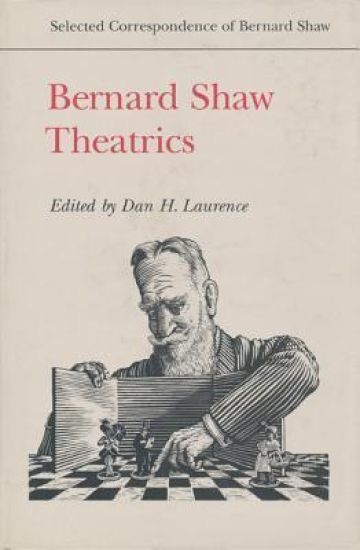
In his introduction Dan H. Laurence notes that 'theatrics' connotes not only activities of a theatrical character but behaviour that manifests itself as theatricality. All the correspondence selected for this volume - most of it hitherto unpublished - relates to Bernard Shaw's theatre dealings and theatrical interest, at the same time attesting to the 'histrionic instinct' and 'theatrified imagination' (his own phrases) of the man who penned them. More than one hundred letters are represented, starting from mid-1889, when Shaw had not yet completed his first play and was known instead as a music critic, journalist, socialist organizer, and street orator. The letters reveal a consummate man of the theatre: a dramatist, director, actor, designer, publicist, financial backer, translator, and critic concerned with such varied issues as censorship, theatre politics, prying journalists, and wireless and television performance. The letters are shaded with histrionic tones of assumed anger, irritation, and anguish. The style invariably is colloquial, free-flowing, ebullient - and personal.

Bernard Shaw was twenty-four and Sidney Webb twenty-one when they met in October 1880 at a gathering of a debating club called the Zetetical Society. Having sympathetic interests, both men decided, after some personal and joint exploration, to devote their lives to improving the human condition. This collection of 140 annotated letters, 74 of which have never been published, documents the subsequent friendship and collaboration shared by Shaw, Webb, and Webb's wife Beatrice, throughout their lives. The letters, written between 1883 and 1946, discuss the founding of the Fabian Society, the British Labour Party, the London School of Economics, and the New Statesman through the Boer, First, and Second World Wars. Fully annotated with headnotes and footnotes, this collection will expand the general view of Shaw the dramatist to incorporate Shaw the political activist and lifelong friend of the Webbs.

A Little Talk on America: What Bernard Shaw Told the Americans about Russia!
Bernard Shaw
Literary Licensing, LLC
2011
nidottu

Three Plays For Puritans By Bernard Shaw Being The Third Volume Of His Collected Plays
Bernard Shaw
Kessinger Pub
2004
pokkari

Three Plays for Puritans by Bernard Shaw: Being the Third Volume of His Collected Plays
Bernard Shaw
Literary Licensing, LLC
2014
nidottu

The Wisdom Of Bernard Shaw: Being Passages From The Works Of Bernard Shaw
Bernard Shaw
Literary Licensing, LLC
2014
nidottu

An attractive and approachable selection of the work of George Bernard Shaw. One of the most remarkable writers of the 20th century, Shaw contributed in a range of ways to both political and social writings as well as creating great works of literature. Shaw is one of only two people to have won both an Academy Award and a Nobel Prize for Literature. Shaw started from the most unpropitious of beginnings. But he possessed a steely self-determination, and turned the unshakeable conviction that he would become a great writer into a self-fulfilling prophecy. This book features selections and extracts from his plays, essays and personal letters.

Bernard Shaw's Preface to Androcles and the Lion
Bernard Shaw
Createspace Independent Publishing Platform
2017
nidottu
The question seems a hopeless one after 2000 years of resolute adherence to the old cry of "Not this man, but Barabbas." Yet it is beginning to look as if Barabbas was a failure, in spite of his strong right hand, his victories, his empires, his millions of money, and his moralities and churches and political constitutions. "This man" has not been a failure yet; for nobody has ever been sane enough to try his way. But he has had one quaint triumph. Barabbas has stolen his name and taken his cross as a standard. There is a sort of compliment in that. There is even a sort of loyalty in it, like that of the brigand who breaks every law and yet claims to be a patriotic subject of the king who makes them. We have always had a curious feeling that though we crucified Christ on a stick, he somehow managed to get hold of the right end of it, and that if we were better men we might try his plan. There have been one or two grotesque attempts at it by inadequate people, such as the Kingdom of God in Munster, which was ended by crucifixion so much more atrocious than the one on Calvary that the bishop who took the part of Annas went home and died of horror. But responsible people have never made such attempts. The moneyed, respectable, capable world has been steadily anti-Christian and Barabbasque since the crucifixion; and the specific doctrine of Jesus has not in all that time been put into political or general social practice.

Bernard Shaw Selected Plays With Perefaces is an unchanged, high-quality reprint of the original edition of 1898. Hansebooks is editor of the literature on different topic areas such as research and science, travel and expeditions, cooking and nutrition, medicine, and other genres. As a publisher we focus on the preservation of historical literature. Many works of historical writers and scientists are available today as antiques only. Hansebooks newly publishes these books and contributes to the preservation of literature which has become rare and historical knowledge for the future.
On the Prospects of Christianity; Bernard Shaw's Preface to Androcles and the Lion
Bernard Shaw
Outlook Verlag
2023
pokkari

On the Prospects of Christianity; Bernard Shaw's Preface to Androcles and the Lion
Bernard Shaw
Outlook Verlag
2023
sidottu

On the Prospects of Christianity; Bernard Shaw's Preface to Androcles and the Lion
Bernard Shaw
Megali Verlag
2023
pokkari
Reproduction of the original. The publishing house Megali specialises in reproducing historical works in large print to make reading easier for people with impaired vision.

On the Prospects of Christianity; Bernard Shaw's Preface to Androcles and the Lion
Bernard Shaw
Megali Verlag
2023
sidottu
Reproduction of the original. The publishing house Megali specialises in reproducing historical works in large print to make reading easier for people with impaired vision.

Dramatic Opinions And Essays, With An Apology; Containing As Well A Word On The Dramatic Opinions And Essays Of Bernard Shaw (Volume I)
Bernard Shaw
Alpha Edition
2020
pokkari

On the Prospects of Christianity; Bernard Shaw's Preface to Androcles and the Lion
Bernard Shaw
Antigonos Verlag
2025
nidottu


Bernard Shaw and H.G. Wells are among the best-known and most controversial literary figures of the twentieth century. Both were rebelliously critical of the social and political, familial and sexual conventions and structures of their time. They shared broadly similar interests, but their lifestyles differed sharply - as did their views on many subjects, including those discussed in their correspondence: religion, socialism, science, war and world history, the theatre, the profession of authorship, and more. The letters are always forthright, often abusive and quarrelsome, sometimes suggesting that the relationship cannot last. They are also often warm, good-natured, playful, and generous - reflecting a fundamental mutual respect and similarity of outlook, however contrasting the temperament and style. The great majority of the two writers' correspondence is published here for the first time. This volumes comprises the personal correspondence of Shaw and Wells through the course of their friendship of more than forty years, and includes and introductory essay by J. Percy Smith. The letters are fully annotated, and are accompanied by information about the circumstances under which each was written, to enable the reader to follow the course of the frequently tempestuous relationship.

Bernard Shaw and Gabriel Pascal
Gabriel Pascal; Bernard Shaw
University of Toronto Press
1996
sidottu
After movie-makers in England bungled film versions of Bernard Shaw's How He Lied to Her Husband and Arms and the Man, producers and directors in Germany and Holland botched those based on Pygmalion, and a Hollywood screenplay desecrated The Devil's Disciple, Shaw took a chance on Gabriel Pascal and gave him permission to produce a movie version of Pygmalion in England. The contract was signed on 13 December 1935 and Pascal, a charming, flamboyant Hungarian emigre with relatively little experience in cinema, did the playwright proud. Shaw's gamble paid off in this Pygmalion, which, to this day, is usually claimed to be the best film version of any of his plays. This first collection of the correspondence of Bernard Shaw and Gabriel Pascal contains 268 letters, the greatest portion of which have not been previously published. They provide an intimate, behind-the-scenes view of the film industry's day-to-day workings and of the art of movie-making, from the signing of the first contract between Shaw and Pascal, to Shaw's death in 1950. The letters reveal the great extent to which Pascal, unlike his predecessors, scrupulously kept Shaw informed of what he did. We learn about whom Pascal negotiated with, the merits of association with certain individuals or businesses, contract problems, the backbiting and backstabbing of the industry, difficulties with casting, and progress throughout the filming. Shaw accepted and embellished some of Pascal's ideas for production, and vehemently disagreed with others. Their correspondence highlights the differences in personality between the two men. Shaw was ever the astute businessman, while Pascal was the eager artist. Shaw the methodical mastermind contrasted sharply with Pascal the entrepreneur with many projects under development, few of which came to fruition. Most important, however, the letters, postal cards, and telegrams collected here reveal how Pascal fought for the integrity of Shavian cinema; how, as a director, he tried to create films that were true to their dramatic sources; and how, in partnership with Pascal, Shaw's cinematic writings flourished.