Kirjojen hintavertailu. Mukana 11 699 587 kirjaa ja 12 kauppaa.

Kirjahaku

Etsi kirjoja tekijän nimen, kirjan nimen tai ISBN:n perusteella.

4 kirjaa tekijältä Bailey Van Hook

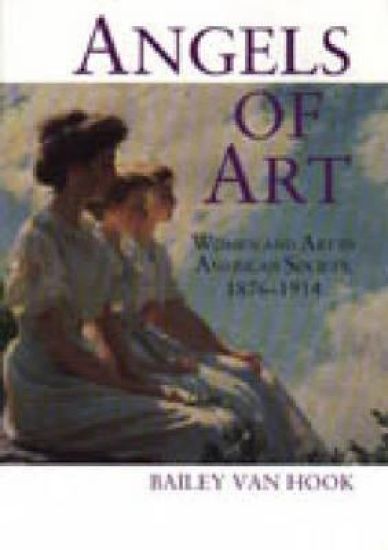
Angels of Art

Angels of Art

Bailey Van Hook

Pennsylvania State University Press
1997
sidottu
Images of women were ubiquitous in America at the turn of the last century. In painting and sculpture, they took on a bewildering variety of identities, from Venus, Ariadne, and Diana to Law, Justice, the Arts, and Commerce. Bailey Van Hook argues here that the artists' concepts of art coincided with the construction of gender in American culture. She finds that certain characteristics such as "ideal," "beautiful," "decorative," and "pure" both describe this art and define the perceived role of women in American society at the time. Most late nineteenth-century American artists had trained in Paris, where they learned to use female imagery as a pictorial language of provocative sensuality. Van Hook first places the American artists in an international context by discussing the works of their French teachers, including Jean-Léon Gérôme and Alexandre Cabanel. She goes on to explore why they soon had to distance themselves from that context, primarily because their art was perceived as either openly sensual or too obliquely foreign by American audiences. Van Hook delineates the modes of representation the American painters chose, which ranged from the more traditional allegorical or mythological subjects to a decorative figure painting indebted to Whistler. Changing American culture ultimately rejected these idealized female images as too genteel and, eventually, too academic and European.Angels of Art is the first study to discuss the predominance of images of women across stylistic boundaries and within the wider context of European art. It relies heavily on contemporary sources both to document critical responses and to find intersecting patterns in attitudes toward women and art.
Angels of Art

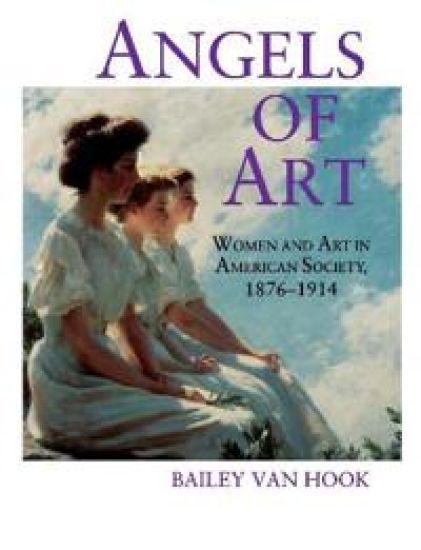
Angels of Art

Bailey Van Hook

Pennsylvania State University Press
1996
pokkari
Images of women were ubiquitous in America at the turn of the last century. In painting and sculpture, they took on a bewildering variety of identities, from Venus, Ariadne, and Diana to Law, Justice, the Arts, and Commerce. Bailey Van Hook argues here that the artists' concepts of art coincided with the construction of gender in American culture. She finds that certain characteristics such as "ideal," "beautiful," "decorative," and "pure" both describe this art and define the perceived role of women in American society at the time. Most late nineteenth-century American artists had trained in Paris, where they learned to use female imagery as a pictorial language of provocative sensuality. Van Hook first places the American artists in an international context by discussing the works of their French teachers, including Jean-Léon Gérôme and Alexandre Cabanel. She goes on to explore why they soon had to distance themselves from that context, primarily because their art was perceived as either openly sensual or too obliquely foreign by American audiences. Van Hook delineates the modes of representation the American painters chose, which ranged from the more traditional allegorical or mythological subjects to a decorative figure painting indebted to Whistler. Changing American culture ultimately rejected these idealized female images as too genteel and, eventually, too academic and European.Angels of Art is the first study to discuss the predominance of images of women across stylistic boundaries and within the wider context of European art. It relies heavily on contemporary sources both to document critical responses and to find intersecting patterns in attitudes toward women and art.
The Virgin and the Dynamo

The Virgin and the Dynamo

Bailey Van Hook

Ohio University Press
2003
sidottu
The beaux-arts mural movement in America was fueled by energetic young artists and architects returning from training abroad. They were determined to transform American art and architecture to make them more thematically cosmopolitan and technically fluid and accomplished. The movement slowly coalesced around the decoration of mansions of the Gilded Age elite, mostly in New York, and of public buildings and institutions across the breadth of the country. The Virgin and the Dynamo: Public Murals in American Architecture, 1893-1917 is the first book in almost a century to concentrate exclusively on the beaux-arts mural movement in the United States. Beginning with a short history of the movement from its inception in Boston during the American Renaissance, Bailey Van Hook focuses on the movement's public manifestations in the period between the World's Columbian Exposition in Chicago in 1893 and the First World War. Professor Van Hook explores different aspects of the mural movement, the concept and meaning of "decoration," the claim that murals are inherently democratic, the shift in preference from allegory to history, the gendered concept of modernity, the ideologies behind the iconography, and, finally, the decline of the movement when it began to be seen as old fashioned and anachronistic. The Virgin and the Dynamo raises our understanding of the beaux-arts movement to a new level. For the general reader, this illustrated history will explain many familiar representations of local and national values.
Violet Oakley

Violet Oakley

Bailey Van Hook

University of Delaware Press
2016
sidottu
Violet Oakley: An Artist's Life is the first full-length biography of Violet Oakley (1874–1961), the only major female artist of the beaux-arts mural movement in the United States, as well as an illustrator, stained glass artist, portraitist and author. There is much human interest here: a pampered and spoiled young woman who suddenly finds herself in near poverty, forced to make a living in illustration to support her parents; a sensitive and idealistic young woman who, in a desperate attempt to save her neurasthenic father, embraces Christian Science, a religion derided by her family and friends; a 28 year old woman who receives one of the plum commissions of the era, a mural cycle in the Pennsylvania State Capitol, in a field dominated by much older and predominantly male artists; a woman in her forties who although professionally successful finds herself very much alone and bonds with her student, Edith Emerson; a friend of artists like dancer Ruth St. Denis and violinist Albert Spalding who nevertheless was supremely conscious of social mores, the “Miss Oakley” of the Social Register who preferred the company of upper class to bohemian society; the tireless self-promoter who traveled abroad to become the unofficial visual historian of the League of Nations yet who ironically was increasingly regarded as a local artist.