Kirjojen hintavertailu. Mukana 12 083 983 kirjaa ja 12 kauppaa.

Kirjahaku

Etsi kirjoja tekijän nimen, kirjan nimen tai ISBN:n perusteella.

8 kirjaa tekijältä Barbara Herman

Kantian Commitments

Kantian Commitments

Barbara Herman

Oxford University Press
2022
sidottu
Kantian Commitments comprises ten essays that represent a series of efforts to rethink many of the fundamentals of Kant's ethics and to draw out some implications for moral theory and practice. The essays of Part One revisit and revise central pieces of Kant's moral framework, offering a new understanding of the formulas of the categorical imperative, revisiting the idea of exceptions to duties, and sharpening the contrast between the value commitments of Kantian theory and other deontologies (especially recent contractualisms). The working hypothesis is to take seriously the idea that the formulas of the categorical imperative frame an account of moral reasoning with standards of validity and soundness that enable moral judgment to explicate the connection between our rational natures and our duties. Part Two takes on some less central but important topics which are informed by the arguments of Part One: the rationale for Kant's moralized view of history; the implications of a Kantian view of morality for social pluralism; the fit of Kant's conception of moral psychology with affect-centered theories of human development; the motivation behind Kant's argument for indirect duties to animals; and the place of the idea of the highest good in a morally good life. The overall aim of the essays is to explore core Kantian commitments through a program of inquiry that peels away assumptions often brought to Kant's texts that introduce questions their arguments were not meant to answer. Removing these obstacles clarifies the ambition and scale of Kantian theory.

The Moral Habitat

The Moral Habitat

Barbara Herman

Oxford University Press
2021
sidottu
In The Moral Habitat, Barbara Herman offers a new and systematic interpretation of Kant's moral and political philosophy. The study begins with an investigation of some understudied imperfect duties which, surprisingly, tell us some important but generally unnoticed facts about what it is to be a moral agent. The second part of the book launches a substantial reinterpretation of Kant's ethics as a system of duties, juridical and ethical, perfect and imperfect, that can incorporate what we learn from imperfect duties and do much more. This system of duties provides the structure for what Herman calls a moral habitat: a made environment, created by and for free and equal persons living together. It is a dynamic system, with duties from different spheres shaping and being affected by each other, each level further interpreting its core anti-subordination value. In the final part, Herman takes up some implications and applications of this moral habitat idea. From considering what would be involved, morally, in recognizing a human right to housing to some meta-ethical issues about objectivity and our responsibility for moral change, we come to appreciate the resources of this holistic agent-centered Kantian view of morality.
The Moral Habitat

The Moral Habitat

Barbara Herman

Oxford University Press
2023
nidottu
In The Moral Habitat, Barbara Herman offers a new and systematic interpretation of Kant's moral and political philosophy. The study begins with an investigation of some understudied imperfect duties which, surprisingly, tell us some important but generally unnoticed facts about what it is to be a moral agent. The second part of the book launches a substantial reinterpretation of Kant's ethics as a system of duties, juridical and ethical, perfect and imperfect, that can incorporate what we learn from imperfect duties and do much more. This system of duties provides the structure for what Herman calls a moral habitat: a made environment, created by and for free and equal persons living together. It is a dynamic system, with duties from different spheres shaping and being affected by each other, each level further interpreting its core anti-subordination value. In the final part, Herman takes up some implications and applications of this moral habitat idea, developing the resources of this holistic agent-centered Kantian view of morality by considering what would be involved, morally, in recognizing a human right to housing to meta-ethical issues about objectivity and our responsibility for moral change.
Kantian Commitments

Kantian Commitments

Barbara Herman

Oxford University Press
2024
nidottu
Kantian Commitments comprises ten essays that represent a series of efforts to rethink many of the fundamentals of Kant's ethics and to draw out some implications for moral theory and practice. In Part One, Herman revisits and revises central pieces of Kant's moral framework, offering a new understanding of the formulas of the categorical imperative, revisiting the idea of exceptions to duties, and sharpening the contrast between the value commitments of Kantian theory and other deontologies (especially recent contractualisms). The working hypothesis is to take seriously the idea that the formulas of the categorical imperative frame an account of moral reasoning with standards of validity and soundness which enable moral judgment to explicate the connection between our rational natures and our duties. Part Two takes on some less central but important topics which are informed by the arguments of Part One: the rationale for Kant's moralized view of history; the implications of a Kantian view of morality for social pluralism; the fit of Kant's conception of moral psychology with affect-centered theories of human development; the motivation behind Kant's argument for indirect duties to animals; and the place of the idea of the highest good in a morally good life. Throughout, Herman aims to explore core Kantian commitments through a program of inquiry that peels away layers of assumption often brought to Kant's texts. Removing these obstacles clarifies the ambition and scale of Kantian theory.

Moral Literacy

Moral Literacy

Barbara Herman

Harvard University Press
2008
nidottu
A distinguished moral philosopher and a leading interpreter of Kant's ethics, Barbara Herman draws on Kant to address timeless issues in ethical theory as well as ones arising from current moral problems, such as obligations to distant need, the history of slavery as it bears on affirmative action, and the moral costs of reparative justice. Challenging various Kantian orthodoxies, Herman offers a view of moral competency as a complex achievement, governed by rational norms and dependent on supportive social conditions. She argues that the objectivity of duties and obligations does not rule out the possibility of or need for moral invention. Her goal is not to revise Kant but to explore the issues and ask the questions that he did not consider. Some of the essays involve explicit interpretation of Kant, and others are prompted by ground-level questions. For example, how should we think about moral character given what we know about the fault lines in normal development? If ordinary moral life is saturated by the content of local institutions, how should our accounts of moral obligation and judgment accommodate this?
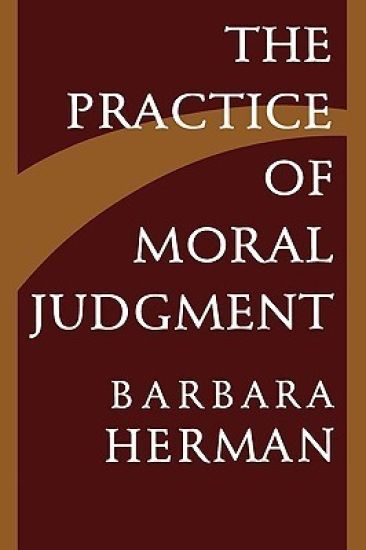
The Practice of Moral Judgment

The Practice of Moral Judgment

Barbara Herman

Harvard University Press
1996
nidottu
Barbara Herman argues for a radical shift in the way we perceive Kant's ethics. She convincingly reinterprets the key texts, at once allowing Kant to mean what he says while showing that what Kant says makes good moral sense. She urges us to abandon the tradition that describes Kantian ethics as a deontology, a moral system of rules of duty. She finds the central idea of Kantian ethics not in duty but in practical rationality as a norm of unconditioned goodness. This book both clarifies Kant's own theory and adds programmatic vitality to modern moral philosophy.
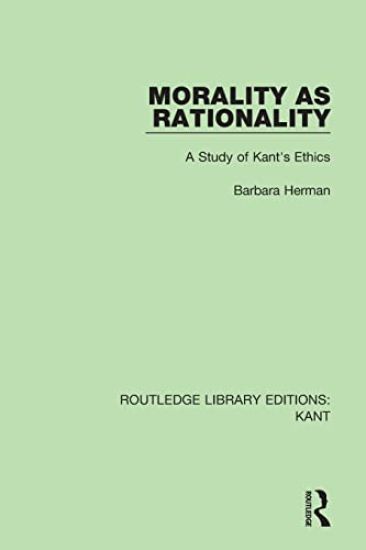
Morality as Rationality

Morality as Rationality

Barbara Herman

Routledge
2016
sidottu
First published in 1990. The aim of this thesis is to show that the way to understand the central claims of Kant’s ethics is to accept the idea that morality is a distinctive form of rationality; that the moral "ought" belongs to a system of imperatives based in practical reason; and that moral judgment, therefore, is a species of rational assessment of agents’ actions. It argues, in effect, that you cannot understand Kant’s views about morality if you read him with Humean assumptions about rationality. This title will be of interest to students of philosophy.
Morality as Rationality

Morality as Rationality

Barbara Herman

Routledge
2017
nidottu
First published in 1990. The aim of this thesis is to show that the way to understand the central claims of Kant’s ethics is to accept the idea that morality is a distinctive form of rationality; that the moral "ought" belongs to a system of imperatives based in practical reason; and that moral judgment, therefore, is a species of rational assessment of agents’ actions. It argues, in effect, that you cannot understand Kant’s views about morality if you read him with Humean assumptions about rationality. This title will be of interest to students of philosophy.