Kirjojen hintavertailu. Mukana 11 342 296 kirjaa ja 12 kauppaa.

Kirjahaku

Etsi kirjoja tekijän nimen, kirjan nimen tai ISBN:n perusteella.

10 kirjaa tekijältä Barbara Kellerman

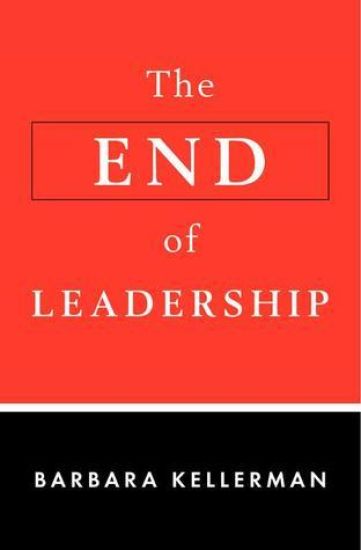
The End of Leadership

The End of Leadership

Barbara Kellerman

HarperBusiness
2012
sidottu
Over the past thirty years, leadership has become a mantra in our culture - a path to power and money, a road to personal and professional success, and a mechanism for creating change that has spawned its own lucrative worldwide industry. Yet why does government remain riddled with inept, corrupt, or badly behaved leaders? Why is business filled with leaders who are venal, self-centered, and seek more power and influence than they can exercise wisely and well? Why, for all attention to ethics, is corruption and malfeasance so pervasive? "The End of Leadership" offers a critical rethinking of the "leadership industry", challenging the idea that leadership can be taught. Breaking with common wisdom, Barbara Kellerman argues that while leaders always were and still are the focus of our collective attention, they have never been as central to success as we think. Even in times past, when leaders had far more power, authority, and influence, they were vulnerable to forces beyond their control, forces that limited their options and constrained their behaviors. In the twenty-first century, she argues, these forces are stronger, more variegated, and more numerous than they ever were before, relegating current notions of leadership to the dustbin of history. Instead, she offers an alternative model that better reflects - and addresses - contemporary political and organizational realities.
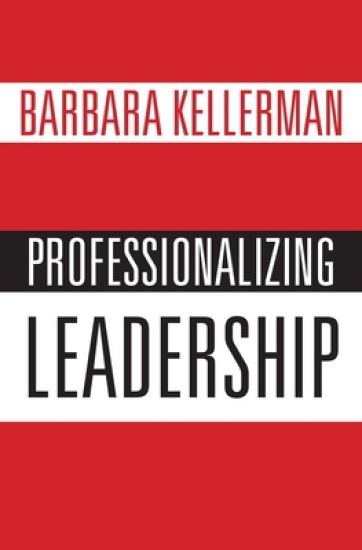
Professionalizing Leadership

Professionalizing Leadership

Barbara Kellerman

Oxford University Press Inc
2018
sidottu
Over the last 40 years, the leadership industry has grown exponentially. Yet leadership education, training, and development still fall far short. Moreover, leaders are demeaned, degraded, and derided as they never were before. Why? The problem is leadership has stayed stuck. It has remained an occupation instead of becoming a profession. Unlike medicine and law, leadership has no core curriculum considered essential. It has no widely agreed on metric, or criteria for qualification. And it has no professional association to oversee the conduct of its members or assure minimum standards. Professionalizing Leadership looks to a past in which learning to lead was the most important of eruditions. It looks to a present in which learning to lead is as effortless as ubiquitous. And it looks to a future in which learning to be a leader might look different altogether - it might resemble the far more rigorous process of learning to be a doctor or a lawyer. As it stands now, the military is the only major American institution that gets it right. It assumes leadership is a profession that requires those who practice it to be taught in accordance with high professional standards. Barbara Kellerman draws on the military experience specifically to develop a template for learning how to lead generally. Leadership in the first quarter of the present century is different from what it was even in the last quarter of the past century - which is why leadership taught casually and carelessly should no longer suffice. Professionalizing Leadership addresses precisely the problem of how to prepare leaders in accordance with professional norms. It provides the template necessary for transforming leadership from dubious occupation to respectable profession.
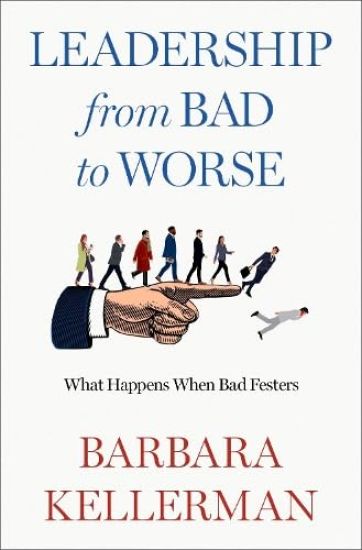
Leadership from Bad to Worse

Leadership from Bad to Worse

Barbara Kellerman

OXFORD UNIVERSITY PRESS INC
2024
sidottu
Leadership from Bad to Worse is about how leadership that is bad, invariably, inexorably, gets worse--unless it is somehow, by someone or something, stopped or slowed. The process of going from bad to worse tends to be steady, as opposed to hasty. But once bad burrows in, it digs in. It digs in deeper and then deeper, making it difficult finally to extract or excise without getting rid of whoever and whatever is involved. This work draws on four cases of bad leadership--two in political leadership, two in business leadership--to show how it goes from bad to worse. Kellerman finds that bad leadership and bad followership go through four phases of development: 1) Onward and Upward; 2) Followers Join In; 3) Leaders Start In; and 4) Bad to Worse. These findings correctly suggest that the book, in addition to being of theoretical interest, is of practical import. It is intended, deliberately, to serve as an early warning system. By breaking bad leadership and followership into phases--each more ominous and ultimately dangerous than the one preceding--their progression will be easier to predict and detect. And easier, therefore, to slow or, preferably, to stop before they turn toxic. Bad leadership is a social disease. But unlike diseases that are physical or psychological, it remains at the margins of our collective concerns. Leadership from Bad to Worse is, then, a corrective. Knowing that bad leadership can be checked before it corrupts is knowing that bad and then worse can be, if not completely precluded, then sometimes short-circuited.
Reinventing Leadership

Reinventing Leadership

Barbara Kellerman

State University of New York Press
1999
pokkari
In a striking departure from past practices, Barbara Kellerman explores the fact that although we persist in viewing political and business leadership separately, the similarities between them far outweigh the differences. Kellerman claims that thinking of government and corporate leaders as a breed apart contributes to the dysfunctional gap between them, and she argues that in order to tackle those political, economic, and social problems that are the most intractable, political and business leaders will have no choice but to work together.
Hard Times

Hard Times

Barbara Kellerman

Stanford University Press
2014
sidottu
Leadership has never played a more prominent role in America's national discourse, and yet our opinions of leaders are at all-time lows. Private sector leaders are widely seen as greedy to the point of being corrupt. Public sector leaders are viewed as incompetent to the point of being inept. And, levels of trust in government have plummeted. As the title of this book conveys, leaders in America are experiencing hard times. Barbara Kellerman argues that we focus on leaders, and even on followers, while ignoring an essential element of leadership: context. This book is a corrective. It enables leaders to track the terrain that they must navigate in order to create change. Rather than a handy-dandy manual on what to do and how to do it, Hard Times is structured as a checklist. Twenty-four brief sections cover key aspects of the American landscape. They trace evolutions and revolutions that have revised our norms, transformed our populations and institutions, and shifted our culture. Kellerman's crash course on context reveals how significant it is to leadership. Clearer still is the fact that leadership is more difficult than it has ever been. It is context that explains why leadership is so fraught with frustration. And, it is context that makes evident why leadership will be better exercised if it is better understood. Calling out patterns that emerge from the checklist, Kellerman challenges leaders to do better. This fascinating read will change the way that all of us think about leadership, while compelling us to consider what it means for our future.
The Enablers

The Enablers

Barbara Kellerman

Cambridge University Press
2021
sidottu
The COVID-19 pandemic will forever be remembered as a pivotal event in American history. Written by one of the world's foremost experts on leadership and followership, this book centers on the first six months of the pandemic and the crises that ran rampant. The chapters focus less on the former president, Donald Trump, than on his followers: on people complicit in his miserable mismanagement of the crisis in public health. Barbara Kellerman provides clear and compelling evidence that Trump was not entirely to blame for everything that went wrong. Many others were responsible including his base, party, administration, inner circle, Republican elites, members of the media, and even medical experts. Far too many surrendered to the president's demands, despite it being obvious his leadership was fatally flawed. The book testifies to the importance of speaking truth to power, and a willingness to take risks properly to serve the public interest.
LEADERSHIP

LEADERSHIP

Barbara Kellerman

McGraw-Hill Education
2023
nidottu
"Bravo to Barbara Kellerman! Building upon a lifetime of scholarship and upon a popular course she has created at Harvard, Kellerman brings between the covers of a single volume the world's classic literature on leadership. Every thoughtful leader will find deep, rich rewards here." -- David Gergen, Director, Center for Public Leadership Harvard Kennedy School, Former Presidential Adviser Bolster your leadership literacy—and improve your performance as a leader or manager.Leadership, says author, leadership expert, and Harvard Professor Barbara Kellerman, "is all about what leaders should learn—but it is decidedly not, deliberately not, about what leadership education has lately come to look like."Instead, Leadership is a concise yet expansive collection of great leadership literature that has stood the test of time. As Kellerman makes clear in her extensive, authoritative commentaries, every single selection has had, and continues to have, an impact on how and what we think about what it means to lead. And every single one has had an impact on leadership as an area of intellectual inquiry—as well as on the course of human history.Part I of Leadership consists of writings about leadership:Lao Tzu—on how to lead lightly Plato—on tyrants and philosopher-kings Machiavelli—on the preservation of powerIn Part II, you'll find examples of what Kellerman uniquely identifies as writing as leadership—works and words that thanks to their persuasiveness and power, changed the world:Thomas Paine—Common Sense Elizabeth Cady Stanton—"Declaration of Sentiments"Rachel Carson—Silent SpringPart III presents leaders in action—individuals who seized the moment to captivate, motivate, and lead with their singular personal power to persuade:Abraham Lincoln—on war and redemption Elizabeth I—on gender and power Vaclav Havel—on the power of the powerlessThe selections themselves, each a classic of the leadership literature, together with Kellerman's expert commentary, make Leadership required reading for those who want to learn about, reflect on, and even apply the greatest leadership literature lessons, ever.Barbara Kellerman is the James MacGregor Burns Lecturer in Public Leadership at Harvard University's John F. Kennedy School of Government. Her writing has appeared in The New York Times, The Washington Post, The Boston Globe, The Los Angeles Times, and Harvard Business Review, and she has appeared on CBS, NBC, NPR, and CNN. She is author and editor of many books on leadership, most recently Bad Leadership and Followership. Kellerman is ranked by Forbes.com as among the "Top 50 Business Thinkers" (2009), and by Leadership Excellence in the top 15 of 100 "best minds on leadership" (2008-2009).
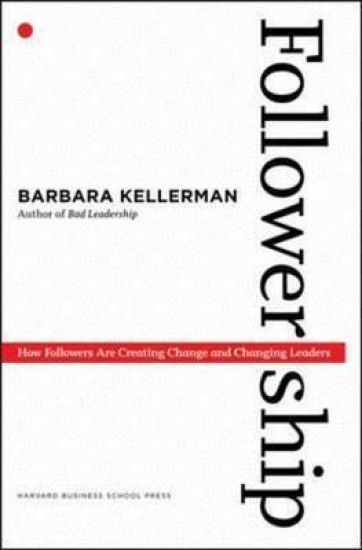
Followership

Followership

Barbara Kellerman

Harvard Business Review Press
2008
sidottu
The author of Bad Leadership introduces a new leadership model that considers the increasingly vital roles of followers in relation to their leaders, examining five different types of followers in terms of how they relate to their leaders as well as to each other, and assesses the influence of followers on the leaders.
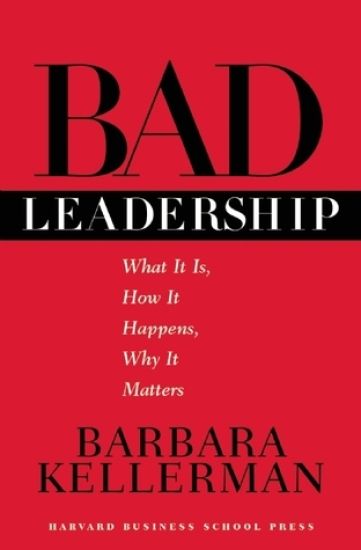
Bad Leadership

Bad Leadership

Barbara Kellerman

Harvard Business Review Press
2004
sidottu
How is Saddam Hussein like Tony Blair? Or Kenneth Lay like Lou Gerstner? Answer: They are, or were, leaders. Many would argue that tyrants, corrupt CEOs, and other abusers of power and authority are not leaders at all--at least not as the word is currently used. But, according to Barbara Kellerman, this assumption is dangerously naive. A provocative departure from conventional thinking, Bad Leadership compels us to see leadership in its entirety. Kellerman argues that the dark side of leadership--from rigidity and callousness to corruption and cruelty--is not an aberration. Rather, bad leadership is as ubiquitous as it is insidious--and so must be more carefully examined and better understood. Drawing on high-profile, contemporary examples--from Mary Meeker to David Koresh, Bill Clinton to Radovan Karadzic, Al Dunlap to Leona Helmsley--Kellerman explores seven primary types of bad leadership and dissects why and how leaders cross the line from good to bad. The book also illuminates the critical role of followers, revealing how they collaborate with, and sometimes even cause, bad leadership. Daring and counterintuitive, Bad Leadership makes clear that we need to face the dark side to become better leaders and followers ourselves. Barbara Kellerman is research director of the Center for Public Leadership and a lecturer in public policy at the Kennedy School of Government, Harvard University.
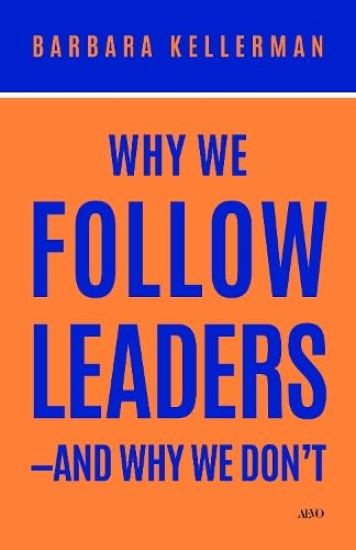
Why We Follow and Why Sometimes We Do not

Why We Follow and Why Sometimes We Do not

Barbara Kellerman

UNIVERSITY OF TORONTO PRESS
2026
sidottu
This groundbreaking book investigates the human tendency to follow, as well as the occasional defiance of this norm. This is the first work to focus not on why people with power and authority behave as they do, but on why people without respond as they do. Leadership is a relationship. There is no leader without at least one follower. Still, notwithstanding their essential importance – especially to leaders – followers are largely ignored. This book is a corrective: followers are placed in the foreground, and leaders in the background. First, Barbara Kellerman focuses on the rewards and punishments that prompt us to go along with the leader and conform to the group. Next, she highlights what motivates some individuals some of the time to do the opposite. Finally, she demonstrates that the human condition is submission: obedience is typical, while resistance is atypical. Drawing upon the latest research in business, government, psychology, philosophy, religion, education, and the sciences, Kellerman’s accessible inquiry will be of interest to readers across disciplines and practices. This latest publication by globally renowned expert Barbara Kellerman is a vital and fresh contribution to the leadership field. Moreover, this book about followers and followership is a critical companion to any book about leaders and leadership.