Kirjojen hintavertailu. Mukana 11 342 296 kirjaa ja 12 kauppaa.

Kirjahaku

Etsi kirjoja tekijän nimen, kirjan nimen tai ISBN:n perusteella.

3 kirjaa tekijältä Barry Bozeman

Science Competes

Science Competes

Barry Bozeman

MIT PRESS LTD
2025
nidottu
When science competes with myriad influences in public policymaking, how can we ensure that it does so effectively? Policymakers, like most people today, have a world of information within easy reach, much of it wrong. How, amidst the chaos and misdirection of our day's information ecosystem, can science compete for the attention and trust of those who make public policy--especially at a time when issues like proliferating infectious diseases and climate change put a premium on accurate and relevant scientific information? What's needed, Barry Bozeman suggests in Science Competes, is a clearer understanding of how scientific information is conveyed, how it is understood and used, and where it fits in the wide array of information that might be of use to those who make and administer policy, laws, and regulations, as well as citizens who actively participate in public life. Acknowledging the importance of different sorts of information--historical, experiential, political, e.g.--to decision making, Bozeman focuses on enhancing, not maximizing, the effective use of science in public policy. This entails recognizing that valid and useful scientific information is not necessarily formal scientific knowledge, but often takes the form of science by-products such as raw or structured data, graphics, and conceptual models. Explaining how such information can be better distinguished from half-truths and pernicious falsehoods, Science Competes also raises the possibility that effective competition might require improvements in science institutions, norms, and ideas about acceptable behavior.
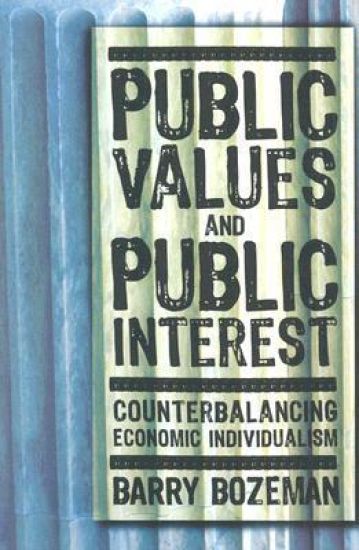
Public Values and Public Interest

Public Values and Public Interest

Barry Bozeman

Georgetown University Press
2007
pokkari
Economic individualism and market-based values dominate today's policymaking and public management circles - often at the expense of the common good. In his new book, Barry Bozeman demonstrates the continuing need for public interest theory in government. "Public Values and Public Interest" offers a direct theoretical challenge to the "utility of economic individualism," the prevailing political theory in the western world. The book's arguments are steeped in a practical and practicable theory that advances public interest as a viable and important measure in any analysis of policy or public administration. According to Bozeman, public interest theory offers a dynamic and flexible approach that easily adapts to changing situations and balances today's market-driven attitudes with the concepts of common good advocated by Aristotle, Saint Thomas Aquinas, John Locke, and John Dewey. In constructing the case for adopting a new governmental paradigm based on what he terms "managing publicness," Bozeman demonstrates why economic indices alone fail to adequately value social choice in many cases. He explores the implications of privatization of a wide array of governmental services - among them Social Security, defense, prisons, and water supplies. Bozeman constructs analyses from both perspectives in an extended study of genetically modified crops to compare the policy outcomes using different core values and questions the public value of engaging in the practice solely for the sake of cheaper food. Thoughtful, challenging, and timely, "Public Values and Public Interest" shows how the quest for fairness can once again play a full part in public policy debates and public administration.