Kirjojen hintavertailu. Mukana 12 016 292 kirjaa ja 12 kauppaa.

Kirjahaku

Etsi kirjoja tekijän nimen, kirjan nimen tai ISBN:n perusteella.

6 kirjaa tekijältä Barry Latzer

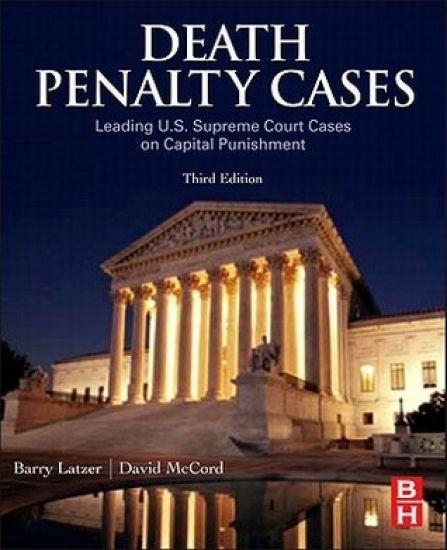
Death Penalty Cases

Death Penalty Cases

Barry Latzer

Butterworth-Heinemann Inc
2010
nidottu
Death Penalty Cases presents significant verbatim excerpts of death-penalty decisions from the United States Supreme Court. The first chapter introduces the topics discussed throughout the book. It also includes a detailed history of the death penalty in the United States. After this introduction, the remaining eighteen chapters are divided into five parts: Foundational Cases, Death-Eligible Crimes and Persons, The Death Penalty Trial, Post-Conviction Review, and Execution Issues. The first part, consisting of five chapters, talks about the mandatory death penalty, mitigating evidence and racial bias. The next part covers death-eligible crimes, such as rape and other crimes that do not involve homicide and murder. The middle part presents the trial process, from choosing the appropriate decision-makers through the sentencing decision. Followed by this is a chapter focusing on the aftermath of conviction, such as claims of innocence. The book concludes by exploring issues related to execution, such as not executing insane convicts. Finally, execution methods are presented.

State Constitutions and Criminal Justice

State Constitutions and Criminal Justice

Barry Latzer

Praeger Publishers Inc
1991
sidottu
The new Judicial Federalism is a significant development in American law: more cases are being decided by state constitutions than ever before in history. In this book, Barry Latzer provides the most thorough treatment available of the criminal law aspects of the New Federalism. His comprehensively researched and documented analysis of the state law movement covers all fifty states over the past two decades.Drawing from both legal and political science perspectives, Latzer examines recent court interpretations of state constitutions, specifically those pertaining to the criminally accused. He provides background on the development of the New Federalism, details the relationship between the U.S. Supreme Court and state courts, and analyzes all of the state constitutional provisions on the issues covered in the book. This is an important resource for professionals and students of criminal justice and law, and anyone concerned with the political-ideological tension between federal and state courts.
The Roots of Violent Crime in America

The Roots of Violent Crime in America

Barry Latzer

Louisiana State University Press
2021
sidottu
The Roots of Violent Crime in America is criminologist Barry Latzer's comprehensive analysis of crimes of violence-including murder, assault, and rape-in the United States from the 1880s through the 1930s. Combining the theoretical perspectives and methodological rigor of criminology with a synthesis of historical scholarship as well as original research and analysis, Latzer challenges conventional thinking about violent crime of this era. While scholars have traditionally cast American cities in the late nineteenth and early twentieth centuries as dreadful places, Latzer suggests that despite overcrowding and poverty, U.S. cities enjoyed low rates of violent crime, especially when compared to rural areas. The rural South and the thinly populated West both suffered much higher levels of brutal crime than the metropolises of the East and Midwest. Latzer deemphasizes racism and bigotry as causes of violence during this period, noting that while many social groups confronted significant levels of discrimination and abuse, only some engaged in high levels of violent crime. Cultural predispositions and subcultures of violence, he posits, led some groups to participate more frequently in violent activity than others. He also argues that the prohibition on alcohol in the 1920s did not drive up rates of violent crime. Though the bootlegger wars contributed considerably to the murder rate in some of America's largest municipalities, Prohibition also eliminated saloons, which served as hubs of vice, corruption, and lawlessness. The Roots of Violent Crime in America stands as a sweeping reevaluation of the causes of crimes of violence in the United States between the Gilded Age and World War II, compelling readers to rethink enduring assumptions on this contentious topic.
The Roots of Violent Crime in America

The Roots of Violent Crime in America

Barry Latzer

LOUISIANA STATE UNIVERSITY PRESS
2022
pokkari
The Roots of Violent Crime in America is criminologist Barry Latzer's comprehensive analysis of crimes of violence—including murder, assault, and rape—in the United States from the 1880s through the 1930s. Combining the theoretical perspectives and methodological rigor of criminology with a synthesis of historical scholarship as well as original research and analysis, Latzer challenges conventional thinking about violent crime of this era. While scholars have traditionally cast American cities in the late nineteenth and early twentieth centuries as dreadful places, Latzer suggests that despite overcrowding and poverty, U.S. cities enjoyed low rates of violent crime, especially when compared to rural areas. The rural South and the thinly populated West both suffered much higher levels of brutal crime than the metropolises of the East and Midwest. Latzer deemphasizes racism and bigotry as causes of violence during this period, noting that while many social groups confronted significant levels of discrimination and abuse, only some engaged in high levels of violent crime. Cultural predispositions and subcultures of violence, he posits, led some groups to participate more frequently in violent activity than others. He also argues that the prohibition on alcohol in the 1920s did not drive up rates of violent crime. Though the bootlegger wars contributed considerably to the murder rate in some of America's largest municipalities, Prohibition also eliminated saloons, which served as hubs of vice, corruption, and lawlessness. The Roots of Violent Crime in America stands as a sweeping reevaluation of the causes of crimes of violence in the United States between the Gilded Age and World War II, compelling readers to rethink enduring assumptions on this contentious topic.
The Rise and Fall of Violent Crime in America

The Rise and Fall of Violent Crime in America

Barry Latzer

Encounter Books,USA
2016
sidottu
A compelling case can be made that violent crime, especially in the period after the late 1960s, was one of the most significant domestic issues in the United States, and perhaps in the nations of the West generally. Aside from the movement for black civil rights, it is hard to think of a phenomenon that had as profound effect on American life in the last third of the 20th century. After 1965, crime rose to such levels that it frightened virtually all Americans and prompted significant alterations in everyday behaviors and even in lifestyles. The risk of being "mugged" became an issue when Americans chose places to live as well as schools for their children, when they selected commuter routes to work, and when they planned their leisure activities. In some locales, people were fearful of leaving their dwellings at any time, day or night, even to go to market. In the worst of the post-1960s crime wave, Americans spent part of each day literally looking back over their shoulders. The Rise and Fall of Violent Crime in America is the first book to comprehensively examine this important phenomenon over the entire postwar era. It combines a social history of the U.S. with the insights of criminology. This work examines the relationship between rising and falling crime and such historical developments as the postwar economic boom, suburbanization and the rise of the middle class, baby booms and busts, war and antiwar protest, the urbanization of minorities, etc.
The Rise and Fall of Violent Crime in America

The Rise and Fall of Violent Crime in America

Barry Latzer

Encounter Books,USA
2017
pokkari
A compelling case can be made that violent crime, especially after the 1960s, was one of the most significant domestic issues in the United States. Indeed, few issues had as profound an effect on American life in the last third of the twentieth century. After 1965, crime rose to such levels that it frightened virtually all Americans and prompted significant alterations in everyday behaviors and even lifestyles. The risk of being mugged was a concern when Americans chose places to live and schools for their children, selected commuter routes to work, and planned their leisure activities. In some locales, people were afraid to leave their dwellings at any time, day or night, even to go to the market. In the worst of the post-1960s crime wave, Americans spent part of each day literally looking back over their shoulders.The Rise and Fall of Violent Crime in America is the first book to comprehensively examine this important phenomenon over the entire postwar era. It combines a social history of the United States with the insights of criminology and examines the relationship between rising and falling crime and such historical developments as the postwar economic boom, suburbanization and the rise of the middle class, baby booms and busts, war and antiwar protest, the urbanization of minorities, and more.