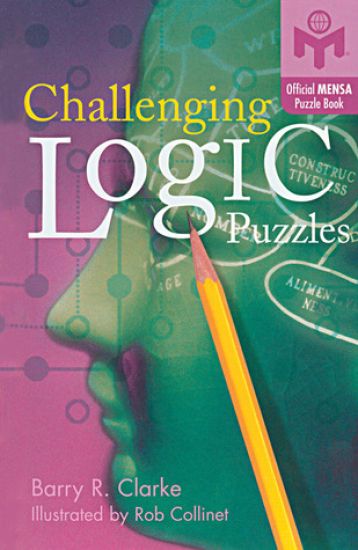
So you think you have the brain-power to tackle tough logic puzzles? Well, try this extraordinary assortment of challenges, including "Mix-and-Match" logic puzzles and "Find-the-Liar" type brain-teasers. Some puzzles have tables that can be used to deduce relationships between people or items. Some use wordplay to present the problem. Others use illustrations to highlight the challenge. Whatever their form, each is designed to stretch your mind to the maximum.
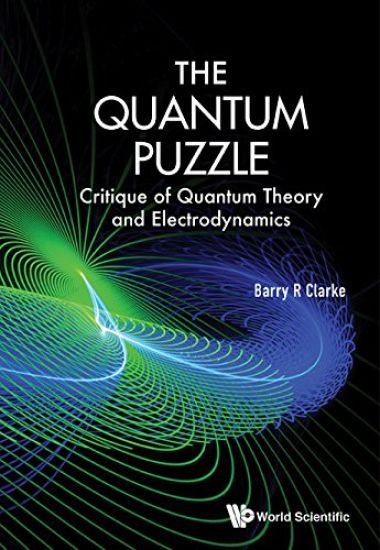
With clear illustrations throughout and without recourse to quantum mechanics, the reader is invited to revisit unsolved problems lying at the foundations of theoretical physics. Maxwell and his contemporaries abandoned their search for a geometrical representation of the electric and magnetic fields. The wave-particle dilemma and Bose-Einstein statistical counting have resulted in unsatisfactory non-realistic interpretations. Furthermore, a simple structure of the hydrogen atom that includes hyperfine levels is still wanting. Working with the latest experimental data in photoionics a proposed solution to the wave-particle dilemma is suggested based on an array of circular-polarized rays. The Bose–Einstein counting procedure is recast in terms of distinguishable elements. Finally, a vortex model of a 'particle' is developed based on a trapped photon. This consists of a single ray revolving around a toroidal surface, and allows a geometrical definition of mass, electric potential, and magnetic momentum. With the adjustment of two parameters, values to 4 dp for the hyperfine frequencies (MHz) of hydrogen can be obtained for which a computer program is available.
In 1861, James Clerk-Maxwell published Part II of his four-part series 'On physical lines of force'. In it, he attempted to construct a vortex model of the magnetic field but after much effort neither he, nor other late nineteenth century physicists who followed him, managed to produce a workable theory. What survived from these attempts were Maxwell's four equations of electrodynamics together with the Lorentz force law, formulae that made no attempt to describe an underlying reality but stood only as a mathematical description of the observed phenomena. When the quantum of action was introduced by Planck in 1900 the difficulties that had faced Maxwell's generation were still unresolved. Since then theories of increasing mathematical complexity have been constructed to attempt to bring the totality of phenomena into order with little success. This work examines the problems that had been abandoned long before quantum mechanics was formulated in 1925 and argues that these issues need to be revisited before real progress in the quantum theory of the electromagnetic field can be made.
In 1861, James Clerk-Maxwell published Part II of his four-part series 'On physical lines of force'. In it, he attempted to construct a vortex model of the magnetic field but after much effort neither he, nor other late nineteenth century physicists who followed him, managed to produce a workable theory. What survived from these attempts were Maxwell's four equations of electrodynamics together with the Lorentz force law, formulae that made no attempt to describe an underlying reality but stood only as a mathematical description of the observed phenomena. When the quantum of action was introduced by Planck in 1900 the difficulties that had faced Maxwell's generation were still unresolved. Since then theories of increasing mathematical complexity have been constructed to attempt to bring the totality of phenomena into order with little success. This work examines the problems that had been abandoned long before quantum mechanics was formulated in 1925 and argues that these issues need to be revisited before real progress in the quantum theory of the electromagnetic field can be made.