Kirjojen hintavertailu. Mukana 12 016 292 kirjaa ja 12 kauppaa.

Kirjahaku

Etsi kirjoja tekijän nimen, kirjan nimen tai ISBN:n perusteella.

16 kirjaa tekijältä Bartosz Adamczewski

Q or not Q?

Q or not Q?

Bartosz Adamczewski

Peter Lang AG
2010
sidottu
The study analyses the current state of research on the synoptic problem and proves that the Synoptic Gospels were written in the Mark, Luke, Matthew order of direct literary dependence. Moreover, the work demonstrates that the Synoptic Gospels are results of systematic, sequential, hypertextual reworking of the contents of the Pauline letters. Accordingly, the so-called ‘Q source’ turns out to be an invention of nineteenth-century scholars with their Romantic hermeneutic presuppositions. Demonstration of the fact that the Gospels are not records of the activity of the historical Jesus but that they narratively illustrate the identity of Christ as it has been revealed in the person and life of Paul the Apostle will certainly have major consequences for the whole Christian theology.
Heirs of the Reunited Church

Heirs of the Reunited Church

Bartosz Adamczewski

Peter Lang AG
2010
sidottu
The work establishes the relative and absolute chronology of Paul’s life. It demonstrates that Paul went to Jerusalem only two times after his conversion. The second visit, which was planned in Rom and described retrospectively in Gal, ended up with the Antiochene conflict. The following Eucharistic schism within early Christianity has lasted for at least a century after Paul’s death in AD 49. The so-called Pastoral Letters, which are in fact ethopoeic, confirm this state of matters. The history of the Pauline mission, as it was described in the Acts of the Apostles, is a result of sixfold hypertextual reworking of Gal 1:17-2:14; Rom 15:25-32 with the use of other Pauline and post-Pauline texts. Luke irenically described the history of early Christianity as a history of the reunited Church.
The Gospel of the Narrative ‘We’

The Gospel of the Narrative ‘We’

Bartosz Adamczewski

Peter Lang AG
2010
sidottu
The work analyses the current state of research on the problem of the relationship of the Fourth Gospel to the Synoptic Gospels. It proves that the Fourth Gospel, which was written c. AD 140–150, is a result of systematic, sequential, hypertextual reworking of the Acts of the Apostles with the use of the Synoptic Gospels, more than ten other early Christian writings, Jewish sacred Scriptures, and Josephus’ works. The work also demonstrates that the character of the ‘disciple whom Jesus loved’ functions in the Fourth Gospel as a narrative embodiment of all generations of the Pauline, post-Pauline, and post-Lukan Gentile Christian Church. These features of the Fourth Gospel imply that it was intended to crown and at the same time close the canon of the New Testament writings.
Constructing Relationships, Constructing Faces

Constructing Relationships, Constructing Faces

Bartosz Adamczewski

Peter Lang AG
2011
sidottu
Using the method of critical intertextual research, this book analyses the phenomena of hypertextuality and ethopoeia in the New Testament writings against the background of the Second Temple literature, the historical Jesus, and the historical Paul. The work demonstrates that all twenty post-Pauline writings including the Gospels, like some of Paul’s letters, are only loosely related to history. On the other hand, the New Testament writings constitute a logically consistent network of intertextual-rhetorical relationships which have to be properly investigated and interpreted. Only analyses of this kind enable us to understand the internal logic of the New Testament as a whole and the true meaning of its individual works.
Hypertextuality and Historicity in the Gospels

Hypertextuality and Historicity in the Gospels

Bartosz Adamczewski

Peter Lang AG
2013
sidottu
This book demonstrates that the Gospels originated from a sequential hypertextual reworking of the contents of Paul’s letters and, in the case of Matthew and John, of the Acts of the Apostles. Consequently, the new quest for the historical Jesus, which takes this discovery into serious consideration, results in a rather limited reconstruction of Jesus’ life. However, since such a reconstruction includes, among others, Jesus’ messiahship, behaving in a way which was later interpreted as pointing to him as the Son of God, instituting the Lord’s Supper, being conscious of the religious significance of his imminent death, dying on the cross, and appearing as risen from the dead to Cephas and numerous other Jewish believers, it can be reconciled with the principles of the Christian faith.
The Gospel of Mark

The Gospel of Mark

Bartosz Adamczewski

Peter Lang AG
2014
sidottu
This commentary demonstrates that the Gospel of Mark is a result of a consistent, strictly sequential, hypertextual reworking of the contents of three of Paul’s letters: Galatians, First Corinthians and Philippians. Consequently, it shows that the Marcan Jesus narratively embodies the features of God’s Son who was revealed in the person, teaching, and course of life of Paul the Apostle. The analysis of the topographic and historical details of the Marcan Gospel reveals that they were mainly borrowed from the Septuagint and from the writings of Flavius Josephus. Other literary motifs were taken from various Jewish and Greek writings, including the works of Homer, Herodotus, and Plato. The Gospel of Mark should therefore be regarded as a strictly theological-ethopoeic work, rather than a biographic one.
The Gospel of Luke

The Gospel of Luke

Bartosz Adamczewski

Peter Lang AG
2016
sidottu
This commentary demonstrates that the Gospel of Luke is a result of twofold, strictly sequential, hypertextual reworking of Paul’s Letter to the Galatians. The ideas of this letter were sequentially illustrated by Luke with the use of numerous literary motifs, taken from other Pauline and post-Pauline letters, the letters of James, Peter, and Jude, the Gospel of Mark, well-known classical Greek and Hellenistic works, the Septuagint, the Damascus Document, and the works of Flavius Josephus. Consequently, the Lucan Jesus narratively embodies the features of God’s Son who was revealed in the person, teaching, and course of life of Paul the Apostle. The Gospel of Luke should therefore be regarded as a strictly theological-ethopoeic work, rather than a biographic one.
The Gospel of Matthew

The Gospel of Matthew

Bartosz Adamczewski

Peter Lang AG
2017
sidottu
This monograph presents an entirely new solution to the synoptic problem. It demonstrates that the Acts of the Apostles functioned as the structure-giving hypotext for the Gospel of Matthew. Accordingly, the Gospel of Matthew is a reworking of not only the Gospel of Luke, but also, in a strictly sequential way, of the Acts of the Apostles. This strictly sequential, hypertextual dependence on Acts explains the Matthean relocations of the Marcan and Lucan material, numerous Matthean modifications thereof, and many surprising features of the Matthean Gospel. Critical explanations of such features, which are offered in this monograph, ensure the reliability of the new solution to the synoptic problem.
The Gospel of John

The Gospel of John

Bartosz Adamczewski

Peter Lang AG
2018
sidottu
This monograph demonstrates that the Fourth Gospel is a result of highly creative, hypertextual reworking of the Acts of the Apostles. The detailed reworking consists of around 900 strictly sequentially organized thematic, and at times also linguistic correspondences between John and Acts. The strictly sequential, hypertextual dependence on Acts explains John’s modifications of the synoptic material, relocations thereof, additions to it, and many other surprising features of the Fourth Gospel. Critical explanations of such features, which are offered in this study, ensure the reliability of the new solution to the problem of the relationship between John and the Synoptics.
Deuteronomy–Judges

Deuteronomy–Judges

Bartosz Adamczewski

Peter Lang AG
2020
sidottu
This monograph demonstrates that the book of Deuteronomy is a result of highly creative, hypertextual reworking of the book of Ezekiel. Likewise, it shows that the books of Joshua–Judges, taken together, are a result of one, highly creative, hypertextual reworking of the book of Deuteronomy. In both cases, the detailed reworking consists of almost 700 strictly sequentially organized conceptual, and at times also linguistic correspondences. The strictly sequential, hypertextual dependence on the earlier works explains numerous surprising features of Deuteronomy and Joshua–Judges. This critical analysis of Deuteronomy and Joshua–Judges sheds entirely new light on the question of the origin of the Pentateuch and the whole Israelite Heptateuch Genesis–Judges.
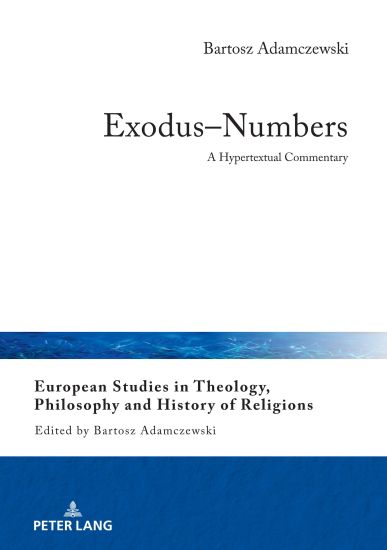
Exodus–Numbers

Exodus–Numbers

Bartosz Adamczewski

Peter Lang AG
2020
sidottu
This monograph demonstrates that the books of Exodus–Numbers, taken together, are the result of one, highly creative, hypertextual reworking of the book of Deuteronomy. This detailed reworking consists of around 1,200 strictly sequentially organized conceptual, and at times also linguistic correspondences between Exodus–Numbers and Deuteronomy. The strictly sequential, hypertextual dependence on Deuteronomy explains numerous surprising features of Exodus–Numbers. The critical analysis of Exodus–Numbers as a coherently composed hypertextual work disproves hypotheses of the existence in these writings of Priestly and non-Priestly materials or multiple literary layers.
Genesis

Genesis

Bartosz Adamczewski

Peter Lang AG
2020
sidottu
This monograph demonstrates that the book of Genesis is a result of highly creative, hypertextual reworking of the book of Deuteronomy. This detailed reworking consists of around 1,000 strictly sequentially organized conceptual, and at times also linguistic correspondences between Genesis and Deuteronomy. The strictly sequential, hypertextual dependence on Deuteronomy explains numerous surprising features of Genesis. The critical analysis of Genesis as a coherently composed hypertextual work disproves hypotheses of the existence in this writing of Priestly and non-Priestly materials or multiple literary layers.
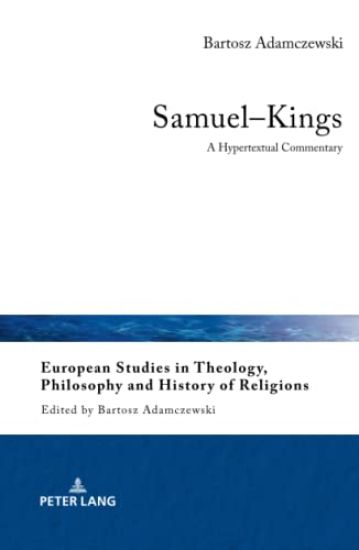
Samuel–Kings

Samuel–Kings

Bartosz Adamczewski

Peter Lang AG
2021
sidottu
The book demonstrates that the books of Samuel–Kings, taken together, are a result of one, highly creative, hypertextual reworking of the book of Deuteronomy. This detailed reworking consists of almost 2000 strictly sequentially organized, conceptual, and at times, also linguistic correspondences between Samuel–Kings and Deuteronomy. The strictly sequential, hypertextual dependence on Deuteronomy explains numerous surprising features of Samuel–Kings. The critical analysis of Samuel–Kings as a coherently composed Judaean hypertextual work disproves the hypothesis of the existence of the Deuteronomistic history and its variants. It also sheds entirely new light on the question of the origin of the so-called Enneateuch Genesis–Kings.
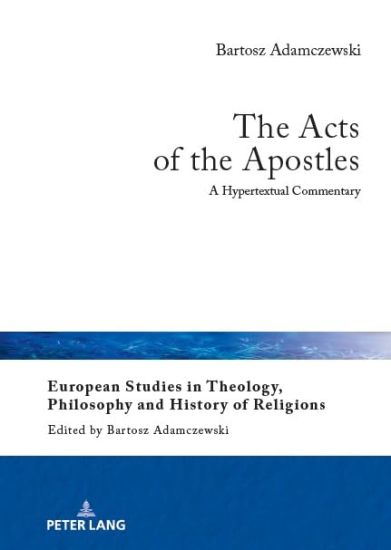
The Acts of the Apostles

The Acts of the Apostles

Bartosz Adamczewski

PETER LANG AG
2023
sidottu
In this monograph, the author demonstrates that the Acts of the Apostles is a highly creative hypertextual reworking of the Letter to the Galatians, with over 500 strictly sequentially organized conceptual and linguistic correspondences between Acts and Galatians. This hypertextual dependence on Galatians explains numerous surprising features of Acts. Critical explanations of these features, which are offered in this monograph, ensure the reliability of the new solution to the problem of the relationship between Acts and the Pauline and post-Pauline letters.
Hebrews and Revelation

Hebrews and Revelation

Bartosz Adamczewski

PETER LANG AG
2025
sidottu
This monograph demonstrates that the Epistle to the Hebrews and the Book of Revelation are results of highly creative, hypertextual reworking of the Acts of the Apostles. In both cases, this detailed reworking consists of around 700 strictly sequentially organized conceptual and often also linguistic correspondences to Acts. The strictly sequential, hypertextual dependence on Acts explains numerous surprising features of both Hebrews and Revelation. Critical explanations of such features, which are offered in this monograph, ensure the reliability of the new solution to the problem of the identities of Hebrews and Revelation, as well as their relationships to the Lucan, post-Pauline school of literary-theological production.
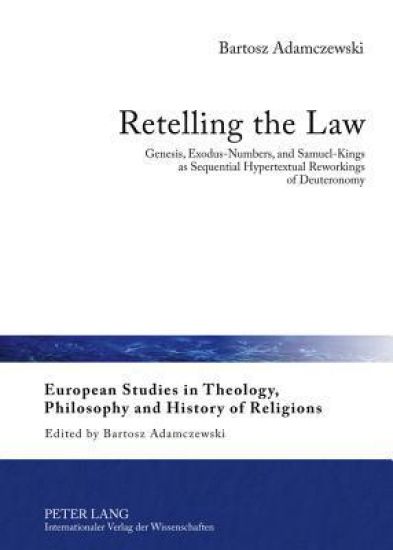
Retelling the Law

Retelling the Law

Bartosz Adamczewski

Peter Lang AG
2012
sidottu
Using the method of critical intertextual research, this book demonstrates that Deuteronomy (written c. 500 BC) is an Israelite sequential hypertextual reworking of Ezekiel, that Genesis and Exodus-Numbers (written c. 400 BC) are Israelite sequential hypertextual reworkings of Deuteronomy, and that Samuel-Kings (written c. 300 BC) is a Judaean sequential hypertextual reworking of Deuteronomy. Consequently, the book disproves the theories of the existence of the so-called sources or traditions of the Pentateuch. The recognition of the fact that the Pentateuch is an Israelite and not a Judaean work may have great consequences for the dialogue between the monotheistic civilizations in our world and for peace initiatives in the Holy Land.