Kirjojen hintavertailu. Mukana 12 352 018 kirjaa ja 12 kauppaa.

Kirjahaku

Etsi kirjoja tekijän nimen, kirjan nimen tai ISBN:n perusteella.

9 kirjaa tekijältä Baruch Fischhoff, Paul Slovic

Decisions

Decisions

Baruch Fischhoff; Paul Slovic

MIT PRESS LTD
2025
nidottu
A lively, authoritative insider's account of how we make decisions and how decision-making research has developed over the last half century. Decisions describes the evolution of decision science (also called behavioral decision research and related to behavioral economics) through its application to challenging personal and public policy decisions, since the inception of the field. Baruch Fischhoff covers all major topics in basic research, including how people create options, determine what matters to them, evaluate their chances of achieving those goals, and engage their emotions. He shows how those processes play out in an exceptionally wide variety of decisions regarding health (including trauma triage and pandemic diseases); safety (including accidents and interpersonal violence); the environment (including climate change and energy); disasters (including tornadoes and floods); and national security (including terrorism and intelligence analysis), among other topics. He also examines how decision-making abilities vary across individuals and across the lifespan, as well as the ethics and politics of how research is conducted and its results are shared and applied.
Bounded Disciplines and Unbounded Problems

Bounded Disciplines and Unbounded Problems

Baruch Fischhoff

Oxford University Press
2025
sidottu
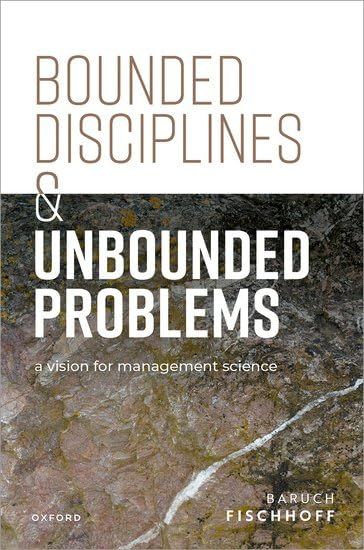
People often face complex, novel, fateful, and wildly unbounded problems throughout their lives. In their work, disciplinary scientists hone their wisdom on the complexities of necessarily bounded problems. Bounded Disciplines and Unbounded Problems offers a vision for schools of management science to bring these worlds together, by doing more of what they do best, co-creating solutions in ways that serve the world and the disciplines. Disciplinary wisdom is illustrated with studies eliciting beliefs and preferences. Collaboration is illustrated with a wide variety of applications, including climate, energy, health, security, technology, and natural disasters. The proposed strategy, for bonding bounded disciplines, offers a realistic path forward, at a time when the value of academia is sometimes questioned by the public, students, and even some of its members.
Risk Analysis and Human Behavior

Risk Analysis and Human Behavior

Baruch Fischhoff

Earthscan Ltd
2011
sidottu
The articles collected here are foundational contributions to integrating behavioural research and risk analysis. They include seminal articles on three essential challenges. One is ensuring effective two-way communication between technical experts and the lay public, so that risk analyses address lay concerns and provide useful information to people who need it. The second is ensuring that analyses make realistic assumptions about human behaviours that affect risk levels (e.g., how people use pharmaceuticals, operate equipment, or respond to evacuation orders). The third is ensuring that analyses recognize the strengths and weaknesses of experts’ understanding, using experts’ knowledge, while understanding its limits. The articles include overviews of the science, essays on the role of risk in society, and applications to domains as diverse as environment, medicine, terrorism, human rights, chemicals, pandemics, vaccination, HIV/AIDS, xenotransplantation, sexual assault, energy, and climate change. The work involves collaborations among scientists from many disciplines, working with practitioners to produce and convey the knowledge needed help people make better risk decisions.
Risk Analysis and Human Behavior

Risk Analysis and Human Behavior

Baruch Fischhoff

Earthscan Ltd
2011
nidottu
The articles collected here are foundational contributions to integrating behavioural research and risk analysis. They include seminal articles on three essential challenges. One is ensuring effective two-way communication between technical experts and the lay public, so that risk analyses address lay concerns and provide useful information to people who need it. The second is ensuring that analyses make realistic assumptions about human behaviours that affect risk levels (e.g., how people use pharmaceuticals, operate equipment, or respond to evacuation orders). The third is ensuring that analyses recognize the strengths and weaknesses of experts’ understanding, using experts’ knowledge, while understanding its limits. The articles include overviews of the science, essays on the role of risk in society, and applications to domains as diverse as environment, medicine, terrorism, human rights, chemicals, pandemics, vaccination, HIV/AIDS, xenotransplantation, sexual assault, energy, and climate change. The work involves collaborations among scientists from many disciplines, working with practitioners to produce and convey the knowledge needed help people make better risk decisions.
Judgment and Decision Making

Judgment and Decision Making

Baruch Fischhoff

Earthscan Ltd
2011
sidottu
Behavioral decision research offers a distinctive approach to understanding and improving decision making. It combines theory and method from multiple disciples (psychology, economics, statistics, decision theory, management science). It employs both empirical methods, to study how decisions are actually made, and analytical ones, to study how decisions should be made and how consequential imperfections are. This book brings together key publications, selected to represent the major topics and approaches used in the field. Put in one place, with integrating commentary, it shows the common elements in a research program that represents the scope of the field, while offering depth in each. Together, they provide a vision for what has become a burgeoning field.
Judgment and Decision Making

Judgment and Decision Making

Baruch Fischhoff

Earthscan Ltd
2011
nidottu
Behavioral decision research offers a distinctive approach to understanding and improving decision making. It combines theory and method from multiple disciples (psychology, economics, statistics, decision theory, management science). It employs both empirical methods, to study how decisions are actually made, and analytical ones, to study how decisions should be made and how consequential imperfections are. This book brings together key publications, selected to represent the major topics and approaches used in the field. Put in one place, with integrating commentary, it shows the common elements in a research program that represents the scope of the field, while offering depth in each. Together, they provide a vision for what has become a burgeoning field.
Risk

Risk

Baruch Fischhoff; John Kadvany

Oxford University Press
2011
nidottu
We find risks everywhere--from genetically modified crops, medical malpractice, and stem-cell therapy to intimacy, online predators, identity theft, inflation, and robbery. They arise from our own acts and they are imposed on us. In this Very Short Introduction, Baruch Fischhoff and John Kadvany draw on the sciences and humanities to explore and explain the many kinds of risk. Using simple conceptual frameworks from decision theory and behavioural research, they examine the science and practice of creating measures of risk, showing how scientists address risks by combining historical records, scientific theories, probability, and expert judgment.Risk: A Very Short Introduction describes what has been learned by cognitive scientists about how people deal with risks, applying these lessons to diverse examples, and demonstrating how understanding risk can aid choices in everyday life and public policies for health, safety, environment, finance, and many other topics. ABOUT THE SERIES: The Very Short Introductions series from Oxford University Press contains hundreds of titles in almost every subject area. These pocket-sized books are the perfect way to get ahead in a new subject quickly. Our expert authors combine facts, analysis, perspective, new ideas, and enthusiasm to make interesting and challenging topics highly readable.
Risk Communication

Risk Communication

M. Granger Morgan; Baruch Fischhoff; Ann Bostrom; Cynthia J. Atman

Cambridge University Press
2001
pokkari
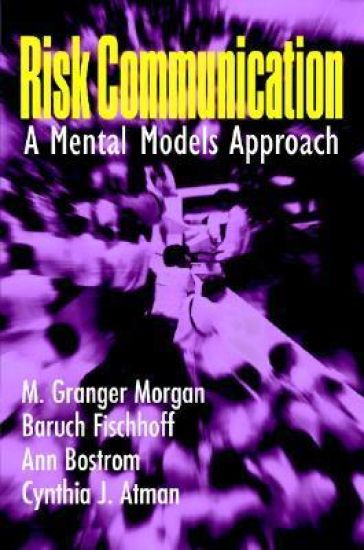
People today must make decisions about many health, safety, and environmental risks. Nuclear power, HIV/AIDS, radon, vaccines, climate change, and emerging infectious diseases are just some issues that may face them in the news media, ballot box, or doctor's office. In order to make sound choices they need to get good information. Because their time is limited, that information has to be carefully selected and clearly presented. This book provides a systematic approach for risk communicators and technical experts, hoping to serve the public by providing information about risks. The procedure uses approaches from risk and decision analysis to identify the most relevant information; it uses approaches from psychology and communication theory to ensure that it is understood. This book is written in nontechnical terms, designed to make the approach feasible for anyone willing to try it. It is illustrated with successful communications, on a variety of topics.
Risk Communication

Risk Communication

M. Granger Morgan; Baruch Fischhoff; Ann Bostrom; Cynthia J. Atman

Cambridge University Press
2001
sidottu
People today must make decisions about many health, safety, and environmental risks. Nuclear power, HIV/AIDS, radon, vaccines, climate change, and emerging infectious diseases are just some issues that may face them in the news media, ballot box, or doctor's office. In order to make sound choices they need to get good information. Because their time is limited, that information has to be carefully selected and clearly presented. This book provides a systematic approach for risk communicators and technical experts, hoping to serve the public by providing information about risks. The procedure uses approaches from risk and decision analysis to identify the most relevant information; it uses approaches from psychology and communication theory to ensure that it is understood. This book is written in nontechnical terms, designed to make the approach feasible for anyone willing to try it. It is illustrated with successful communications, on a variety of topics.