Kirjojen hintavertailu. Mukana 11 244 527 kirjaa ja 12 kauppaa.

Kirjahaku

Etsi kirjoja tekijän nimen, kirjan nimen tai ISBN:n perusteella.

5 kirjaa tekijältä Behrooz Parhami

Computer Architecture

Computer Architecture

Behrooz Parhami

Oxford University Press Inc
2005
sidottu
PART I: sets the stage, provides context, reviews some of the prerequisite topics and gives a taste of what is to come in the rest of the book. Included are two refresher-type chapters on digital circuits and components, a discussion of types of computer systems, an overview of digital computer technology, and a detailed perspective on computer system 3erformance. PART II:lays out the user's interface to computer hardware known as the instruction-set architechture (ISA). For better understanding, the instruction set of MiniMIPS (a simplified, yet very realistic, machine for which open reference material and simulation tools exist) is described. Included is a chapter on variations in ISA (e.g. RISC vs CISC) and associated cost performace tradeoffs. The next two parts cover the central processing unit (CPU). PART III: describes the structure of arithmetic/logic units (ALUs) in some detail. Included are discussions of fixed- and floating-point number representations, design of high-speed adders, shift and logical operations, and hardware multipliers/dividers. Implementation aspects and pitfalls of floating-point arthimetic are also discussed. PART IV: is devoted to data path and control circuits comprising the CPU. Beginning with instruction execution steps, the needed components and control mechanisms are derived. These are followed by an exposition of control design strategies, use of a pipelined data path for performance enhancement, and various limitations of pipelining due to data and control dependencies. PART V: concerned with the memory system. The technologies in use for primary and secondary memories are described, along with their strengths and limitations. It is shown how the use of cache memories effectively bridges the speed gap between CPU and main memory. Similarly, the use of virtual memory to provide the illusion of a vast main memory is explained. PART VI: deals with input/output and interfacing topics. A discussion of I/O device technologies is followed by methods of I/O programming and the roles of buses and links (including standards) in I/O communication and interfacing. Elements of processes and context switching, for exception handling or multireaded computation, are also covered. PART VII: introduces advanced architectures. An overview of performance enhancement strategies, beyond simple pipelining, is presented and examples of applications requiring higher performance are cited. These are followed by design strategies and example architectures based on vector or array proccessing, multiprocessing, and multicomputing.
Computer Arithmetic

Computer Arithmetic

Behrooz Parhami

Oxford University Press Inc
2009
sidottu
Ideal for graduate and senior undergraduate courses in computer arithmetic and advanced digital design, Computer Arithmetic: Algorithms and Hardware Designs, Second Edition, provides a balanced, comprehensive treatment of computer arithmetic. It covers topics in arithmetic unit design and circuit implementation that complement the architectural and algorithmic speedup techniques used in high-performance computer architecture and parallel processing. Using a unified and consistent framework, the text begins with number representation and proceeds through basic arithmetic operations, floating-point arithmetic, and function evaluation methods. Later chapters cover broad design and implementation topics-including techniques for high-throughput, low-power, fault-tolerant, and reconfigurable arithmetic. An appendix provides a historical view of the field and speculates on its future. An indispensable resource for instruction, professional development, and research, Computer Arithmetic: Algorithms and Hardware Designs, Second Edition, combines broad coverage of the underlying theories of computer arithmetic with numerous examples of practical designs, worked-out examples, and a large collection of meaningful problems. This second edition includes a new chapter on reconfigurable arithmetic, in order to address the fact that arithmetic functions are increasingly being implemented on field-programmable gate arrays (FPGAs) and FPGA-like configurable devices. Updated and thoroughly revised, the book offers new and expanded coverage of saturating adders and multipliers, truncated multipliers, fused multiply-add units, overlapped quotient digit selection, bipartite and multipartite tables, reversible logic, dot notation, modular arithmetic, Montgomery modular reduction, division by constants, IEEE floating-point standard formats, and interval arithmetic. Features: * Divided into 28 lecture-size chapters * Emphasizes both the underlying theories of computer arithmetic and actual hardware designs * Carefully links computer arithmetic to other subfields of computer engineering * Includes 717 end-of-chapter problems ranging in complexity from simple exercises to mini-projects * Incorporates many examples of practical designs * Uses consistent standardized notation throughout * Instructor's manual includes solutions to text problems * An author-maintained website http://www.ece.ucsb.edu/~parhami/text comp arit.htm contains instructor resources, including complete lecture slides
Computer Arithmetic

Computer Arithmetic

Behrooz Parhami

Oxford University Press Inc
2011
nidottu
Ideal for graduate and senior undergraduate courses in computer arithmetic and advanced digital design, Computer Arithmetic: Algorithms and Hardware Designs, Second Edition, provides a balanced, comprehensive treatment of computer arithmetic. It covers topics in arithmetic unit design and circuit implementation that complement the architectural and algorithmic speedup techniques used in high-performance computer architecture and parallel processing. Using a unified and consistent framework, the text begins with number representation and proceeds through basic arithmetic operations, floating-point arithmetic, and function evaluation methods. Later chapters cover broad design and implementation topics-including techniques for high-throughput, low-power, fault-tolerant, and reconfigurable arithmetic. An appendix provides a historical view of the field and speculates on its future. An indispensable resource for instruction, professional development, and research, Computer Arithmetic: Algorithms and Hardware Designs, Second Edition, combines broad coverage of the underlying theories of computer arithmetic with numerous examples of practical designs, worked-out examples, and a large collection of meaningful problems. This second edition includes a new chapter on reconfigurable arithmetic, in order to address the fact that arithmetic functions are increasingly being implemented on field-programmable gate arrays (FPGAs) and FPGA-like configurable devices. Updated and thoroughly revised, the book offers new and expanded coverage of saturating adders and multipliers, truncated multipliers, fused multiply-add units, overlapped quotient digit selection, bipartite and multipartite tables, reversible logic, dot notation, modular arithmetic, Montgomery modular reduction, division by constants, IEEE floating-point standard formats, and interval arithmetic.
Introduction to Parallel Processing

Introduction to Parallel Processing

Behrooz Parhami

Kluwer Academic/Plenum Publishers
1999
sidottu
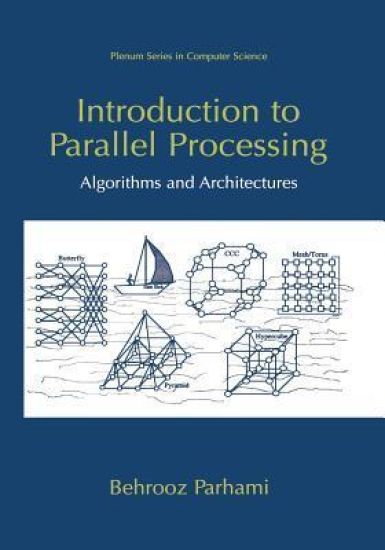
THE CONTEXT OF PARALLEL PROCESSING The field of digital computer architecture has grown explosively in the past two decades. Through a steady stream of experimental research, tool-building efforts, and theoretical studies, the design of an instruction-set architecture, once considered an art, has been transformed into one of the most quantitative branches of computer technology. At the same time, better understanding of various forms of concurrency, from standard pipelining to massive parallelism, and invention of architectural structures to support a reasonably efficient and user-friendly programming model for such systems, has allowed hardware performance to continue its exponential growth. This trend is expected to continue in the near future. This explosive growth, linked with the expectation that performance will continue its exponential rise with each new generation of hardware and that (in stark contrast to software) computer hardware will function correctly as soon as it comes off the assembly line, has its down side. It has led to unprecedented hardware complexity and almost intolerable dev- opment costs. The challenge facing current and future computer designers is to institute simplicity where we now have complexity; to use fundamental theories being developed in this area to gain performance and ease-of-use benefits from simpler circuits; to understand the interplay between technological capabilities and limitations, on the one hand, and design decisions based on user and application requirements on the other.
Introduction to Parallel Processing

Introduction to Parallel Processing

Behrooz Parhami

Springer-Verlag New York Inc.
2013
nidottu
THE CONTEXT OF PARALLEL PROCESSING The field of digital computer architecture has grown explosively in the past two decades. Through a steady stream of experimental research, tool-building efforts, and theoretical studies, the design of an instruction-set architecture, once considered an art, has been transformed into one of the most quantitative branches of computer technology. At the same time, better understanding of various forms of concurrency, from standard pipelining to massive parallelism, and invention of architectural structures to support a reasonably efficient and user-friendly programming model for such systems, has allowed hardware performance to continue its exponential growth. This trend is expected to continue in the near future. This explosive growth, linked with the expectation that performance will continue its exponential rise with each new generation of hardware and that (in stark contrast to software) computer hardware will function correctly as soon as it comes off the assembly line, has its down side. It has led to unprecedented hardware complexity and almost intolerable dev- opment costs. The challenge facing current and future computer designers is to institute simplicity where we now have complexity; to use fundamental theories being developed in this area to gain performance and ease-of-use benefits from simpler circuits; to understand the interplay between technological capabilities and limitations, on the one hand, and design decisions based on user and application requirements on the other.