Kirjojen hintavertailu. Mukana 11 244 527 kirjaa ja 12 kauppaa.

Kirjahaku

Etsi kirjoja tekijän nimen, kirjan nimen tai ISBN:n perusteella.

2 kirjaa tekijältä Benjamin Bertram

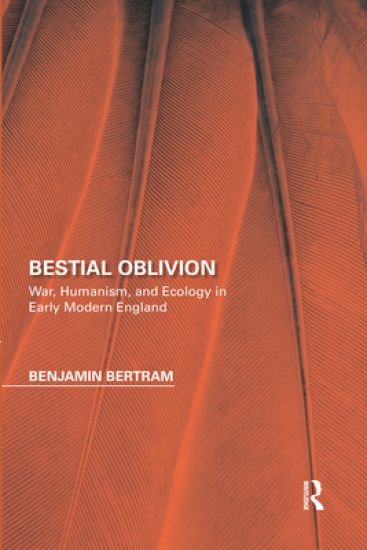
Bestial Oblivion

Bestial Oblivion

Benjamin Bertram

Routledge
2020
nidottu
Although war is a heterogeneous assemblage of the human and nonhuman, it nevertheless builds the illusion of human autonomy and singularity. Focusing on war and ecology, a neglected topic in early modern ecocriticism, Bestial Oblivion: War, Humanism, and Ecology in Early Modern England shows how warfare unsettles ideas of the human, yet ultimately contributes to, and is then perpetuated by, anthropocentrism. Bertram’s study of early modern warfare’s impact on human-animal and human-technology relationships draws upon posthumanist theory, animal studies, and the new materialisms, focusing on responses to the Anglo-Spanish War, the Italian Wars, the Wars of Religion, the colonization of Ireland, and Jacobean “peace.” The monograph examines a wide range of texts—essays, drama, military treatises, paintings, poetry, engravings, war reports, travel narratives—and authors—Erasmus, Machiavelli, Digges, Shakespeare, Marlowe, Coryate, Bacon—to show how an intricate web of perpetual war altered the perception of the physical environment as well as the ideologies and practices establishing what it meant to be human.
Bestial Oblivion

Bestial Oblivion

Benjamin Bertram

Routledge
2018
sidottu
Although war is a heterogeneous assemblage of the human and nonhuman, it nevertheless builds the illusion of human autonomy and singularity. Focusing on war and ecology, a neglected topic in early modern ecocriticism, Bestial Oblivion: War, Humanism, and Ecology in Early Modern England shows how warfare unsettles ideas of the human, yet ultimately contributes to, and is then perpetuated by, anthropocentrism. Bertram’s study of early modern warfare’s impact on human-animal and human-technology relationships draws upon posthumanist theory, animal studies, and the new materialisms, focusing on responses to the Anglo-Spanish War, the Italian Wars, the Wars of Religion, the colonization of Ireland, and Jacobean “peace.” The monograph examines a wide range of texts—essays, drama, military treatises, paintings, poetry, engravings, war reports, travel narratives—and authors—Erasmus, Machiavelli, Digges, Shakespeare, Marlowe, Coryate, Bacon—to show how an intricate web of perpetual war altered the perception of the physical environment as well as the ideologies and practices establishing what it meant to be human.