Kirjojen hintavertailu. Mukana 11 244 527 kirjaa ja 12 kauppaa.

Kirjahaku

Etsi kirjoja tekijän nimen, kirjan nimen tai ISBN:n perusteella.

362 kirjaa tekijältä Benjamin Disraeli

Benjamin Disraeli Letters

Benjamin Disraeli Letters

Benjamin Disraeli

University of Toronto Press
1993
sidottu
Against a European background of the 1848 revolutions and Louis Napoleon's 1851 coup, the 602 letters of this volume cover Disraeli's accession to the leadership of his party in the House of Commons and his first attempts to move the party beyond reactionary protectionism and ultra-Protestantism. In this period, Disraeli works hard at all aspects of his new role, finding 'good men' to bring into the party, patching rifts within it, and establishing a new platform on which to maintain the system of landed aristocracy in the age of free trade. When the chance to form a government comes, however, his party is unsuccessful. The turmoil in the world at large is matched by that in Disraeli's own affairs. Foremost are the deaths of his father, a central figure in his intellectual development, and of Lord George Bentinck, the anchor of his financial and political strategies. Once again, his creditors threaten to drive him from public life, and come alarmingly close to success on at least one occasion. In addition, his marriage goes through a major crisis, as Mary Anne Disraeli's jealousy over his frequent correspondence with Lady Londonderry and his regular visits to her precipitates an actual separation and period of estrangement. His major correspondent and confidante continues to be his sister Sarah, but there are also a surprising number of letters (many of them previously unpublished) to major figures such as Metternich and Derby. The volume ends with the exchanges between Disraeli and other political leaders on the verge of a second chance at government, which in 1852 will bring a brief taste of power at last.

Benjamin Disraeli Letters

Benjamin Disraeli Letters

Benjamin Disraeli

University of Toronto Press
1997
sidottu
Benjamin Disraeli, Queen Victoria's favourite prime minister, was, in the words of Robert Blake, 'the best letter-writer among English statesmen.' This, the latest volume in the critically acclaimed Letters of Benjamin Disraeli series, contains or describes 951 letters (784 previously unpublished) written by Disraeli between 1852 and 1856. These years cover his first cabinet post, as chancellor of the exchequer, his attempts as House leader to unify the Conservative party, and his opposition to the Crimean War, both in the House and in his newspaper, The Press. Included are significant runs of correspondence, such as 63 letters (34 previously unpublished) to the 14th Earl of Derby, and 75 letters (none previously published) to Lord Stanley, the future 15th Earl of Derby, as well as more personal ones, such as 59 letters to the eccentric Mrs Brydges Willyams, the 'female Croesus' who offered Disraeli a substantial legacy. These illuminate anew both his public and private life, and show the strength of his resolve to reshape party policies to suit the age of industrialism and free trade. New light is also thrown on other matters, such as the supposed plagiarism in his panegyric on the Duke of Wellington. Ten appendices include full cabinet lists, Disraeli's own reminiscences of the period, and Stanley's remarkable verbatim notes of intimate conversations with Disraeli at Hughenden Manor.
Benjamin Disraeli Letters

Benjamin Disraeli Letters

Benjamin Disraeli

University of Toronto Press
1982
sidottu
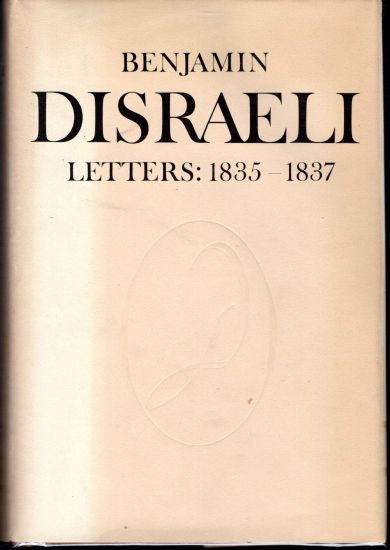
The 334 letters in this volume cover the period from Disraeli's establishment in the Tory camp under the patronage of Lord Lyndhurst to his election to parliament in 1837. The most important issue to which they speak is the course of Disraeli's political ambitions. In 1835 the road to parliament was not yet clear, for he continued to be haunted by troubles from his past. He was beset by charges of opportunism in his Taunton campaign of 1835, and the longest letters here are those to Edwards Beadon written in justification of past conduct; Disraeli had still to learn the truth of his later dictum, 'never explain.' Also, debts contracted many years before continued to plague him, as they would in years to come. He was tempted by a variety of money-making schemes and the later correspondence makes clear just how close he came to permanent ruin at the hands of his creditors in the spring of 1837. Had the fate of debtors' prison materialized it is doubtful that he would ever have been eligible, in law or in reputation, for a parliamentary career. Disraeli's eventual election for Maidstone in the summer of 1837 marked the emergence of his formal public role. Because he set out early and was a long time in attaining his goals, one is tempted to laud his patience. But the record here suggests that it was instead a matter of energy and endurance. This volume of the Letters brings Disraeli to the threshold of the Victorian era and the beginning of his career as a politician. In late 1837 he failed in his maiden speech, but all major successes lay ahead.
Benjamin Disraeli Letters

Benjamin Disraeli Letters

Benjamin Disraeli

University of Toronto Press
1989
sidottu
The 435 letters in this volume cover the most dramatic period of Disraeli's middle life - one which is still subject to continuing debate and interpretation, but the one in which the potential of his diverse talents at last begins to be realized. In his second Parliamentary session (1842 to 1847) the member for Shrewsbury establishes himself as the most exciting speaker in the House of Commons. The letters also provoke reassessment of the political splinter group 'Young England,' whose aims are nothing less than the purge and reform of the Conservative party. In 1947, as a peader of the Protectionists, he achieves his political goal of fifteen before: election as a member in his home county of Buckinghamshire. In this period, too, he becomes a best-selling novelist, with his three 'condition of England' novels. Finally, as 'knight of the shire' and with his debts more manageable through the help and thrift of his wife, Mary Anne, he is in a position to realize another ambition, that of becoming a country gentleman, and begins the purchase of Hughenden Manor. Ten appendixes include Disraeli's 1847 election canvass lists, his commonplace books of this period, and a complete inventory of the contents of his London residence, the collateral for a desperate loan in 1842.
Benjamin Disraeli Letters

Benjamin Disraeli Letters

Benjamin Disraeli

University of Toronto Press
2004
sidottu
Benjamin Disraeli was perhaps the most colourful Prime Minister in British history. This seventh volume of the highly acclaimed Benjamin Disraeli Letters edition shows also that he was a dedicated, resourceful, and farsighted statesman. It contains 670 letters written between 1857 and 1859. They address friends, family, political colleagues, and, not least, Queen Victoria and Prince Albert. During this period, Disraeli shepherded a fragile Conservative government through the Indian Mutiny, the Second Opium War with China, the Orsini bomb plot, and the Franco-Austrian-Piedmontese War, only to fail at home over parliamentary reform. Day-by-day politics and behind-the-scenes strategy dominate, while lighter-hearted letters to friends and family reveal the private Disraeli’s charm and wit. With an appendix of 115 newly found letters dating from 1825, as well as information on 219 unfound letters, full annotations to each letter, an exhaustive name-and-subject index and a comprehensive introduction, this volume will be a vital resource for new understanding of this enigmatic statesman.
Benjamin Disraeli Letters

Benjamin Disraeli Letters

Benjamin Disraeli

University of Toronto Press
2009
sidottu
Benjamin Disraeli (1804-81) was one of the most important figures in nineteenth-century Europe, spending three decades in British government and twice serving as prime minister. This volume collects 556 of Disraeli's letters from a tumultuous period in European history – years that witnessed the Italian revolution, the Polish revolt against Russia, anxiety about Napoleon III's intentions in Europe, and the American Civil War. The letters, of which more than four hundred have never before been published, provide revealing insights into Disraeli's thoughts on political and social issues; they also illuminate his style of leadership and the inner workings of the Conservative party. This eighth volume of Benjamin Disraeli Letters also includes recently recovered letters from years covered by previous volumes, including four to Lionel de Rothschild that reveal a hitherto unknown collaboration between Rothschild, Disraeli, and Lord George Bentinck on an anonymous pamphlet promoting Jewish political rights. Fully annotated, this volume is a welcome addition to the series.
Benjamin Disraeli Letters

Benjamin Disraeli Letters

Benjamin Disraeli

University of Toronto Press
1982
pokkari
The private letters of a statesman are always inviting material for historians and when he has claim to literary fame as well the correspondence assumes a double significance. Benjamin Disraeli (1804-1881) belonged to an age that gave pride of place to the written word as an instrument of both business and pleasure. This volume includes 363 letters (many previously unpublished) from his school boy days to his establishment in the Tory camp under the patronage of Lord Lyndhurst. Most prominent are Disraeli's letters to his sister, Sarah, with whom he corresponded frequently over several decades. To her he confided his hopes, interspersed with his observations and descriptions of social, literary and political events. The letters to Sarah supply a skeleton around which Disraeli's young manhood can be reconstructed and shed valuable light on the remaining documents in the volume. The correspondence also includes accounts of his tour of the Low Countries and the Rhine in 1824, his adventurous trip to Spain, Greece, the Near East and Egypt in 1830, his tense negotiations with publishers and his campaign to shine as a member of aristocratic society and win political patronage. The letters demonstrate the fine eye for detail and the capacity for self-dramatization and literary conceits which mark his novels. With their annotations they also provide a remarkably detailed account of life in the upper reaches of English society as viewed from below, and of Disraeli's ambitions to enter that life.
Benjamin Disraeli Letters

Benjamin Disraeli Letters

Benjamin Disraeli

University of Toronto Press
1982
pokkari
The 334 letters in this volume cover the period from Disraeli's establishment in the Tory camp under the patronage of Lord Lyndhurst to his election to parliament in 1837. The most important issue to which they speak is the course of Disraeli's political ambitions. In 1835 the road to parliament was not yet clear, for he continued to be haunted by troubles from his past. He was beset by charges of opportunism in his Taunton campaign of 1835, and the longest letters here are those to Edwards Beadon written in justification of past conduct; Disraeli had still to learn the truth of his later dictum, 'never explain.' Also, debts contracted many years before continued to plague him, as they would in years to come. He was tempted by a variety of money-making schemes and the later correspondence makes clear just how close he came to permanent ruin at the hands of his creditors in the spring of 1837. Had the fate of debtors' prison materialized it is doubtful that he would ever have been eligible, in law or in reputation, for a parliamentary career. Disraeli's eventual election for Maidstone in the summer of 1837 marked the emergence of his formal public role. Because he set out early and was a long time in attaining his goals, one is tempted to laud his patience. But the record here suggests that it was instead a matter of energy and endurance. This volume of the Letters brings Disraeli to the threshold of the Victorian era and the beginning of his career as a politician. In late 1837 he failed in his maiden speech, but all major successes lay ahead.
Benjamin Disraeli Quotes: Benjamin Disraeli, quotes, quotations, famous quotes

Benjamin Disraeli Quotes: Benjamin Disraeli, quotes, quotations, famous quotes

Benjamin Disraeli

Createspace Independent Publishing Platform
2016
nidottu
"The Best Benjamin Disraeli Quotation Book ever Published. Special Edition This book of Benjamin Disraeli quotes contains only the rarest and most valuable quotations ever recorded about Benjamin Disraeli, authored by a team of experienced researchers. Hundreds of hours have been spent in sourcing, editing and verifying only the best quotations about Benjamin Disraeli for your reading pleasure, saving you time and expensive referencing costs. This book contains over 38 pages of quotations which are immaculately presented and formatted for premium consumption. Be inspired by these Benjamin Disraeli quotes; this book is a niche classic which will have you coming back to enjoy time and time again. What's Inside: Contains only the best quotations on Benjamin Disraeli Over 38 pages of premium content Beautifully formatted and edited for maximum enjoyment Makes for the perfect niche gift for you or someone special Enjoy such quotes such as: A Conservative Government is an organized hypocrisy. Benjamin Disraeli A University should be a place of light, of liberty, and of learning. Benjamin Disraeli A consistent soul believes in destiny, a capricious one in chance. Benjamin Disraeli A great city, whose image dwells in the memory of man, is the type of some great idea. Rome represents conquest; Faith hovers over the towers of Jerusalem; and Athens embodies the pre-eminent quality of the antique world, Art. Benjamin Disraeli A majority is always better than the best repartee. Benjamin Disraeli A man may speak very well in the House of Commons, and fail very completely in the House of Lords. There are two distinct styles requisite: I intend, in the course of my career, if I have time, to give a specimen of both. ... And much more Click Add to Cart and Enjoy "