
Kirjojen hintavertailu. Mukana 11 342 296 kirjaa ja 12 kauppaa.

Kirjahaku

Etsi kirjoja tekijän nimen, kirjan nimen tai ISBN:n perusteella.

4 kirjaa tekijältä Benjamin J. Kaplan

Calvinists and Libertines

Calvinists and Libertines

Benjamin J. Kaplan

Clarendon Press
1995
sidottu
After the Reformation, the Dutch Republic emerged as the most religiously tolerant country in seventeenth-century Europe. Benjamin Kaplan examines the reasons behind this phenomenon, focusing on the struggle of Calvinist reformers to realize their theocratic aspirations in the Netherlands, and the fierce opposition offered to them by a large, amorphous group of people known as `Libertines'. Nowhere was this struggle more intense than in Utrecht, a city at the heart of the Dutch Reformation. The author illuminates the nature of this conflict through a study of the city and people of Utrecht, examing social relations, popular piety, civic culture, and state formation. This urban case-study shows how Dutch religious developments fitted into the wider European framework. Offering a fascinating microcosm of religious tensions in Europe around 1600, Kaplan shows how the Calvinist-Libertine conflict in the Netherlands was in fact a local manifestation of a broader European phenomenon: the struggle between champions and opponents of `confessionalism'. He thus combines a new interpretation of the Dutch Reformation with a presentation that makes this largely unknown phenomenon accessible to students of other countries. As the first case-study in English of the Dutch Reformation, Calvinists and Libertines fills an important gap in our knowledge of Dutch history and in our understanding of the European Reformation as a whole.
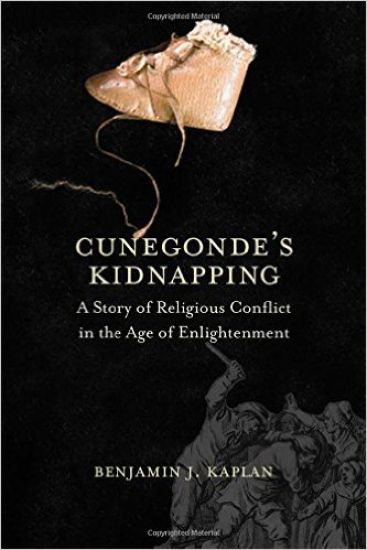
Cunegonde's Kidnapping

Cunegonde's Kidnapping

Benjamin J. Kaplan

Yale University Press
2015
sidottu
How a popular religious war erupted on the Dutch-German border, despite the ideals of religious tolerance proclaimed by the Enlightenment In a remote village on the Dutch-German border, a young Catholic woman named Cunegonde tries to kidnap a baby to prevent it from being baptized in a Protestant church. When she is arrested, fellow Catholics stage an armed raid to free her from detention. These dramatic events of 1762 triggered a cycle of violence, starting a kind of religious war in the village and its surrounding region. Contradicting our current understanding, this war erupted at the height of the Age of Enlightenment, famous for its religious toleration. Cunegonde’s Kidnapping tells in vivid detail the story of this hitherto unknown conflict. Drawing characters, scenes, and dialogue straight from a body of exceptional primary sources, it is the first microhistorical study of religious conflict and toleration in early modern Europe. In it, award-winning historian Benjamin J. Kaplan explores the dilemmas of interfaith marriage and the special character of religious life in a borderland, where religious dissenters enjoy unique freedoms. He also challenges assumptions about the impact of Enlightenment thought and suggests that, on a popular level, some parts of eighteenth-century Europe may not have witnessed a “rise of toleration.”
Divided by Faith

Divided by Faith

Benjamin J. Kaplan

The Belknap Press
2009
nidottu
As religious violence flares around the world, we are confronted with an acute dilemma: Can people coexist in peace when their basic beliefs are irreconcilable? Benjamin Kaplan responds by taking us back to early modern Europe, when the issue of religious toleration was no less pressing than it is today.Divided by Faith begins in the wake of the Protestant Reformation, when the unity of western Christendom was shattered, and takes us on a panoramic tour of Europe's religious landscape--and its deep fault lines--over the next three centuries. Kaplan's grand canvas reveals the patterns of conflict and toleration among Christians, Jews, and Muslims across the continent, from the British Isles to Poland. It lays bare the complex realities of day-to-day interactions and calls into question the received wisdom that toleration underwent an evolutionary rise as Europe grew more "enlightened." We are given vivid examples of the improvised arrangements that made peaceful coexistence possible, and shown how common folk contributed to toleration as significantly as did intellectuals and rulers. Bloodshed was prevented not by the high ideals of tolerance and individual rights upheld today, but by the pragmatism, charity, and social ties that continued to bind people divided by faith.Divided by Faith is both history from the bottom up and a much-needed challenge to our belief in the triumph of reason over faith. This compelling story reveals that toleration has taken many guises in the past and suggests that it may well do the same in the future.
Reformation and the Practice of Toleration
The Dutch Republic was the most religiously diverse land in early modern Europe, gaining an international reputation for toleration. In Reformation and the Practice of Toleration, Benjamin Kaplan explains why the Protestant Reformation had this outcome in the Netherlands and how people of different faiths managed subsequently to live together peacefully. Bringing together fourteen essays by the author, the book examines the opposition of so-called Libertines to the aspirations of Calvinist reformers for uniformity and discipline. It analyzes the practical arrangements by which multiple religious groups were accommodated. It traces the dynamics of religious life in Utrecht and other mixed communities. And it explores the relationships that developed between people of different faiths, especially in ‘mixed’ marriages.