Kirjojen hintavertailu. Mukana 12 016 292 kirjaa ja 12 kauppaa.

Kirjahaku

Etsi kirjoja tekijän nimen, kirjan nimen tai ISBN:n perusteella.

6 kirjaa tekijältä Benny Bing

Video Over Wireless

Video Over Wireless

Benny Bing

McGraw-Hill Professional
2015
sidottu
Publisher's Note: Products purchased from Third Party sellers are not guaranteed by the publisher for quality, authenticity, or access to any online entitlements included with the product.State-of-the-art wireless video standards, techniques, and best practicesThis fully illustrated guide teaches the latest methods for effectively delivering and consuming high-quality mobile Internet video content on cross-platform personal devices. Video Over Wireless features clear and concise explanations of next-generation technologies, including over-the-top TV, wireless broadband, and video streaming and aggregation. Experienced educator and author Benny Bing offers expert insights on emerging standards as well as invaluable tips for maximizing coding efficiency and enhancing error resiliency. Video Over Wireless covers:Pay, digital, and online TVInternet-based mobile video Media clouds and cloud support for mobile appsNon-real-time TV delivery802.11ac and 4G/5G LTE standards Wi-Fi deployments and applicationsKey issues in wireless transmissionSingle-antenna design for handheld devicesMobile digital TV and ATSC 2.0/3.0Video traffic smoothing and multiplexingApple and Microsoft adaptive bit rate streamingSpatial and temporal error concealmentWebM, H.264/MPEG-4 AVC, and H.265/HEVCVideo coding enhancements and the impact of different content types
Broadband Wireless Multimedia Networks

Broadband Wireless Multimedia Networks

Benny Bing

John Wiley Sons Inc
2013
sidottu
Provides a clear, coherent review of all major wireless broadband standards with an emphasis on managing the explosive growth in mobile video 802.11ac/ad, 802.16m, 802.22, and LTE-Advanced are the emerging broadband wireless standards that offer many powerful wireless features. This book gives an accessible overview of the various standards and practical information on 802.11 link adaptation, 4G smartphone antenna design, wireless video streaming, and smart grids. Broadband Wireless Multimedia Networks distills the many complex wireless features in a clean and concise manner so that the reader can understand the key principles. Topics covered include adaptive modulation and coding, orthogonal frequency-division multiple access, single-carrier frequency-division multiple access, multiple antenna systems, medium access control time and frequency-division duplex, transmission, and the frame formats. With wireless operators now carrying a much greater amount of video traffic than data and voice traffic, the book also covers adaptive bit rate streaming and bandwidth management for 3D and HD video delivery to multi-screen personal devices. Featured chapters in the book are: Overview of Broadband Wireless NetworksIEEE 802.11 StandardIEEE 802.16 StandardLong-Term EvolutionATSC Digital TV and IEEE 802.22 StandardsMesh, Relay, and Interworking NetworksWireless Video StreamingGreen Communications in Wireless Home Area Networks Including over 180 chapter-end exercises and 200 illustrative figures; and accessible recorded tutorials, Broadband Wireless Multimedia Networks is ideal for industry professionals and practitioners, graduate students, and researchers.
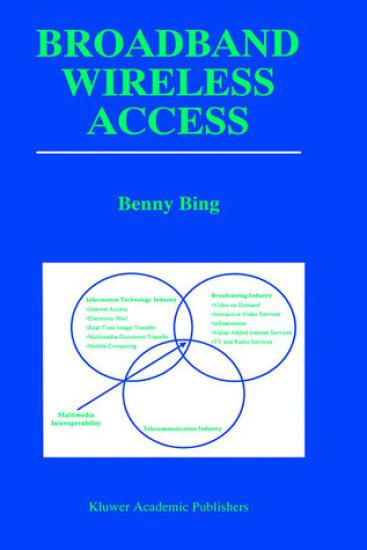
Broadband Wireless Access

Broadband Wireless Access

Benny Bing

Springer
2000
sidottu
This chapter has discussed how a commonbroadcast medium can be shared among many contending users. Multiple access protocols differ primarily by the amount of coordination needed to control potentially conflicting packet transmissions. Ato neextreme is random access where no coordinationis provideda ndp acket collisions arep ossible. Atthe other endo fthe spectrum, the class of fixed assignment access protocols eliminates collisions entirely butpay the price ofadditional overhead required forscheduling user access. Hybrid access protocolsb etweenthese two extremes exist While these protocols attempt to combine the advantages ofrandom andfixed access, they also suffer the c ombined drawbacks and overhead ofboth classes of access schemes. Amongt he many factors that determine the performance ofa n access protocol include the propagation delay/packet transmission timeratio, the message arrival process, the types of feedback information available, the user population, and the ability of the user to sense the activities in the network. BIBLIOGRAPHY [ABRA93] Abramson, N. , Multiple Access Communications , IEEE Press, 1993. [BERT92] Bertsekas, D. and Gallager, R. , Data Networks , Prentice Hall, 1992. [CHOU83]Chou,W, ComputerCommunications Volume1:Principles , Prentice Hall, 1983. [CIDO87] Cidon, I. andSidi, M. , "Erasures and Noise in Splitting Multiple Access Algorithms", IEEE Transactions on Information Theory, Vol. 33, No. 1, January 1987, pp. 132 - 140. [CIDO88] Cidon, I, Kodesh, H. and Sidi, M. , "Erasure, Capture and Random Power Level Selectionin Multiple Access Systems", IEEE Transactions on Communications , Vol. 3 6,N o. 3,March 1988, pp. 263 - 271.
Next-Generation Video Coding and Streaming

Next-Generation Video Coding and Streaming

Benny Bing

John Wiley Sons Inc
2015
sidottu
Reviews the new High Efficiency Video Coding (HEVC) standard and advancements in adaptive streaming technologies for use in broadband networks and the InternetThis book describes next-generation video coding and streaming technologies with a comparative assessment of the strengths and weaknesses. Specific emphasis is placed on the H.265/HEVC video coding standard and adaptive bit rate video streaming. In addition to evaluating the impact of different types of video content and powerful feature sets on HEVC coding efficiency, the text provides an in-depth study on the practical performance of popular adaptive streaming platforms and useful tips for streaming optimization. Readers will learn of new over-the-top (OTT) online TV advancements, the direction of the broadband telecommunications industry, and the latest developments that will help keep implementation costs down and maximize return on infrastructure investment. Reviews the emerging High Efficiency Video Coding (HEVC) standard and compares its coding performance with the MPEG-4 Advanced Video Coding (AVC) and MPEG-2 standardsProvides invaluable insights into the intra and inter coding efficiencies of HEVC, such as the impact of hierarchical block partitioning and new prediction modesEvaluates the performance of the Apple and Microsoft adaptive streaming platforms and presents innovative techniques related to aggregate stream bandwidth prediction, duplicate chunkIncludes end-of-chapter homework problems and access to instructor slides Next-Generation Video Coding and Streaming is written for students, researchers, and industry professionals working in the field of video communications.Benny Bing has worked in academia for over 20 years. He has published over 80 research papers and 12 books, and has 6 video patents licensed to industry. He has served as a technical editor for several IEEE journals and an IEEE Communications Society Distinguished lecturer. He also received the National Association of Broadcasters (NAB) Technology Innovation Award for demonstrations of advanced media technologies.
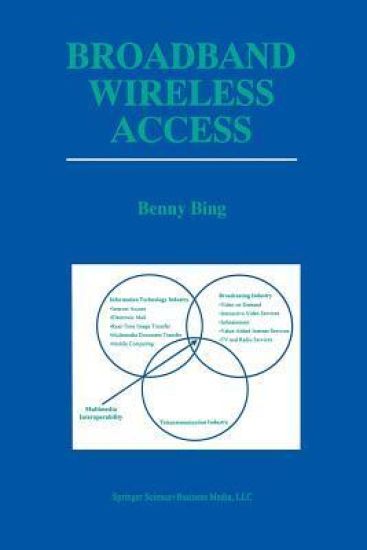
Broadband Wireless Access

Broadband Wireless Access

Benny Bing

Springer-Verlag New York Inc.
2013
nidottu
This chapter has discussed how a commonbroadcast medium can be shared among many contending users. Multiple access protocols differ primarily by the amount of coordination needed to control potentially conflicting packet transmissions. Ato neextreme is random access where no coordinationis provideda ndp acket collisions arep ossible. Atthe other endo fthe spectrum, the class of fixed assignment access protocols eliminates collisions entirely butpay the price ofadditional overhead required forscheduling user access. Hybrid access protocolsb etweenthese two extremes exist While these protocols attempt to combine the advantages ofrandom andfixed access, they also suffer the c ombined drawbacks and overhead ofboth classes of access schemes. Amongt he many factors that determine the performance ofa n access protocol include the propagation delay/packet transmission timeratio, the message arrival process, the types of feedback information available, the user population, and the ability of the user to sense the activities in the network. BIBLIOGRAPHY [ABRA93] Abramson, N. , Multiple Access Communications , IEEE Press, 1993. [BERT92] Bertsekas, D. and Gallager, R. , Data Networks , Prentice Hall, 1992. [CHOU83]Chou,W, ComputerCommunications Volume1:Principles , Prentice Hall, 1983. [CIDO87] Cidon, I. andSidi, M. , "Erasures and Noise in Splitting Multiple Access Algorithms", IEEE Transactions on Information Theory, Vol. 33, No. 1, January 1987, pp. 132 - 140. [CIDO88] Cidon, I, Kodesh, H. and Sidi, M. , "Erasure, Capture and Random Power Level Selectionin Multiple Access Systems", IEEE Transactions on Communications , Vol. 3 6,N o. 3,March 1988, pp. 263 - 271.
3D and HD Broadband Video Networking

3D and HD Broadband Video Networking

Benny Bing

Artech House Publishers
2010
sidottu
Recent years have seen an exponential increase in video and multimedia traffic transported over the internet and broadband access networks. This timely resource addresses the key challenge facing many service providers today: effective bandwidth management for supporting high-quality video delivery. Written by a recognized expert in the field, this practical book describes ways to optimize video transmission over emerging broadband networks. Moreover, the book explores new wireless access networks that can enable video connectivity both inside and outside the residential premise.