Kirjojen hintavertailu. Mukana 11 342 296 kirjaa ja 12 kauppaa.

Kirjahaku

Etsi kirjoja tekijän nimen, kirjan nimen tai ISBN:n perusteella.

11 kirjaa tekijältä Bill Green

Engaging Curriculum

Engaging Curriculum

Bill Green

Routledge
2019
nidottu
Explicitly linking curriculum inquiry to English education via recurring themes of representation, democracy and knowledge, this book is a call for both researchers and practitioners to engage with curriculum, explicitly and deliberatively, as both a concept and a question. The approach is broadly conceptual and constitutes an exercise in theoretical and philosophical inquiry. While deeply informed by North American debates and developments, this book offers a distinctive counterpoint and a strategically ‘ex-centric’ perspective, being equally informed by the curriculum scene in Australia, as well as the UK and elsewhere. Divided into two sections, this book first addresses matters of general curriculum inquiry, while the second turns more specifically to English teaching and to associated questions of language, literacy and literature in L1 education. Green brings the two together through a critical examination of the Australian national curriculum, especially in its implications and challenges for English teaching, and with due regard for the project of transnational curriculum inquiry.
Garth Boomer, English Teaching and Curriculum Leadership
This book provides a broad introduction to the critical work of leading Australian educator Garth Boomer, widely recognised as a significant figure in English teaching. This insightful text provides an accessible introduction to his work, with particular reference to English curriculum and pedagogy, and provides a fascinating account of his journey as a scholar-practitioner, from classroom teaching to the highest levels of the educational bureaucracy.Bill Green explores Boomer’s huge influence on literacy education, teacher development, curriculum inquiry, and educational policy, and critically asks why Boomer’s insights and arguments about English teaching from the last century have such importance for the field now. This text also focuses on the nature and significance of his curriculum thinking, specifically his arguments and provocations regarding English teaching, the English classroom, and the contexts that infuse and shape them. It constitutes a rich resource for rethinking English teaching in the present day and provides an important contribution to the historical imagination.With all due consideration of the larger context of social life and educational thought, this text will help any student of English in Education and Language Arts obtain a deeper understanding of Boomer’s vital contribution to the field of education.
Garth Boomer, English Teaching and Curriculum Leadership
This book provides a broad introduction to the critical work of leading Australian educator Garth Boomer, widely recognised as a significant figure in English teaching. This insightful text provides an accessible introduction to his work, with particular reference to English curriculum and pedagogy, and provides a fascinating account of his journey as a scholar-practitioner, from classroom teaching to the highest levels of the educational bureaucracy.Bill Green explores Boomer’s huge influence on literacy education, teacher development, curriculum inquiry, and educational policy, and critically asks why Boomer’s insights and arguments about English teaching from the last century have such importance for the field now. This text also focuses on the nature and significance of his curriculum thinking, specifically his arguments and provocations regarding English teaching, the English classroom, and the contexts that infuse and shape them. It constitutes a rich resource for rethinking English teaching in the present day and provides an important contribution to the historical imagination.With all due consideration of the larger context of social life and educational thought, this text will help any student of English in Education and Language Arts obtain a deeper understanding of Boomer’s vital contribution to the field of education.
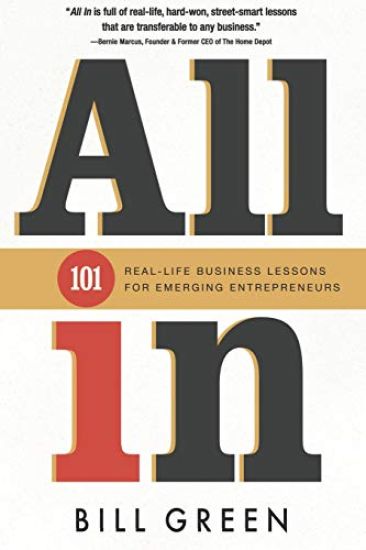
All in: 101 Real Life Business Lessons For Emerging Entrepreneurs
#1 New Book for Entrepreneurs as seen on Forbes.com, Inc.com & Mashable.com You have the Big Idea, the drive and ambition. You see the market, and you've identified the customers. You want to be wildly successful. You wonder, how certain entrepreneurs have achieved success without a fancy education or unlimited access to capital. Enter Bill Green, a serial entrepreneur. Using his own impressive business achievements (and his few fiascos), Green provides the reader with the practical tools needed to launch their Big Idea or improve their existing business. In a unique, humorous, and impassioned style, Bill shares 101 key insights he has gleaned over a 40-year business career that began with a single flea market table. He shares the lessons he learned that allowed him to leverage his flea market business table into one of the largest industrial distribution companies in the country and how he subsequently successfully invested in or founded numerous companies across multiple end markets. His message is universal and is the ideal road map for anyone who might wonder how the Bill Greens of the business world do what they do so well.
Engaging Curriculum

Engaging Curriculum

Bill Green

Routledge
2017
sidottu
Explicitly linking curriculum inquiry to English education via recurring themes of representation, democracy and knowledge, this book is a call for both researchers and practitioners to engage with curriculum, explicitly and deliberatively, as both a concept and a question. The approach is broadly conceptual and constitutes an exercise in theoretical and philosophical inquiry. While deeply informed by North American debates and developments, this book offers a distinctive counterpoint and a strategically ‘ex-centric’ perspective, being equally informed by the curriculum scene in Australia, as well as the UK and elsewhere. Divided into two sections, this book first addresses matters of general curriculum inquiry, while the second turns more specifically to English teaching and to associated questions of language, literacy and literature in L1 education. Green brings the two together through a critical examination of the Australian national curriculum, especially in its implications and challenges for English teaching, and with due regard for the project of transnational curriculum inquiry.
Boltzmann's Tomb

Boltzmann's Tomb

Bill Green

Bellevue Literary Press
2011
sidottu
A selection of the Scientific American book club Recommended by MSNBC, Los Angeles Times, & American Association for the Advancement of Science's SB&F magazine "This wonderful scientific memoir captures the romance and beauty of research in precise poetic prose that is as gorgeous and evocative as anything written by Rilke, painted by Seurat, or played by Casals." --Mary Doria Russell, author of Doc and The Sparrow "A radiant love letter to science from a scientist with a poet's soul ...Green is an exquisite writer, and his fierce focus and mastery of style are reminiscent of the biologist and essayist Lewis Thomas." --Kirkus Reviews In Boltzmann's Tomb, Bill Green interweaves the story of his own lifelong evolution as a scientist, and his work in the Antarctic, with a travelogue that is a personal and universal history of science. Like Richard Holmes' The Age of Wonder--this book serves as a marvelous introduction to the great figures of science. Along with lyrical meditations on the tragic life of Galileo, the wildly eccentric Tycho Brahe, and the visionary Sir Isaac Newton, Green's ruminations return throughout to the lesser-known figure of Ludwig Boltzmann. Using Boltzmann's theories of randomness and entropy as a larger metaphor for the unpredictable paths that our lives take, Green shows us that science, like art, is a lived adventure. Bill Green is a geochemist and professor emeritus at Miami University in Oxford, Ohio. He is also the author of Water, Ice & Stone: Science and Memory on the Antarctic Lakes which received the American Museum of Natural History's John Burroughs Award for Nature Writing, was a finalist for the PEN/Martha Albrand Award, and was excerpted in The Ends of the Earth: An Anthology of the Finest Writing on the Arctic and the Antarctic, edited by Elizabeth Kolbert.