Kirjojen hintavertailu. Mukana 11 732 216 kirjaa ja 12 kauppaa.

Kirjahaku

Etsi kirjoja tekijän nimen, kirjan nimen tai ISBN:n perusteella.

3 kirjaa tekijältä Birgit M. Kaiser

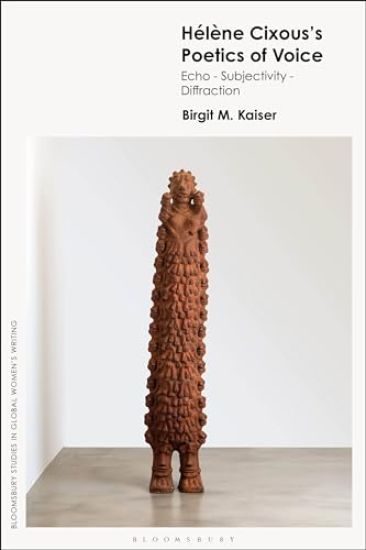
Hélène Cixous’s Poetics of Voice

Hélène Cixous’s Poetics of Voice

Birgit M. Kaiser

BLOOMSBURY PUBLISHING PLC
2024
sidottu
Exploring the poetic fictions of prominent French, feminist writer Hélène Cixous, this open access book highlights rich and timely ideas of selfhood in her work. With careful elaboration of the writer’s relationship with Algeria, Birgit M. Kaiser shows how Cixous reflects on experiences of colonial and patriarchal othering. More than that, she crafts a voice – an autofictive "I" – that takes the figure of Echo as a guiding mythology to portray selfhood as diffractive, always already exceeding binary models of self/other that remain central to conceptions of subjectivity. Putting forward the notion of ‘echology’, Kaiser examines how Cixous performs selfhood within ecologies of cohabitation, thereby critiquing and revising key tenets of psychoanalysis and its narrative of the subject.Drawing from famous texts such as The Laugh of the Medusa, The Newly Born Woman, and The Portrait of Dora, but also more recent titles like Osnabrück, So Close, Death Shall be Dethroned or Cixous's collaborations with Adel Abdessemed, Hélène Cixous's Poetics of Voice: Echo - Subjectivity - Diffraction offers fresh variations on familiar psychoanalytic and semiotic axes, and new ventures into dialogue with feminist new materialisms.Elegant, politically dynamic and providing exciting news ways into Cixous’s work and poetics, the concept of ‘echology’ lends new perspectives for feminist and postcolonial formations of selfhood and new imaginations of what it means to be human within planetary life.The eBook editions of this book are available open access under a CC BY-NC-ND 4.0 licence on bloomsburycollections.com. Open access was funded by Utrecht University.
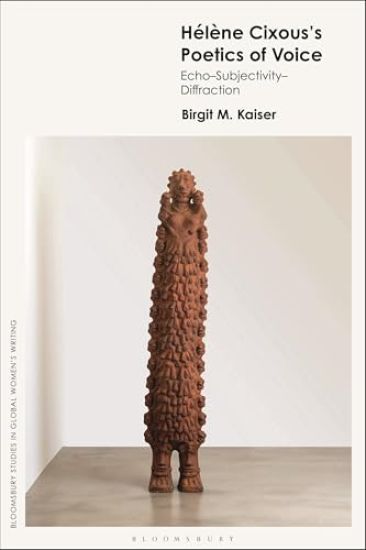
Hélène Cixous’s Poetics of Voice

Hélène Cixous’s Poetics of Voice

Birgit M. Kaiser

BLOOMSBURY PUBLISHING PLC
2026
nidottu
Exploring the poetic fictions of prominent French, feminist writer Hélène Cixous, this open access book highlights rich and timely ideas of selfhood in her work. With careful elaboration of the writer’s relationship with Algeria, Birgit M. Kaiser shows how Cixous reflects on experiences of colonial and patriarchal othering. More than that, she crafts a voice – an autofictive "I" – that takes the figure of Echo as a guiding mythology to portray selfhood as diffractive, always already exceeding binary models of self/other that remain central to conceptions of subjectivity. Putting forward the notion of ‘echology’, Kaiser examines how Cixous performs selfhood within ecologies of cohabitation, thereby critiquing and revising key tenets of psychoanalysis and its narrative of the subject.Drawing from famous texts such as The Laugh of the Medusa, The Newly Born Woman, and The Portrait of Dora, but also more recent titles like Osnabrück, So Close, Death Shall be Dethroned or Cixous's collaborations with Adel Abdessemed, Hélène Cixous's Poetics of Voice: Echo - Subjectivity - Diffraction offers fresh variations on familiar psychoanalytic and semiotic axes, and new ventures into dialogue with feminist new materialisms.Elegant, politically dynamic and providing exciting news ways into Cixous’s work and poetics, the concept of ‘echology’ lends new perspectives for feminist and postcolonial formations of selfhood and new imaginations of what it means to be human within planetary life.The eBook editions of this book are available open access under a CC BY-NC-ND 4.0 licence on bloomsburycollections.com. Open access was funded by Utrecht University.
Figures of Simplicity

Figures of Simplicity

Birgit M. Kaiser

State University of New York Press
2012
pokkari
A fascinating comparison of the work of Heinrich von Kleist and Herman Melville.Figures of Simplicity explores a unique constellation of figures from philosophy and literature-Heinrich von Kleist, Herman Melville, G. W. Leibniz, and Alexander Baumgarten-in an attempt to recover alternative conceptions of aesthetics and dimensions of thinking lost in the disciplinary narration of aesthetics after Kant. This is done primarily by tracing a variety of "simpletons" that populate the writings of Kleist and Melville. These figures are not entirely ignorant, or stupid, but simple. Their simplicity is a way of thinking; one that author Birgit Mara Kaiser here suggests is affective thinking. Kaiser avers that Kleist and Melville are experimenting in their texts with an affective mode of thinking, and thereby continue, she argues, a key line within eighteenth-century aesthetics: the relation of rationality and sensibility. Through her analyses, she offers an outline of what thinking can look like if we take affectivity into account.