
Kirjojen hintavertailu. Mukana 11 342 296 kirjaa ja 12 kauppaa.

Kirjahaku

Etsi kirjoja tekijän nimen, kirjan nimen tai ISBN:n perusteella.

12 kirjaa tekijältä Bo Rothstein

Controlling Corruption

Controlling Corruption

Bo Rothstein

Oxford University Press
2021
sidottu
This book presents a radically new approach of how societies can bring corruption under control. Since the late 1990s, the detrimental effects of corruption to human well-being have become well established in research. This has resulted in a stark increase in anti-corruption programs launched by international organizations such as the World Bank, the African Union, the EU, as well as many national development organizations. Despite these efforts, evaluations of the effects of these anti-corruption programs have been disappointing. As it can be measured, it is difficult to find substantial effects from such anti-corruption programs. The argument in this book is that this huge policy failure can be explained by three factors. Firstly, it argues that the corruption problem has been poorly conceptualized since what should count as the opposite of corruption has been left out. Secondly, the problem has been located in the wrong social spaces. It is neither a cultural nor a legal problem. Instead, it is for the most part located in what organization theory defines as the 'standard operating procedures' in social organizations. Thirdly, the general theory that has dominated anti-corruption efforts -- the principal-agent theory -- is based on serious misspecification of the basic nature of the problem. The book presents a reconceptualization of corruption and a new theory -- drawing on the tradition of the social contract - to explain it and motivate policies of how to get corruption under control. Several empirical cases serve to underpin this new theory ranging from the historical organization of religious practices to specific social policies, universal education, gender equality, and auditing. Combined, these amount to a strategic theory known as 'the indirect approach'.

Controlling Corruption

Controlling Corruption

Bo Rothstein

Oxford University Press
2021
nidottu
This book presents a radically new approach of how societies can bring corruption under control. Since the late 1990s, the detrimental effects of corruption to human well-being have become well established in research. This has resulted in a stark increase in anti-corruption programs launched by international organizations such as the World Bank, the African Union, the EU, as well as many national development organizations. Despite these efforts, evaluations of the effects of these anti-corruption programs have been disappointing. As it can be measured, it is difficult to find substantial effects from such anti-corruption programs. The argument in this book is that this huge policy failure can be explained by three factors. Firstly, it argues that the corruption problem has been poorly conceptualized since what should count as the opposite of corruption has been left out. Secondly, the problem has been located in the wrong social spaces. It is neither a cultural nor a legal problem. Instead, it is for the most part located in what organization theory defines as the 'standard operating procedures' in social organizations. Thirdly, the general theory that has dominated anti-corruption efforts -- the principal-agent theory -- is based on serious misspecification of the basic nature of the problem. The book presents a reconceptualization of corruption and a new theory -- drawing on the tradition of the social contract - to explain it and motivate policies of how to get corruption under control. Several empirical cases serve to underpin this new theory ranging from the historical organization of religious practices to specific social policies, universal education, gender equality, and auditing. Combined, these amount to a strategic theory known as 'the indirect approach'.
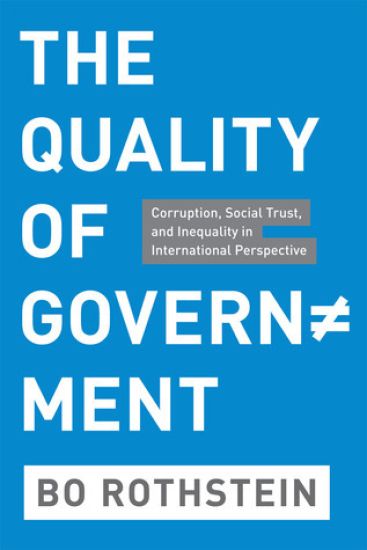
The Quality of Government

The Quality of Government

Bo Rothstein

University of Chicago Press
2011
sidottu
The relationship between government, virtue, and wealth has held a special fascination since Aristotle, and the importance of each frames policy debates today in both developed and developing countries. While it's clear that low-quality government institutions have tremendous negative effects on the health and wealth of societies, the criteria for good governance remain far from clear. In this pathbreaking book, leading political scientist Bo Rothstein provides a theoretical foundation for empirical analysis on the connection between the quality of government and important economic, political, and social outcomes. Focusing on the effects of government policies, he argues that unpredictable actions constitute a severe impediment to economic growth and development - and that a basic characteristic of quality government is impartiality in the exercise of power. This is borne out by cross-sectional analyses, experimental studies, and in-depth historical investigations. Timely and topical, "The Quality of Government" tackles such issues as political legitimacy, social capital, and corruption.
THE QUALITY OF GOVERNMENT - CORRUPTION, SOCIALTRUST AND INEQUALITY IN INTERNATIONAL PERSPECTIVE
The relationship between government, virtue, and wealth has held a special fascination since Aristotle, and the importance of each frames policy debates today in both developed and developing countries. While it's clear that low-quality government institutions have tremendous negative effects on the health and wealth of societies, the criteria for good governance remain far from clear. In this pathbreaking book, leading political scientist Bo Rothstein provides a theoretical foundation for empirical analysis on the connection between the quality of government and important economic, political, and social outcomes. Focusing on the effects of government policies, he argues that unpredictable actions constitute a severe impediment to economic growth and development - and that a basic characteristic of quality government is impartiality in the exercise of power. This is borne out by cross-sectional analyses, experimental studies, and in-depth historical investigations. Timely and topical, "The Quality of Government" tackles such issues as political legitimacy, social capital, and corruption.
Just Institutions Matter

Just Institutions Matter

Bo Rothstein

Cambridge University Press
1998
pokkari
In this book Bo Rothstein seeks to defend the universal welfare state against a number of important criticisms which it has faced in recent years. He combines genuine philosophical analysis of normative issues concerning what the state ought to do with empirical political scientific research in public policy examining what the state can do. Issues discussed include the relationship between welfare state and civil society, the privatization of social services, and changing values within society. His analysis centres around the importance of political institutions as both normative and empirical entities, and Rothstein argues that the choice of such institutions at certain formative moments in a country’s history is what determines the political support for different types of social policy. He thus explains the great variation among contemporary welfare states in terms of differing moral and political logics which have been set in motion by the deliberate choices of political institutions. The book is an important contribution to both philosophical and political debates about the future of the welfare state.
Social Traps and the Problem of Trust

Social Traps and the Problem of Trust

Bo Rothstein

Cambridge University Press
2005
pokkari
A 'social trap' is a situation where individuals, groups or organisations are unable to cooperate owing to mutual distrust and lack of social capital, even where cooperation would benefit all. Examples include civil strife, pervasive corruption, ethnic discrimination, depletion of natural resources and misuse of social insurance systems. Much has been written attempting to explain the problem, but rather less material is available on how to escape it. In this book, Bo Rothstein explores how social capital and social trust are generated and what governments can do about it. He argues that it is the existence of universal and impartial political institutions together with public policies which enhance social and economic equality that creates social capital. By introducing the theory of collective memory into the discussion, Rothstein makes an empirical and theoretical claim for how universal institutions can be established.
Social Traps and the Problem of Trust

Social Traps and the Problem of Trust

Bo Rothstein

Cambridge University Press
2005
sidottu
A 'social trap' is a situation where individuals, groups or organisations are unable to cooperate owing to mutual distrust and lack of social capital, even where cooperation would benefit all. Examples include civil strife, pervasive corruption, ethnic discrimination, depletion of natural resources and misuse of social insurance systems. Much has been written attempting to explain the problem, but rather less material is available on how to escape it. In this book, Bo Rothstein explores how social capital and social trust are generated and what governments can do about it. He argues that it is the existence of universal and impartial political institutions together with public policies which enhance social and economic equality that creates social capital. By introducing the theory of collective memory into the discussion, Rothstein makes an empirical and theoretical claim for how universal institutions can be established.
De samhälleliga institutionernas kvalitet : slutrapport från ett forskningsprogram
Det statsvetenskapliga forskningsprogrammet The Quality of Government Institute at University of Gothenburg tilldelades anslag av Stiftelsen Riksbankens Jubileumsfond år 2007. Programmets forskare kan visa att korrupta, inkompetenta och på annat sätt dysfunktionella samhällsinstitutioner är en viktig orsak till fattigdom och mänskligt lidande. QoG-institutets unika databaser kommer dessutom att möjliggöra fortsatt forskning inom fältet.Detta är programmets slutrapport.
Den socialdemokratiska staten : reformer och förvaltning inom svensk arbetsmarknads- och skolpolitik
Bo Rothstein är idag en av Sveriges ledande stats­vetare. Hans avhandling, Den socialdemokratiska staten, blev startskottet för hans tre uppmärksammade arbeten om den moderna staten. I denna bok, som Arkiv förlag nu återutger, finns utgångspunkten för såväl Den korporativa staten som det mer programmatiska a­rbetet Vad bör staten göra? I Den socialdemokratiska staten tar sig Rothstein an två olika politikområden: skolan och arbetsmark­naden. Han ser Arbetsmarknadsstyrelsen som en socialdemokratisk reformbyråkrati, präglad av en kaderförvaltning och befolkad av tjänstemän med rötter i fackföreningar och arbetarrörelse. Jämfört med AMS är skolans byråkrati, förkroppsligad i Skolöverstyrelsen, mer traditionell. Dessa två slags förvaltningsapparater gav socialdemokratin radikalt olika möjlig­heter att genomdriva sina politiska mål, framgångsrikt ifråga om arbetsmarknaden och mindre framgångsrikt i skolans fall. Rothstein visar att politik inte bara är att vilja utan också att ha verktyg för att kunna genomföra.
Vad bör staten göra? : om välfärdsstatens moraliska och politiska logik
Försämrade stats?nanser, ökande kritik mot staten som vill styra och ställa med invånarnas privata sfär, frågan om privatisering av offentliga uppgifter och medborgarnas krav på större valfrihet leder fram till frågan om den generella välfärdspolitiken måste överges till förmån för mer individuella lösningar.I denna bok analyseras vad staten bör göra, dvs. hur statens förhållande till medborgarna bör kon-strueras, vad rättvisa är och hur denna kan uppnås. Denna spekulativa teori kombineras med mera jord-nära forskningsresultat om vad staten kan göra. Författaren redogör för den moderna politiska ?lo-so?ns diskussion om social rättvisa och går igenom forskningen om sociala reformers implementering. I denna forskning har man försökt ta reda på vilka slags välfärdsreformer som fungerar och vilka som vanligtvis misslyckas. Resonemanget mynnar ut i en konstruktiv teori om den moderna välfärds-politikens framtid.Här diskuteras också hur man skall förklara varför sociala normer om rättvisa varierar, varför välfärdspolitiken är så olika i olika länder, frågan om valfrihet, konkurrens och privatisering av offentliga tjänster och hur man historiskt kan karaktärisera den svenska välfärdspolitikens inriktning.I denna andra reviderade upplaga ?nns ett ny-skrivet kapitel om välfärdspolitiken och det sociala kapitalet.
Grundbulten : tillit och visionen om en liberal socialism
Sedan några årtionden är både liberalism och socialism på stark tillbakagång och utsatta för hård kritik – ofta från nya och oväntade håll. Den svenska demokratin har kommit på obestånd. I sin första populärvetenskapliga bok ger Bo Rothstein läsaren ett noga underbyggt förslag, det han kallar liberal socialism: en väg bort från en fruktans politik i riktning mot mellanmänsklig tillit som grund för ett demokratiskt samhälle – och en demokratisk ekonomi. Tanken är lika klar som radikal: Liberalismens löfte om respekt för individens autonomi och socialismens löfte om social och ekonomisk rättvisa borde kunna ta varandra i hand.
Grundbulten : tillit och visionen om en liberal socialism
Sedan några årtionden är både liberalism och socialism på stark tillbakagång och utsatta för hård kritik – ofta från nya och oväntade håll. Den svenska demokratin har kommit på obestånd. I sin första populärvetenskapliga bok ger Bo Rothstein läsaren ett noga underbyggt förslag, det han kallar liberal socialism: en väg bort från en fruktans politik i riktning mot mellanmänsklig tillit som grund för ett demokratiskt samhälle – och en demokratisk ekonomi. Tanken är lika klar som radikal: Liberalismens löfte om respekt för individens autonomi och socialismens löfte om social och ekonomisk rättvisa borde kunna ta varandra i hand.