
Kirjahaku
Etsi kirjoja tekijän nimen, kirjan nimen tai ISBN:n perusteella.
9 kirjaa tekijältä Boris Pritsker
Expanding Mathematical Toolbox: Interweaving Topics, Problems, and Solutions
Boris Pritsker
TAYLOR FRANCIS LTD
2023
nidottu
Expanding Mathematical Toolbox: Interweaving Topics, Problems, and Solutions offers several topics from different mathematical disciplines and shows how closely they are related. The purpose of this book is to direct the attention of readers who have an interest in and talent for mathematics to engaging and thought-provoking problems that should help them change their ways of thinking, entice further exploration and possibly lead to independent research and projects in mathematics. In spite of the many challenging problems, most solutions require no more than a basic knowledge covered in a high-school math curriculum.To shed new light on a deeper appreciation for mathematical relationships, the problems are selected to demonstrate techniques involving a variety of mathematical ideas. Included are some interesting applications of trigonometry, vector algebra and Cartesian coordinate system techniques, and geometrical constructions and inversion in solving mechanical engineering problems and in studying models explaining non-Euclidean geometries.This book is primarily directed at secondary school teachers and college professors. It will be useful in teaching mathematical reasoning because it emphasizes how to teach students to think creatively and strategically and how to make connections between math disciplines. The text also can be used as a resource for preparing for mathematics Olympiads. In addition, it is aimed at all readers who want to study mathematics, gain deeper understanding and enhance their problem-solving abilities. Readers will find fresh ideas and topics offering unexpected insights, new skills to expand their horizons and an appreciation for the beauty of mathematics.
Expanding Mathematical Toolbox: Interweaving Topics, Problems, and Solutions
Boris Pritsker
TAYLOR FRANCIS LTD
2023
sidottu
Expanding Mathematical Toolbox: Interweaving Topics, Problems, and Solutions offers several topics from different mathematical disciplines and shows how closely they are related. The purpose of this book is to direct the attention of readers who have an interest in and talent for mathematics to engaging and thought-provoking problems that should help them change their ways of thinking, entice further exploration and possibly lead to independent research and projects in mathematics. In spite of the many challenging problems, most solutions require no more than a basic knowledge covered in a high-school math curriculum.To shed new light on a deeper appreciation for mathematical relationships, the problems are selected to demonstrate techniques involving a variety of mathematical ideas. Included are some interesting applications of trigonometry, vector algebra and Cartesian coordinate system techniques, and geometrical constructions and inversion in solving mechanical engineering problems and in studying models explaining non-Euclidean geometries.This book is primarily directed at secondary school teachers and college professors. It will be useful in teaching mathematical reasoning because it emphasizes how to teach students to think creatively and strategically and how to make connections between math disciplines. The text also can be used as a resource for preparing for mathematics Olympiads. In addition, it is aimed at all readers who want to study mathematics, gain deeper understanding and enhance their problem-solving abilities. Readers will find fresh ideas and topics offering unexpected insights, new skills to expand their horizons and an appreciation for the beauty of mathematics.
Mathematical Labyrinths. Pathfinding
Boris Pritsker
World Scientific Publishing Co Pte Ltd
2020
sidottu
Mathematical Labyrinths. Pathfinding provides an overview of various non-standard problems and the approaches to their solutions. The essential idea is a framework laid upon the reader on how to solve nonconventional problems — particularly in the realm of mathematics and logic. It goes over the key steps in approaching a difficult problem, contemplating a plan for its solution, and discusses set of mental models to solve math problems.The book is not a routine set of problems. It is rather an entertaining and educational journey into the fascinating world of mathematical reasoning and logic. It is about finding the best path to a solution depending on the information given, asking and answering the right questions, analyzing and comparing alternative approaches to problem solving, searching for generalizations and inventing new problems. It also considers as an important pedagogical tool playing mathematical and logical games, deciphering mathematical sophisms, and interpreting mathematical paradoxes.It is suitable for mathematically talented and curious students in the age range 10-20. There are many 'Eureka'- type, out of the ordinary, fun problems that require bright idea and insight. These intriguing and thought-provoking brainteasers and logic puzzles should be enjoyable by the audience of almost any age group, from 6-year-old children to 80-year-old and older adults.
Mathematical Labyrinths. Pathfinding
Boris Pritsker
World Scientific Publishing Co Pte Ltd
2020
nidottu
Mathematical Labyrinths. Pathfinding provides an overview of various non-standard problems and the approaches to their solutions. The essential idea is a framework laid upon the reader on how to solve nonconventional problems — particularly in the realm of mathematics and logic. It goes over the key steps in approaching a difficult problem, contemplating a plan for its solution, and discusses set of mental models to solve math problems.The book is not a routine set of problems. It is rather an entertaining and educational journey into the fascinating world of mathematical reasoning and logic. It is about finding the best path to a solution depending on the information given, asking and answering the right questions, analyzing and comparing alternative approaches to problem solving, searching for generalizations and inventing new problems. It also considers as an important pedagogical tool playing mathematical and logical games, deciphering mathematical sophisms, and interpreting mathematical paradoxes.It is suitable for mathematically talented and curious students in the age range 10-20. There are many 'Eureka'- type, out of the ordinary, fun problems that require bright idea and insight. These intriguing and thought-provoking brainteasers and logic puzzles should be enjoyable by the audience of almost any age group, from 6-year-old children to 80-year-old and older adults.
The goal of the book is to provide insight into many enjoyable and fascinating aspects of geometry, and to reveal interesting geometrical properties. The emphasis is on the practical applications of theory in the problem-solving process. The chapters cover a myriad of topics among which are the classic theorems and formulas such as Archimedes' Law of the Lever, the Pythagorean Theorem, Heron's formula, Brahmagupta's formula, Appollonius's Theorem, Euler's line properties, the Nine-Point Circle, Fagnano's Problem, the Steiner-Lehmus Theorem, Napoleon's Theorem, Ceva's Theorem, Menelaus's Theorem, Pompeiu's Theorem, and Morley's Miracle. The book focuses on geometric thinking — what it means, how to develop it, and how to recognize it. 'Geometrical Kaleidoscope' consists of a kaleidoscope of topics that seem to not be related at first glance. However, that perception disappears as you go from chapter to chapter and explore the multitude of surprising relationships, unexpected connections, and links. Readers solving a chain of problems will learn from them general techniques, rather than isolated instances of the application of a technique. In spite of the many problems' challenging character, their solutions require no more than a basic knowledge covered in a high school geometry curriculum. There are plenty of problems for readers to work out for themselves (solutions are provided at the end of the book).In the 2nd edition of the book there are many new ideas and additional explanations that help the reader better understand the solutions of problems and connect the chapters to one another. A new chapter 'Alternative proofs of the Pythagorean Theorem' is added. It covers seven different proofs of the famous theorem and discusses its generalizations and applications. There is also Appendix and Index added, which were missing in the first edition of the book.
The goal of the book is to provide insight into many enjoyable and fascinating aspects of geometry, and to reveal interesting geometrical properties. The emphasis is on the practical applications of theory in the problem-solving process. The chapters cover a myriad of topics among which are the classic theorems and formulas such as Archimedes' Law of the Lever, the Pythagorean Theorem, Heron's formula, Brahmagupta's formula, Appollonius's Theorem, Euler's line properties, the Nine-Point Circle, Fagnano's Problem, the Steiner-Lehmus Theorem, Napoleon's Theorem, Ceva's Theorem, Menelaus's Theorem, Pompeiu's Theorem, and Morley's Miracle. The book focuses on geometric thinking — what it means, how to develop it, and how to recognize it. 'Geometrical Kaleidoscope' consists of a kaleidoscope of topics that seem to not be related at first glance. However, that perception disappears as you go from chapter to chapter and explore the multitude of surprising relationships, unexpected connections, and links. Readers solving a chain of problems will learn from them general techniques, rather than isolated instances of the application of a technique. In spite of the many problems' challenging character, their solutions require no more than a basic knowledge covered in a high school geometry curriculum. There are plenty of problems for readers to work out for themselves (solutions are provided at the end of the book).In the 2nd edition of the book there are many new ideas and additional explanations that help the reader better understand the solutions of problems and connect the chapters to one another. A new chapter 'Alternative proofs of the Pythagorean Theorem' is added. It covers seven different proofs of the famous theorem and discusses its generalizations and applications. There is also Appendix and Index added, which were missing in the first edition of the book.
Learning Geometry Through Problem Solving
Boris Pritsker
WORLD SCIENTIFIC PUBLISHING CO PTE LTD
2026
sidottu
This new volume focuses on problem-solving in plane geometry topics and is suitable for any reader with elementary geometrical knowledge at the secondary school level. The author has assembled an exceptional collection of geometry exercises with approximately equal weight allocated among different types of problems: proofs, calculations, and geometric straightedge-and-compass constructions.The book is divided into seven chapters, with sets of problems arranged in approximate order of increasing difficulty. The first chapter is devoted to a discussion of several useful strategies and techniques for approaching geometric problems. The next chapter presents warm-up exercises to 'stretch' geometric muscles and refresh the very basic facts about topics covered in subsequent chapters. Each of the following chapters: 'Triangles,' 'Quadrilaterals,' 'Circles,' and 'Areas' has three sections (A, B, and C), starting with simple problems and questions (section A), progressing to intermediate problems (section B), and ending with more advanced and complex challenges (section C), some of which were offered in math Olympiads and various math contests. The final chapter is a mixture of challenging problems comprising material covered in previous chapters.At the end of the book, the 'Solutions and Answers' section provides detailed explanations and solutions for all the problems. In that section, for many interesting problems, the author reveals not just one but multiple alternative solutions, compares them, and discusses their effectiveness. The emphasis is on how to acquire insight and develop different strategies for tackling geometrical challenges. By solving these problems, readers discover fascinating links between them, unlock geometrical secrets, build self-confidence, and — for many skeptics — discover that learning geometry can be fun and enjoyable!
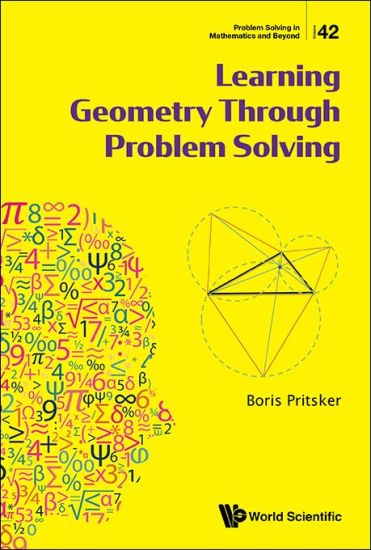
Learning Geometry Through Problem Solving
Boris Pritsker
WORLD SCIENTIFIC PUBLISHING CO PTE LTD
2026
nidottu
This new volume focuses on problem-solving in plane geometry topics and is suitable for any reader with elementary geometrical knowledge at the secondary school level. The author has assembled an exceptional collection of geometry exercises with approximately equal weight allocated among different types of problems: proofs, calculations, and geometric straightedge-and-compass constructions.The book is divided into seven chapters, with sets of problems arranged in approximate order of increasing difficulty. The first chapter is devoted to a discussion of several useful strategies and techniques for approaching geometric problems. The next chapter presents warm-up exercises to 'stretch' geometric muscles and refresh the very basic facts about topics covered in subsequent chapters. Each of the following chapters: 'Triangles,' 'Quadrilaterals,' 'Circles,' and 'Areas' has three sections (A, B, and C), starting with simple problems and questions (section A), progressing to intermediate problems (section B), and ending with more advanced and complex challenges (section C), some of which were offered in math Olympiads and various math contests. The final chapter is a mixture of challenging problems comprising material covered in previous chapters.At the end of the book, the 'Solutions and Answers' section provides detailed explanations and solutions for all the problems. In that section, for many interesting problems, the author reveals not just one but multiple alternative solutions, compares them, and discusses their effectiveness. The emphasis is on how to acquire insight and develop different strategies for tackling geometrical challenges. By solving these problems, readers discover fascinating links between them, unlock geometrical secrets, build self-confidence, and — for many skeptics — discover that learning geometry can be fun and enjoyable!