Kirjojen hintavertailu. Mukana 11 244 527 kirjaa ja 12 kauppaa.

Kirjahaku

Etsi kirjoja tekijän nimen, kirjan nimen tai ISBN:n perusteella.

10 kirjaa tekijältä Boris Z. Rumer

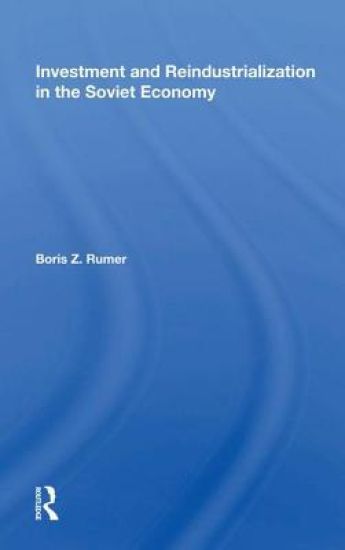
Investment and Reindustrialization in the Soviet Economy
Investment activity in the Soviet Union is presently undergoing a decline hitherto unknown in the history of the nation: The growth of capital investment has stopped, while levels of production have fallen. One important factor in this phenomenon is the Soviet policy of reindustrialization—shifting new investments into the expansion and improvement of existing facilities—which severely limits capital available for new construction. In this book, Dr. Rumer examines current Soviet investment policies and assesses their impact on economic development, especially in Siberia. Reindustrialization is intended to combine more rapid amortization for updating and retooling, growth in the volume of industrial output, and minimal capital investment. However, concludes Dr. Rumer, this investment pattern hinders the development of Siberia and thus reinforces the spatial polarization of fuel-energy and raw-material resources in the east of the country and the manufacturing industry in the west, with serious consequences for Soviet strategic/military vulnerability and for the Soviet economy.
Central Asia and the New Global Economy
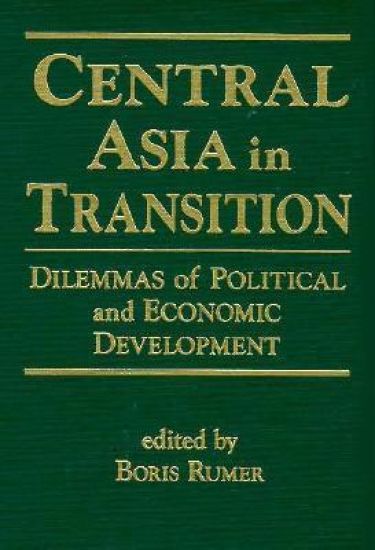
Central Asia's new states have been buffeted by financial ill winds from East Asia and Russia and by Islamic revolutionary movements from the south. In the context of widespread and deepening impoverishment, endemic corruption, gaping inequalities, and external pressures to undertake difficult reforms, economic crisis threatens to expand into profoundly destabilizing social and political crises as well.This volume analyzes the geopolitical and macroeconomic situation of Central Asia, local policy responses to the current crisis, and alternative scenarios for the foreseeable future. It devotes particular attention to Kazakhstan, Turkmenistan, and Uzbekistan. Beyond the immediate case, the book focuses on policy measures and institutional improvements that could most directly impact the capacity of economies in the region to adapt to the globalization process.
Central Asia

Central Asia

Boris Z. Rumer

Routledge
2002
sidottu
The societies of Central Asia are besieged from within and without. The political elites - virtually unchanged despite the transition to independent statehood - battle radical Islamic movements and other oppositional threats that are continuously fueled by economic instability, corruption, environmental deterioration, and the collapse of social services. This survey of political, economic, and social development in Central Asia offers geopolitical context, unparalleled coverage, and analytical depth to our understanding of a region that appears to be rapidly spiraling into crisis.
Central Asia

Central Asia

Boris Z. Rumer

Routledge
2002
nidottu
The societies of Central Asia are besieged from within and without. The political elites - virtually unchanged despite the transition to independent statehood - battle radical Islamic movements and other oppositional threats that are continuously fueled by economic instability, corruption, environmental deterioration, and the collapse of social services. This survey of political, economic, and social development in Central Asia offers geopolitical context, unparalleled coverage, and analytical depth to our understanding of a region that appears to be rapidly spiraling into crisis.
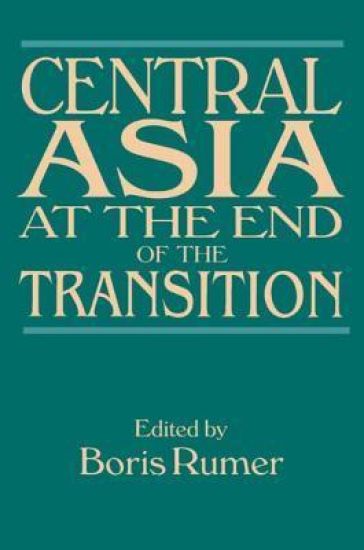
Central Asia at the End of the Transition
For better or worse, the former Soviet republics of Central Asia have largely completed their post-independence transitions. Over more than a decade, they have established themselves as independent states whose internal regimes and external relations have characteristic patterns and vulnerabilities both individually and as a group. The purpose of this volume is to assess both what has been accomplished and the trends of development in the region, especially its leading states. How sound are the foundations of this "bulwark against the spread of terrorism" in Eurasia?
Central Asia at the End of the Transition
For better or worse, the former Soviet republics of Central Asia have largely completed their post-independence transitions. Over more than a decade, they have established themselves as independent states whose internal regimes and external relations have characteristic patterns and vulnerabilities both individually and as a group. The purpose of this volume is to assess both what has been accomplished and the trends of development in the region, especially its leading states. How sound are the foundations of this "bulwark against the spread of terrorism" in Eurasia?
Soviet Central Asia

Soviet Central Asia

Boris Z. Rumer

TAYLOR FRANCIS LTD
2023
sidottu
Soviet Central Asia (1989) explores the economic development of the four republics of Central Asia that suffered under Moscow’s economic policies – Uzbekistan, Tajikistan, Turkmenistan and Kirghizia. The Soviet literary weekly Literaturnaia gazeta described Soviet economic policies there as a ‘tragic experiment’, and this book argues that Central Asia serves as a prime example of the failure of Soviet regional development policies. It analyses the special role of the region in the Soviet economy and such key issues as industrial development, cotton production, water resources and labour. It also addresses the social ramifications of the underdevelopment of the region’s economy and the impact of new policies under Gorbachev.
Soviet Central Asia

Soviet Central Asia

Boris Z. Rumer

TAYLOR FRANCIS LTD
2024
nidottu
Soviet Central Asia (1989) explores the economic development of the four republics of Central Asia that suffered under Moscow’s economic policies – Uzbekistan, Tajikistan, Turkmenistan and Kirghizia. The Soviet literary weekly Literaturnaia gazeta described Soviet economic policies there as a ‘tragic experiment’, and this book argues that Central Asia serves as a prime example of the failure of Soviet regional development policies. It analyses the special role of the region in the Soviet economy and such key issues as industrial development, cotton production, water resources and labour. It also addresses the social ramifications of the underdevelopment of the region’s economy and the impact of new policies under Gorbachev.