
Kirjojen hintavertailu. Mukana 12 016 292 kirjaa ja 12 kauppaa.

Kirjahaku

Etsi kirjoja tekijän nimen, kirjan nimen tai ISBN:n perusteella.

2 kirjaa tekijältä Brenda Machosky

Thinking Allegory Otherwise

Thinking Allegory Otherwise

Brenda Machosky

Stanford University Press
2009
sidottu
Thinking Allegory Otherwise is a unique collection of essays by allegory specialists and other scholars who engage allegory in exciting new ways. The contributors include Jody Enders, Karen Feldman, Angus Fletcher, Blair Hoxby, Brenda Machosky, Catherine Gimelli Martin, Stephen Orgel, Maureen Quilligan, James Paxson, Daniel Selcer, Gordon Teskey, and Richard Wittman. The essays are not limited to an examination of literary texts and works of art, and in fact focus on a wide range of topics that includes architecture, philosophy, theatre, science, and law. The book proves the truth of the statement that all language is allegorical, and more importantly it shows its consequences. To "think allegory otherwise" is to think otherwise— to rethink not only the idea of allegory itself, but also the law and its execution, the literality of figurative abstraction, and the figurations upon which even hard science depends.
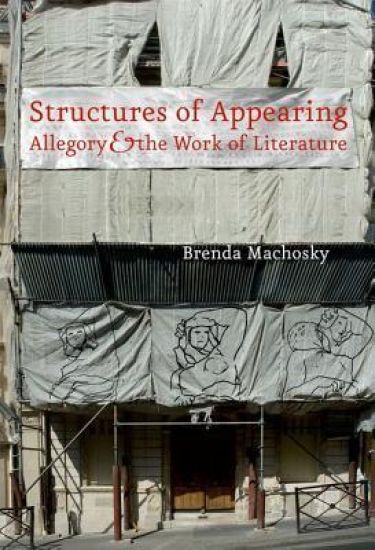
Structures of Appearing

Structures of Appearing

Brenda Machosky

Fordham University Press
2012
sidottu
Taking a phenomenological approach to allegory, Structures of Appearing seeks to revise the history of aesthetics, identifying it is an ideology that has long subjugated art to philosophical criteria of judgment. Rather than being a mere signifying device, allegory is the structure by which something appears that cannot otherwise appear. It thus supports the appearance and necessary experience of philosophical ideas that are otherwise impossible to present or represent. Allegory is as central to philosophy as it is to literature. Following suggestions by Walter Benjamin, Machosky argues that allegory itself must appear allegorically and thus cannot be forced into a logos-centric metaphysical system. She builds on the work of Maurice Blanchot and Emmanuel Levinas to argue that the allegorical image is not a likeness to anything, not a subjective reflection, but an absolute otherness that becomes accessible by virtue of its unique structure. Allegory thus makes possible not merely the textual work of literature but the work that literature is. Machosky develops this insight in readings of Prudentius, Dante, Spenser, Hegel, Goethe, and Kafka.