Kirjojen hintavertailu. Mukana 11 244 527 kirjaa ja 12 kauppaa.

Kirjahaku

Etsi kirjoja tekijän nimen, kirjan nimen tai ISBN:n perusteella.

13 kirjaa tekijältä Brett Christophers

The Great Leveler

The Great Leveler

Brett Christophers

Harvard University Press
2016
sidottu
For all the turmoil that roiled financial markets during the Great Recession and its aftermath, Wall Street forecasts once again turned bullish and corporate profitability soared to unprecedented heights. How does capitalism consistently generate profits despite its vulnerability to destabilizing events that can plunge the global economy into chaos? The Great Levelerelucidates the crucial but underappreciated role of the law in regulating capitalism’s rhythms of accumulation and growth.Brett Christophers argues that capitalism requires a delicate balance between competition and monopoly. When monopolistic forces become dominant, antitrust law steps in to discourage the growth of giant corporations and restore competitiveness. When competitive forces become dominant, intellectual property law steps in to protect corporate assets and encourage investment. These two sets of laws—antitrust and intellectual property—have a pincer effect on corporate profitability, ensuring that markets become neither monopolistic, which would lead to rent-seeking and stagnation, nor overly competitive, which would drive down profits.Christophers pursues these ideas through a close study of the historical development of American and British capitalist economies from the late nineteenth century to the present, tracing the relationship between monopoly and competition in each country and the evolution of legal mechanisms for keeping these forces in check. More than an illuminating study of the economic role of law, The Great Leveler is a bold and fresh dissection of the anatomy of modern capitalism.
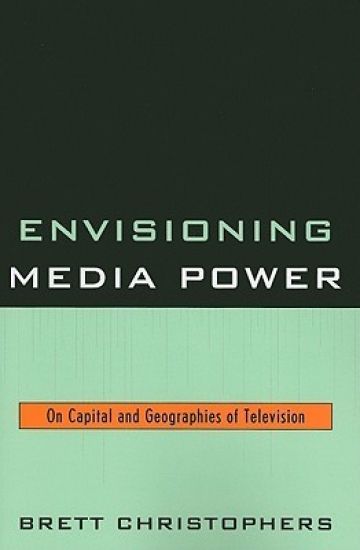
Envisioning Media Power

Envisioning Media Power

Brett Christophers

Lexington Books
2009
sidottu
Envisioning Media Power develops an original geographical perspective on the nature and exercise of power in the international television economy. It uses theories of political economy as the basis for a comparative empirical examination of the UK and New Zealand television markets, while closely considering these markets' respective relationships with the US market and its globally-influential media corporations. In fleshing out this geographical perspective, the book critically addresses the power to produce, reproduce, and extract profit from territorialized media markets. To understand such powers, the book examines processes of creation and dissemination of industry knowledge, structures of industry governance, and the locational characteristics of television's operational economy. Through its rigorous and creative combination of conceptual insights with empirical substance, Envisioning Media Power both illuminates the fabric of television's international space economy, and ultimately offers a unique theoretic argument - suggesting that power, knowledge and geography are inseparable not only from one another, but from the process of accumulation of media capital.
Envisioning Media Power

Envisioning Media Power

Brett Christophers

Lexington Books
2010
nidottu
Envisioning Media Power develops an original geographical perspective on the nature and exercise of power in the international television economy. It uses theories of political economy as the basis for a comparative empirical examination of the UK and New Zealand television markets, while closely considering these markets' respective relationships with the US market and its globally influential media corporations. In fleshing out this geographical perspective, the book critically addresses the power to produce, reproduce, and extract profit from territorialized media markets. To understand such powers, the book examines processes of creation and dissemination of industry knowledge, structures of industry governance, and the locational characteristics of television's operational economy. Through its rigorous and creative combination of conceptual insights with empirical substance, Envisioning Media Power both illuminates the fabric of television's international space economy, and ultimately offers a unique theoretic argument—suggesting that power, knowledge and geography are inseparable not only from one another, but from the process of accumulation of media capital.
Positioning the Missionary

Positioning the Missionary

Brett Christophers

University of British Columbia Press
1998
sidottu
Positioning the Missionary examines Anglican missionary work in nineteenth-century British Columbia. Its chief protagonists are John Booth Good, an agent of the Society for the Propagation of the Gospel, and the Nlha7kapmx poeple of southwestern B.C. Asking why the Nkha7kapmx embraced Good, how he sought to evangelize and civilize them, and how they responded, it situates Good's mission at several scales: the local ethnographic literature; histories of contact and conflict in mainland B.C. from the early nineteenth century; the theology and sociology of mission; and the recent critical literature on European colonialism.Christophers rethinks mission work in the light of contemporary theories of colonial discourse and disciplinary power, and speculates about the interpretative potential of such concepts. In addition to Good's encounter with the Nlha7kapmx, Positioning the Missionary also refers to other colonial missions, identifying by turns the peculiarity of Good's experience and the ways in which it conforms to broader patterns of mission history. As a reflection on the ongoing politics of colonialism, this book discusses Good's contribution to the devastation of Nlha7kapmx culture and his duplicitous role in the appropriation of Nlha7kapmx lands.
Positioning the Missionary

Positioning the Missionary

Brett Christophers

University of British Columbia Press
1999
pokkari
Positioning the Missionary examines Anglican missionary work in nineteenth-century British Columbia. Its chief protagonists are John Booth Good, an agent of the Society for the Propagation of the Gospel, and the Nlha7kapmx poeple of southwestern B.C. Asking why the Nkha7kapmx embraced Good, how he sought to evangelize and civilize them, and how they responded, it situates Good's mission at several scales: the local ethnographic literature; histories of contact and conflict in mainland B.C. from the early nineteenth century; the theology and sociology of mission; and the recent critical literature on European colonialism.Christophers rethinks mission work in the light of contemporary theories of colonial discourse and disciplinary power, and speculates about the interpretative potential of such concepts. In addition to Good's encounter with the Nlha7kapmx, Positioning the Missionary also refers to other colonial missions, identifying by turns the peculiarity of Good's experience and the ways in which it conforms to broader patterns of mission history. As a reflection on the ongoing politics of colonialism, this book discusses Good's contribution to the devastation of Nlha7kapmx culture and his duplicitous role in the appropriation of Nlha7kapmx lands.
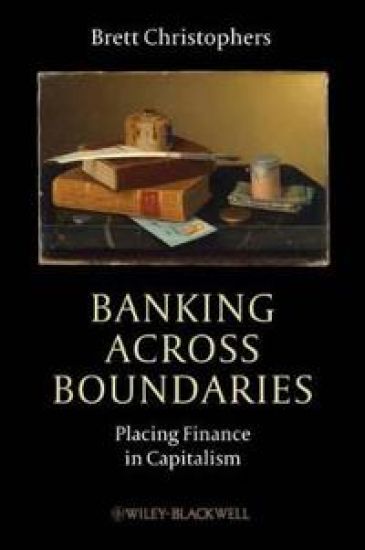
Banking Across Boundaries

Banking Across Boundaries

Brett Christophers

Wiley-Blackwell (an imprint of John Wiley Sons Ltd)
2013
nidottu
This compelling contribution to contemporary debates about the banking industry offers a unique perspective on its geographical and conceptual 'placement'. It traces the evolving links between the two, revealing how our notions of banking 'productiveness' have evolved alongside the shifting loci of banking activity. An original contribution to the urgent debates taking place on banking sparked by the current economic crisisOffers a unique perspective on the geographical and social concept of 'placement' of the banking industryCombines theoretical approaches from political economy with contemporary literature on the performativity of economicsDetails the globalization of Western banking, and analyzes how representations of the banking sector's productiveness have shifted throughout the evolution of Western economic theoryAnalyzes the social conceptualization of the nature – and value – of the banking industryIlluminates not only how economic ideas 'perform' and shape the economic world, but how those ideas are themselves always products of particular economic realities
Banking Across Boundaries

Banking Across Boundaries

Brett Christophers

Wiley-Blackwell (an imprint of John Wiley Sons Ltd)
2013
sidottu
This compelling contribution to contemporary debates about the banking industry offers a unique perspective on its geographical and conceptual 'placement'. It traces the evolving links between the two, revealing how our notions of banking 'productiveness' have evolved alongside the shifting loci of banking activity. An original contribution to the urgent debates taking place on banking sparked by the current economic crisisOffers a unique perspective on the geographical and social concept of 'placement' of the banking industryCombines theoretical approaches from political economy with contemporary literature on the performativity of economicsDetails the globalization of Western banking, and analyzes how representations of the banking sector's productiveness have shifted throughout the evolution of Western economic theoryAnalyzes the social conceptualization of the nature – and value – of the banking industryIlluminates not only how economic ideas 'perform' and shape the economic world, but how those ideas are themselves always products of particular economic realities
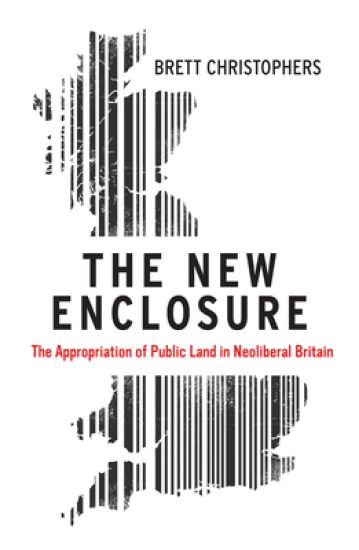
The New Enclosure

The New Enclosure

Brett Christophers

Verso Books
2019
nidottu
Much has been written about Britain's trailblazing post-1970s privatization program, but the biggest privatization of them all has until now escaped scrutiny: the privatization of land. Since Margaret Thatcher took power in 1979, and hidden from the public eye, about 10 per cent of the entire British land mass, including some of its most valuable real estate, has passed from public to private hands. Forest land, defence land, health service land and above all else local authority land- for farming and school sports, for recreation and housing - has been sold off en masse. Why? How? And with what social, economic and political consequences? The New Enclosure provides the first ever study of this profoundly significant phenomenon, situating it as a centrepiece of neoliberalism in Britain and as a successor programme to the original eighteenth-century enclosures. With more public land still slated for disposal, the book identifies the stakes and asks what, if anything, can and should be done.
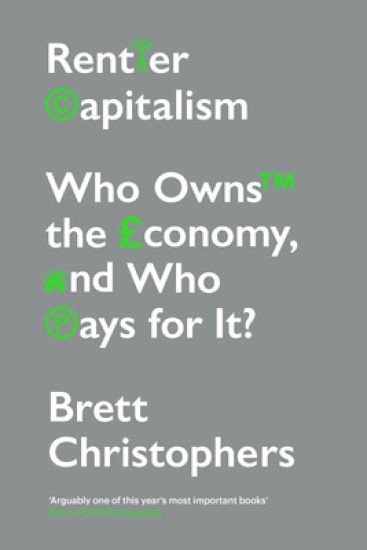
Rentier Capitalism

Rentier Capitalism

Brett Christophers

Verso Books
2022
nidottu
In this landmark book, the author of The New Enclosure provides a forensic examination and sweeping critique of early-twenty-first-century capitalism. Brett Christophers styles this as 'rentier capitalism', in which ownership of key types of scarce assets - such as land, intellectual property, natural resources, or digital platforms - is all-important and dominated by a few unfathomably wealthy companies and individuals: rentiers. If a small elite owns today's economy, everybody else foots the bill. Nowhere is this divergence starker, Christophers shows, than in the United Kingdom, where the prototypical ills of rentier capitalism - vast inequalities combined with entrenched economic stagnation - are on full display and have led the country inexorably to the precipice of Brexit. With profound lessons for other countries subject to rentier dominance, Christophers' examination of the UK case is indispensable to those wanting not just to understand this insidious economic phenomenon but to overcome it. Frequently invoked but never previously analysed and illuminated in all its depth and variety, rentier capitalism is here laid bare for the first time.
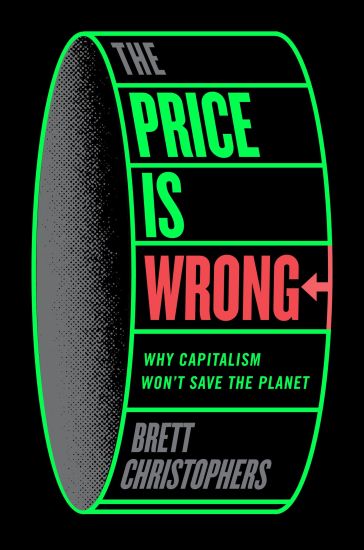
The Price is Wrong

The Price is Wrong

Brett Christophers

Verso Books
2024
sidottu
What if our understanding of capitalism and climate is back to front? What if the problem is not that transitioning to renewables is too expensive, but that saving the planet is not sufficiently profitable?This is Brett Christophers' claim. The global economy is moving too slowly toward sustainability because the return on green investment is too low.Today's consensus is that the key to curbing climate change is to produce green electricity and electrify everything possible. The main economic barrier in that project has seemingly been removed. But while prices of solar and wind power have tumbled, the golden era of renewables has yet to materialize.The problem is that investment is driven by profit, not price, and operating solar and wind farms remains a marginal business, dependent everywhere on the state's financial support.We cannot expect markets and the private sector to solve the climate crisis while the profits that are their lifeblood remain unappetizing. But there is an alternative to providing surrogate green profits through subsidies: to take energy out of the private sector's hands.An essential intervention, The Price Is Wrong is as politically far-reaching as it is factually illuminating.
The Price is Wrong

The Price is Wrong

Brett Christophers

Verso Books
2025
nidottu
RECENT TECHNICAL ADVANCES mean it is typically cheaper to produce electricity from renewable sources than from fossil fuels. Yet, around the world, the transition to green energy is happening too slowly if it is happening at all. As Brett Christophers argues, the problem is rooted in the absurdist nature of capitalist priorities: saving the planet on which our lives depend is not sufficiently profitable.
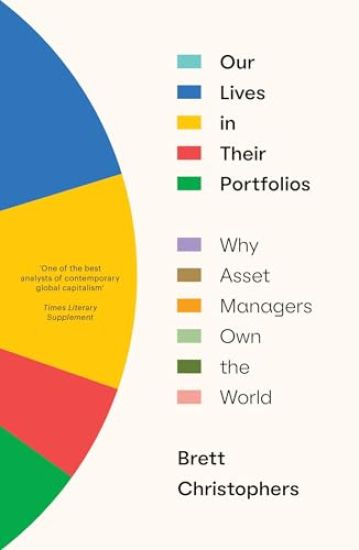
Our Lives in Their Portfolios

Our Lives in Their Portfolios

Brett Christophers

Verso Books
2023
sidottu
Banks have taken a backseat since the global financial crisis over a decade ago. Today, our new financial masters are asset managers, like Blackstone and BlackRock. And they don't just own financial assets.The roads we drive on; the pipes that supply our drinking water; the farmland that provides our food; energy systems for electricity and heat; hospitals, schools, and even the homes in which many of us live-all now swell asset managers' bulging investment portfolios.As the owners of more and more of the basic building blocks of everyday life, asset managers shape the lives of each and every one of us in profound and disturbing ways. In this eye-opening follow-up to Rentier Capitalism, Brett Christophers peels back the veil on ""asset manager society.""Asset managers, he shows, are unlike traditional owners of housing and other essential infrastructure. Buying and selling these life-supporting assets at a dizzying pace, the crux of their business model is not long-term investment and careful custodianship but making quick profits for themselves and the investors that back them.In asset manager society, the natural and built environments that sustain us become one more vehicle for siphoning money from the many to the few.
Our Lives in Their Portfolios

Our Lives in Their Portfolios

Brett Christophers

Verso Books
2024
nidottu
Banks have taken a backseat since the global financial crisis over a decade ago. Today, our new financial masters are asset managers, like Blackstone and BlackRock. And they don't just own financial assets.The roads we drive on; the pipes that supply our drinking water; the farmland that provides our food; energy systems for electricity and heat; hospitals, schools, and even the homes in which many of us live-all now swell asset managers' bulging investment portfolios.As the owners of more and more of the basic building blocks of everyday life, asset managers shape the lives of each and every one of us in profound and disturbing ways. In this eye-opening follow-up to Rentier Capitalism, Brett Christophers peels back the veil on ""asset manager society.""Asset managers, he shows, are unlike traditional owners of housing and other essential infrastructure. Buying and selling these life-supporting assets at a dizzying pace, the crux of their business model is not long-term investment and careful custodianship but making quick profits for themselves and the investors that back them.In asset manager society, the natural and built environments that sustain us become one more vehicle for siphoning money from the many to the few.