Kirjojen hintavertailu. Mukana 11 590 110 kirjaa ja 12 kauppaa.

Kirjahaku

Etsi kirjoja tekijän nimen, kirjan nimen tai ISBN:n perusteella.

5 kirjaa tekijältä Brian A. Hatcher

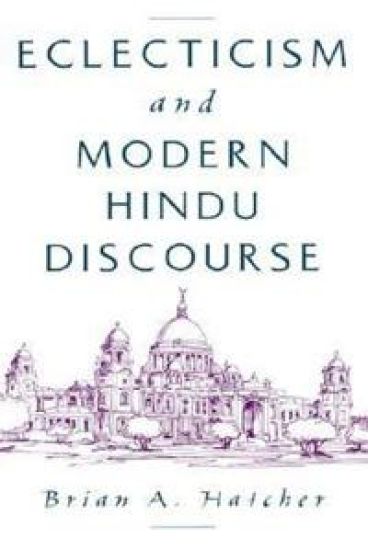
Eclecticism and Modern Hindu Discourse

Eclecticism and Modern Hindu Discourse

Brian A. Hatcher

Oxford University Press Inc
1999
sidottu
Hindu apologists routinely support their interpretations of the Hindu world view with what seems an almost promiscuous use of the world's many philosophies and religions. The truths of Hindu thought are commonly demonstrated with references to sources as disparate as the Upanishads, the New Testament, and the sermons of Theodore Parker. These strange, even bizarre, juxtapositions pose a troubling problem for many sympathetic Western scholars of this tradition, namely, what to do about the absurdities that Indian thinkers want to pass for historical truths? This book examines the classical roots and contempoary significance of eclecticism within modern Hindu discourse. Hatcher begins by focusing on the thought of Swami Vivekananda as exemplary of the tone and character of modern Hindu eclecticism. Vivekananda, who became well-known in the West after his sensational appearance at the Chicago World's Fair of 1893, regularly spiced his lectures with references to Jesus, the Buddha, and the prophet Muhammad, as well as to his own personal guru, Sri Ramakrishna. Hatcher then seeks to identify the ancient Indian antecedents of this eclecticism, finding them especially in the sacrificial ritualism of the Vedas. Returning to the modern period, he focuses on 19th-century Bengal, introducing the reader to a wide range of modern Indian eclecticisms. The development of Hindu thought during this period, Hatcher argues, can only be understood within the context of the enforced cultural encounter created by British colonial rule. In conclusion, Hatcher attempts to strike a delicate balance between the contending views of eclecticism as poesis and as a form of false consciousness. He proposes a pragmatic approach to evaluating the validity of eclectic knowledge.
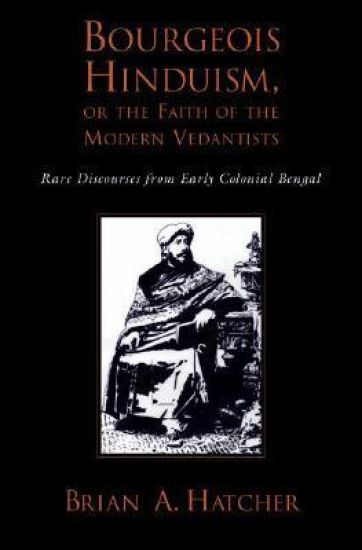
Bourgeouis Hinduism, or Faith of the Modern Vedantists

Bourgeouis Hinduism, or Faith of the Modern Vedantists

Brian A. Hatcher

Oxford University Press Inc
2007
sidottu
In 1839 a group of Hindu elite gathered in Calcutta to share and propagate their faith in a non-idolatrous form of worship. The group, known as the Tattvabodhin Sabh, met weekly to worship and hear discourses from members on ways to promote a rational and morally responsible mode of worship. They called upon ancient sources of Hindu spirituality to guide them in developing a modern form of theism they referred to as "Vedanta." In this book, Brian Hatcher situates the theology and moral vision set forth in these hitherto unknown discourses against the backdrop of religious and social change in early colonial Calcutta. In doing so, he demonstrates how the theology of the Tattvabodhin Sabh legitimated the worldly interests of Calcutta's emergent bourgeoisie. This 'bourgeois Vedanta' sanctioned material prosperity while providing members with a means of spiritual fulfillment. Hatcher's important study includes the first ever complete, annotated translation of Sabhyadiger vaktrta, the earliest extant record of the Tattvabodhin Sabh. The translation is supplemented with a detailed analysis of the text demonstrating that its twenty-one unsigned discourses were composed by such major figures in nineteenth-century Bengal as Debendranath Tagore, Isvaracandra Vidyasagara, Isvaracandra Gupta, and Aksayakumara Datta. In many cases, these are the earliest known writings we have for such individuals. This rare set of discourses provides Hatcher with an opportunity to explore a decisive moment in the construction of modern Vedanta, and to comment on the concerns this Vedantic movement raised for contemporary Christian observers. Hatcher is able to demonstrate the decisive role played by the Tattvabodhin Sabha in both reviving and reformulating the teachings of Rammohan Roy, the founder of Vedantic reform in colonial India. At the same time, Hatcher suggests that the earliest members of the Sabha are best viewed as 'Brhamos without Rammohan.' Only later would they look to Rammohan as their founding father. Apart from bringing to light the guiding ideals of an association that was to have a profound influence on religious and intellectual life in nineteenth-century Bengal, Hatcher's analysis will promote reflection on a variety of topics central to understanding the development of modern forms of Hindu belief and practice.
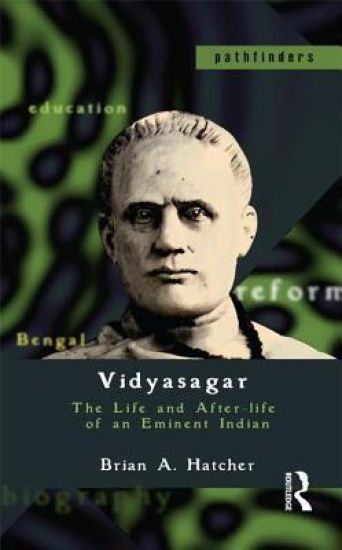
Vidyasagar

Vidyasagar

Brian A. Hatcher

Routledge India
2014
nidottu
This book offers a new interpretation of the life and legacy of the Indian reformer and intellectual, Ishvarchandra Vidyasagar (1820–91). Drawing upon autobiography, biography, secondary criticism and a range of Vidyasagar’s original writings in Bengali, the book interrogates the role of history, memory and controversy, and emphasises the key challenge of pinning down the identity of an enigmatic and multi-faceted figure. By examining lesser-known works of Vidyasagar (including several pseudonymous and posthumous works) alongside the evidence of his public career, the author calls attention to the colonial transformation of intellectual and social life, the nature of life writing, the limits of standard biographies and the problem of modern Indian identity as such. Based on decades of research and an original perspective, this book will be especially useful to scholars of modern Indian history, biographical studies, comparative literature and those interested in Bengal.
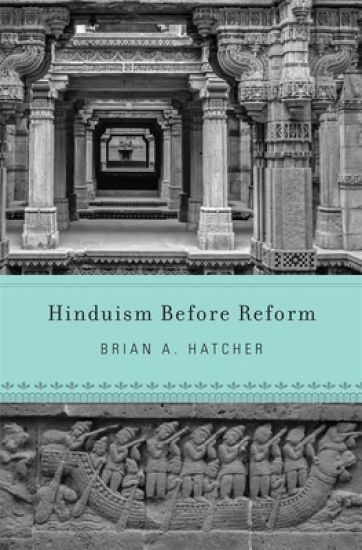
Hinduism Before Reform

Hinduism Before Reform

Brian A. Hatcher

Harvard University Press
2020
sidottu
A bold retelling of the origins of contemporary Hinduism, and an argument against the long-established notion of religious reform.By the early eighteenth century, the Mughal Empire was in decline, and the East India Company was making inroads into the subcontinent. A century later Christian missionaries, Hindu teachers, Muslim saints, and Sikh rebels formed the colorful religious fabric of colonial India. Focusing on two early nineteenth-century Hindu communities, the Brahmo Samaj and the Swaminarayan Sampraday, and their charismatic figureheads—the “cosmopolitan” Rammohun Roy and the “parochial” Swami Narayan—Brian Hatcher explores how urban and rural people thought about faith, ritual, and gods. Along the way he sketches a radical new view of the origins of contemporary Hinduism and overturns the idea of religious reform.Hinduism Before Reform challenges the rigid structure of revelation-schism­-reform-sect prevalent in much history of religion. Reform, in particular, plays an important role in how we think about influential Hindu movements and religious history at large. Through the lens of reform, one doctrine is inevitably backward-looking while another represents modernity. From this comparison flows a host of simplistic conclusions. Instead of presuming a clear dichotomy between backward and modern, Hatcher is interested in how religious authority is acquired and projected.Hinduism Before Reform asks how religious history would look if we eschewed the obfuscating binary of progress and tradition. There is another way to conceptualize the origins and significance of these two Hindu movements, one that does not trap them within the teleology of a predetermined modernity.
Vidyasagar

Vidyasagar

Brian A. Hatcher

Routledge India
2016
sidottu
This book offers a new interpretation of the life and legacy of the Indian reformer and intellectual, Ishvarchandra Vidyasagar (1820–91). Drawing upon autobiography, biography, secondary criticism and a range of Vidyasagar’s original writings in Bengali, the book interrogates the role of history, memory and controversy, and emphasises the key challenge of pinning down the identity of an enigmatic and multi-faceted figure. By examining lesser-known works of Vidyasagar (including several pseudonymous and posthumous works) alongside the evidence of his public career, the author calls attention to the colonial transformation of intellectual and social life, the nature of life writing, the limits of standard biographies and the problem of modern Indian identity as such. Based on decades of research and an original perspective, this book will be especially useful to scholars of modern Indian history, biographical studies, comparative literature and those interested in Bengal.