Kirjojen hintavertailu. Mukana 12 390 323 kirjaa ja 12 kauppaa.

Kirjahaku

Etsi kirjoja tekijän nimen, kirjan nimen tai ISBN:n perusteella.

5 kirjaa tekijältä Brian D. Behnken

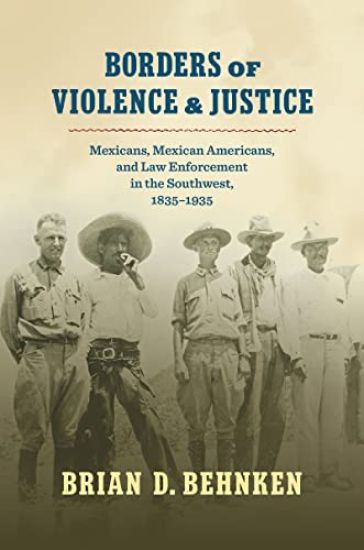
Borders of Violence and Justice

Borders of Violence and Justice

Brian D. Behnken

THE UNIVERSITY OF NORTH CAROLINA PRESS
2022
sidottu
Brian Behnken offers a sweeping examination of the interactions between Mexican-origin people and law enforcement—both legally codified police agencies and extralegal justice—across the U.S. Southwest (especially Arizona, California, New Mexico, and Texas) from the 1830s to the 1930s. Representing a broad, colonial regime, police agencies and extralegal groups policed and controlled Mexican-origin people to maintain state and racial power in the region, treating Mexicans and Mexican Americans as a "foreign" population that they deemed suspect and undesirable. White Americans justified these perceptions and the acts of violence that they spawned with racist assumptions about the criminality of Mexican-origin people, but Behnken details the many ways Mexicans and Mexican Americans responded to violence, including the formation of self-defense groups and advocacy organizations. Others became police officers, vowing to protect Mexican-origin people from within the ranks of law enforcement. Mexican Americans also pushed state and territorial governments to professionalize law enforcement to halt abuse.The long history of the border region between the United States and Mexico has been one marked by periodic violence, but Behnken shows us in unsparing detail how Mexicans and Mexican Americans refused to stand idly by in the face of relentless assault.
Borders of Violence and Justice

Borders of Violence and Justice

Brian D. Behnken

THE UNIVERSITY OF NORTH CAROLINA PRESS
2022
pokkari
Brian Behnken offers a sweeping examination of the interactions between Mexican-origin people and law enforcement—both legally codified police agencies and extralegal justice—across the U.S. Southwest (especially Arizona, California, New Mexico, and Texas) from the 1830s to the 1930s. Representing a broad, colonial regime, police agencies and extralegal groups policed and controlled Mexican-origin people to maintain state and racial power in the region, treating Mexicans and Mexican Americans as a "foreign" population that they deemed suspect and undesirable. White Americans justified these perceptions and the acts of violence that they spawned with racist assumptions about the criminality of Mexican-origin people, but Behnken details the many ways Mexicans and Mexican Americans responded to violence, including the formation of self-defense groups and advocacy organizations. Others became police officers, vowing to protect Mexican-origin people from within the ranks of law enforcement. Mexican Americans also pushed state and territorial governments to professionalize law enforcement to halt abuse.The long history of the border region between the United States and Mexico has been one marked by periodic violence, but Behnken shows us in unsparing detail how Mexicans and Mexican Americans refused to stand idly by in the face of relentless assault.
Brown and Blue

Brown and Blue

Brian D. Behnken

THE UNIVERSITY OF NORTH CAROLINA PRESS
2025
sidottu
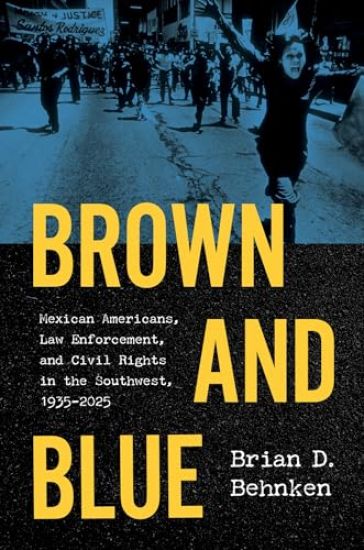
This sweeping history tells a story of fits and starts of Mexican Americans' interactions with law enforcement and the criminal justice system in the US Southwest. Looking at primarily Arizona, California, New Mexico, and Texas, it tells a complex story: that violent, often racist acts committed by police against Mexican American people sparked protests demanding reform, and criminal justice authorities frequently responded positively to these protests with reforms such as recruiting Mexican Americans into local police forces or altering training procedures at police academies.Brian D. Behnken demonstrates the central role that the struggle for police reform played in the twentieth-century Chicano movement, whose relevance continues today. By linking social activism and law enforcement, Behnken illuminates how the policing issues of today developed and what reform remains to be done.
Brown and Blue

Brown and Blue

Brian D. Behnken

THE UNIVERSITY OF NORTH CAROLINA PRESS
2025
pokkari
This sweeping history tells a story of fits and starts of Mexican Americans' interactions with law enforcement and the criminal justice system in the US Southwest. Looking at primarily Arizona, California, New Mexico, and Texas, it tells a complex story: that violent, often racist acts committed by police against Mexican American people sparked protests demanding reform, and criminal justice authorities frequently responded positively to these protests with reforms such as recruiting Mexican Americans into local police forces or altering training procedures at police academies.Brian D. Behnken demonstrates the central role that the struggle for police reform played in the twentieth-century Chicano movement, whose relevance continues today. By linking social activism and law enforcement, Behnken illuminates how the policing issues of today developed and what reform remains to be done.
Racism in American Popular Media

Racism in American Popular Media

Brian D. Behnken; Gregory D. Smithers

Praeger Publishers Inc
2015
sidottu
This book examines how the media—including advertising, motion pictures, cartoons, and popular fiction—has used racist images and stereotypes as marketing tools that malign and debase African Americans, Latinos, American Indians, and Asian Americans in the United States.Were there damaging racist depictions in Gone with the Wind and children's cartoons such as Tom and Jerry and Mickey Mouse? How did widely known stereotypes of the Latin lover, the lazy Latino, the noble savage and the violent warrior American Indian, and the Asian as either a martial artist or immoral and tricky come about? This book utilizes an ethnic and racial comparative approach to examine the racism evidenced in multiple forms of popular media, enabling readers to apply their critical thinking skills to compare and analyze stereotypes, grasp the often-subtle sources of racism in the everyday world around us, and understand how racism in the media was used to unite white Americans and exclude ethnic people from the body politic of the United States.Authors Brian D. Behnken and Gregory D. Smithers examine the popular media from the late 19th century through the 20th century to the early 21st century. This broad coverage enables readers to see how depictions of people of color, such as Aunt Jemima, have been consistently stereotyped back to the 1880s and to grasp how those depictions have changed over time. The book's chapters explore racism in the popular fiction, advertising, motion pictures, and cartoons of the United States, and examine the multiple groups affected by this racism, including African Americans, Latino/as, Asian Americans, and American Indians. Attention is also paid to the efforts of minorities—particularly civil rights activists—in challenging and combating racism in the popular media.