Kirjojen hintavertailu. Mukana 11 622 422 kirjaa ja 12 kauppaa.

Kirjahaku

Etsi kirjoja tekijän nimen, kirjan nimen tai ISBN:n perusteella.

3 kirjaa tekijältä Brian D. Ripley

Stochastic Simulation

Stochastic Simulation

Brian D. Ripley

John Wiley Sons Inc
2006
nidottu
WILEY-INTERSCIENCE PAPERBACK SERIES The Wiley-Interscience Paperback Series consists of selected books that have been made more accessible to consumers in an effort to increase global appeal and general circulation. With these new unabridged softcover volumes, Wiley hopes to extend the lives of these works by making them available to future generations of statisticians, mathematicians, and scientists. ". . .this is a very competently written and useful addition to the statistical literature; a book every statistician should look at and that many should study!" —Short Book Reviews, International Statistical Institute ". . .reading this book was an enjoyable learning experience. The suggestions and recommendations on the methods [make] this book an excellent reference for anyone interested in simulation. With its compact structure and good coverage of material, it [is] an excellent textbook for a simulation course." —Technometrics ". . .this work is an excellent comprehensive guide to simulation methods, written by a very competent author. It is especially recommended for those users of simulation methods who want more than a 'cook book'. " —Mathematics Abstracts This book is a comprehensive guide to simulation methods with explicit recommendations of methods and algorithms. It covers both the technical aspects of the subject, such as the generation of random numbers, non-uniform random variates and stochastic processes, and the use of simulation. Supported by the relevant mathematical theory, the text contains a great deal of unpublished research material, including coverage of the analysis of shift-register generators, sensitivity analysis of normal variate generators, analysis of simulation output, and more.
Spatial Statistics

Spatial Statistics

Brian D. Ripley

John Wiley Sons Inc
2004
nidottu
The Wiley-Interscience Paperback Series consists of selected books that have been made more accessible to consumers in an effort to increase global appeal and general circulation. With these new unabridged softcover volumes, Wiley hopes to extend the lives of these works by making them available to future generations of statisticians, mathematicians, and scientists. "Books such as this that bring together, clarify, and summarize recent research can lead to a great increase of interest in the area. . . . a major achievement in describing many aspects of spatial data and discussing, with examples, different methods of analysis." –Royal Statistical Society "Dr. Ripley’s book is an excellent survey of the spatial statistical methodology. It is very well illustrated with examples [that] give a clear view of the wide scope of the subject, the way in which techniques often have to be tailored to particular applications, and the different sorts of spatial data that arise." –The Bulletin of the London Mathematics Society Spatial Statistics provides a comprehensive guide to the analysis of spatial data. Each chapter covers a particular data format and the associated class of problems, introducing theory, giving computational suggestions, and providing examples. Methods are illustrated by computer-drawn figures. The book serves as an introduction to this rapidly growing research area for mathematicians and statisticians, and as a reference to new computer methods for researchers in ecology, geology, archaeology, and the earth sciences.
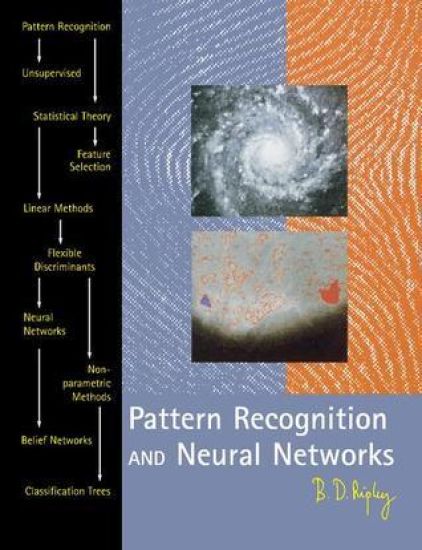
Pattern Recognition and Neural Networks

Pattern Recognition and Neural Networks

Brian D. Ripley

Cambridge University Press
2008
pokkari
This 1996 book is a reliable account of the statistical framework for pattern recognition and machine learning. With unparalleled coverage and a wealth of case-studies this book gives valuable insight into both the theory and the enormously diverse applications (which can be found in remote sensing, astrophysics, engineering and medicine, for example). So that readers can develop their skills and understanding, many of the real data sets used in the book are available from the author's website: www.stats.ox.ac.uk/~ripley/PRbook/. For the same reason, many examples are included to illustrate real problems in pattern recognition. Unifying principles are highlighted, and the author gives an overview of the state of the subject, making the book valuable to experienced researchers in statistics, machine learning/artificial intelligence and engineering. The clear writing style means that the book is also a superb introduction for non-specialists.