Kirjojen hintavertailu. Mukana 11 244 527 kirjaa ja 12 kauppaa.

Kirjahaku

Etsi kirjoja tekijän nimen, kirjan nimen tai ISBN:n perusteella.

16 kirjaa tekijältä Brian Vickers

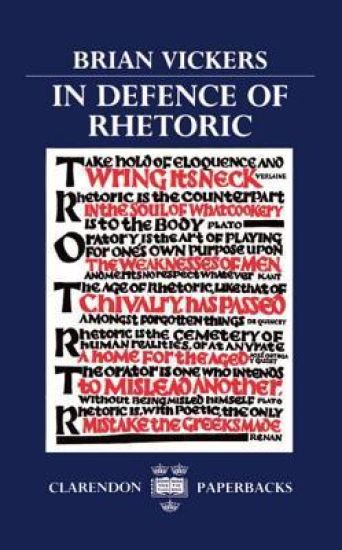
In Defence of Rhetoric

In Defence of Rhetoric

Brian Vickers

Clarendon Press
1989
nidottu
Setting out to reinstate rhetoric, this book opens with an overview of the rhetorical system as developed in classical times. In Defence of Rhetoric surveys and analyses material from Aristotle to Plato through the Renaissance to the modern novel and the critical theories of Roman Jakobson and Paul de Man.
Shakespeare, Co-Author

Shakespeare, Co-Author

Brian Vickers

Oxford University Press
2002
sidottu
No issue in Shakespeare studies is more important than determining what he wrote. For over two centuries scholars have discussed the evidence that Shakespeare worked with co-authors on several plays, and have used a variety of methods to differentiate their shares from his. In this wide-ranging study, Brian Vickers takes up and extends these discussions, presenting compelling evidence that Shakespeare wrote Titus Andronicus together with George Peele, Timon of Athens with Thomas Middleton, Pericles with George Wilkins, and Henry VIII and The Two Noble Kinsmen with John Fletcher. In Part One Vickers reviews the standard processes of co-authorship as they can be reconstructed from documents connected with the Elizabethan stage, and shows that every major, and most minor dramatists in the Elizabethan, Jacobean, and Caroline theatres collaborated in getting plays written and staged. This is combined with a survey of the types of methodology used since the early nineteenth century to identify co-authorship, and a critical evaluation of some 'stylometric' techniques. Part Two is devoted to detailed analyses of the five collaborative plays, discussing every significant case made for and against Shakespeare's co-authorship. Synthesising two centuries of discussion, Vickers reveals a solidly based scholarly tradition, building on and extending previous work, identifying the co-authors' contributions in increasing detail. The range and quantity of close verbal analysis brought together in Shakespeare, Co-Author present a compelling case to counter those 'conservators' of Shakespeare who maintain that he is the sole author of his plays.
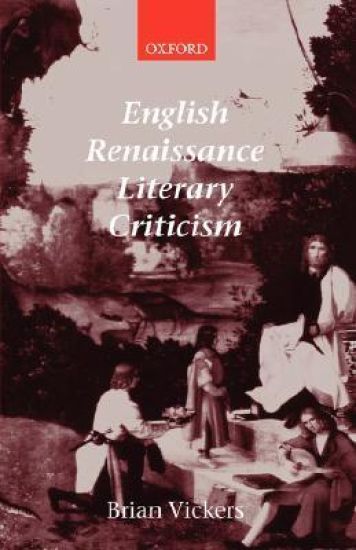
English Renaissance Literary Criticism

English Renaissance Literary Criticism

Brian Vickers

Oxford University Press
2003
nidottu
In this collection of English Renaissance literary criticism, Vickers demonstrates that English critics in the period 1520 to 1650 owed most to classical writers on rhetoric and poetics: Cicero, Horace, Quintilian, Plutarch. Annotated selections identify classical and other sources and give translations for Greek, Latin, and Italian texts.
Shakespeare, Co-Author

Shakespeare, Co-Author

Brian Vickers

Oxford University Press
2004
nidottu
No issue in Shakespeare studies is more important than determining what he wrote. For over two centuries scholars have discussed the evidence that Shakespeare worked with co-authors on several plays, and have used a variety of methods to differentiate their contributions from his. In this wide-ranging study, Brian Vickers takes up and extends these discussions, presenting compelling evidence that Shakespeare wrote Titus Andronicus together with George Peele, Timon of Athens with Thomas Middleton, Pericles with George Wilkins, and Henry VIII and The Two Noble Kinsmen with John Fletcher. In Part One Vickers reviews the standard processes of co-authorship as they can be reconstructed from documents connected with the Elizabethan stage, and shows that every major, and most minor dramatists in the Elizabethan, Jacobean, and Caroline theatres collaborated in getting plays written and staged. This is combined with a survey of the types of methodology used since the early nineteenth century to identify co-authorship, and a critical evaluation of some 'stylometric' techniques. Part Two is devoted to detailed analyses of the five collaborative plays, discussing every significant case made for and against Shakespeare's co-authorship. Synthesizing two centuries of discussion, Vickers reveals a solidly based scholarly tradition, building on and extending previous work, identifying the co-authors' contributions in increasing detail. The range and quantity of close verbal analysis brought together in Shakespeare, Co-Author present a compelling case to counter those 'conservators' of Shakespeare who maintain that he is the sole author of his plays.
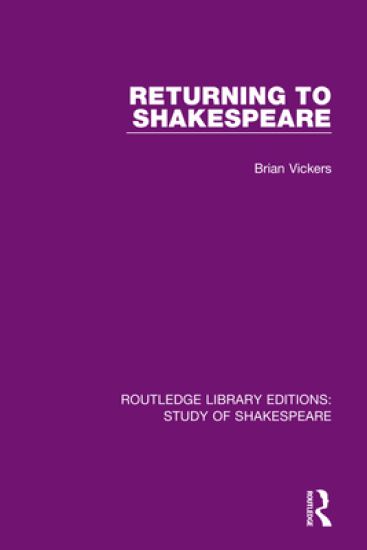
Returning to Shakespeare

Returning to Shakespeare

Brian Vickers

Routledge
2021
sidottu
Returning to Shakespeare addresses two broad areas of Shakespeare criticism: the unity of form and meaning, and the history of the plays’ reception. Originally published in 1989, the collection represents the best of Brian Vickers’ work from the previous fifteen years, in a revised and expanded form.The first part of the book focuses on the connection between a work’s structural or formal properties and our experience of it. A new study of the Sonnets shows how personal relationships are literally embodied in personal pronouns. An essay on Shakespeare’s hypocrites (Richard III, Iago, Macbeth) analyses the uncomfortable intimacy established between them and the audience by means of soliloquies and asides. Another traces the interplay between politics and the family in Coriolanus, two forms of pressure which combine to push the hero outside society.In the second part Professor Vickers examines some key episodes in the history of Shakespeare criticism. One essay reviews the persistence of drastically altered adaptations of Shakespeare on the London stage from the 1690s to the 1830s, due to the conservatism of both theatre managers and audience. Another reconstructs the debate over Hamlet’s character in the last quarter of the eighteenth century, in which the Romantic image of a hero lacking control of his faculties emerged for the first time.This is an important collection by an outstanding Shakespeare critic which will interest specialists and general readers alike.
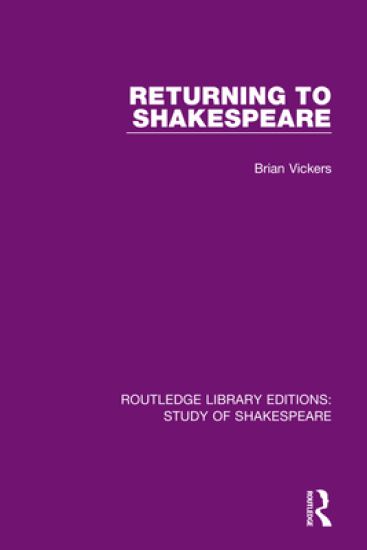
Returning to Shakespeare

Returning to Shakespeare

Brian Vickers

TAYLOR FRANCIS LTD
2023
nidottu
Returning to Shakespeare addresses two broad areas of Shakespeare criticism: the unity of form and meaning, and the history of the plays’ reception. Originally published in 1989, the collection represents the best of Brian Vickers’ work from the previous fifteen years, in a revised and expanded form.The first part of the book focuses on the connection between a work’s structural or formal properties and our experience of it. A new study of the Sonnets shows how personal relationships are literally embodied in personal pronouns. An essay on Shakespeare’s hypocrites (Richard III, Iago, Macbeth) analyses the uncomfortable intimacy established between them and the audience by means of soliloquies and asides. Another traces the interplay between politics and the family in Coriolanus, two forms of pressure which combine to push the hero outside society.In the second part Professor Vickers examines some key episodes in the history of Shakespeare criticism. One essay reviews the persistence of drastically altered adaptations of Shakespeare on the London stage from the 1690s to the 1830s, due to the conservatism of both theatre managers and audience. Another reconstructs the debate over Hamlet’s character in the last quarter of the eighteenth century, in which the Romantic image of a hero lacking control of his faculties emerged for the first time.This is an important collection by an outstanding Shakespeare critic which will interest specialists and general readers alike.
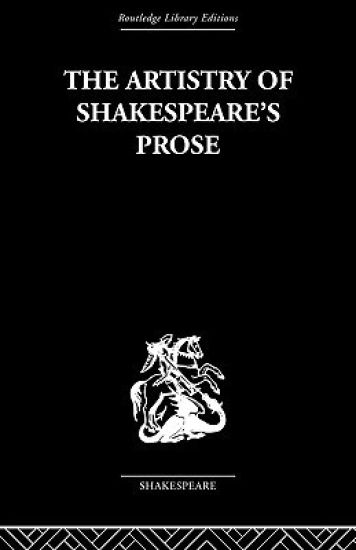
The Artistry of Shakespeare's Prose
First published in 1968. This re-issues the revised edition of 1979. The Artistry of Shakespeare's Prose is the first detailed study of the use of prose in the plays. It begins by defining the different dramatic and emotional functions which Shakespeare gave to prose and verse, and proceeds to analyse the recurrent stylistic devices used in his prose. The general and particular application of prose is then studied through all the plays, in roughly chronological order.
The Artistry of Shakespeare's Prose
First published in 1968. This re-issues the revised edition of 1979. The Artistry of Shakespeare's Prose is the first detailed study of the use of prose in the plays. It begins by defining the different dramatic and emotional functions which Shakespeare gave to prose and verse, and proceeds to analyse the recurrent stylistic devices used in his prose. The general and particular application of prose is then studied through all the plays, in roughly chronological order.
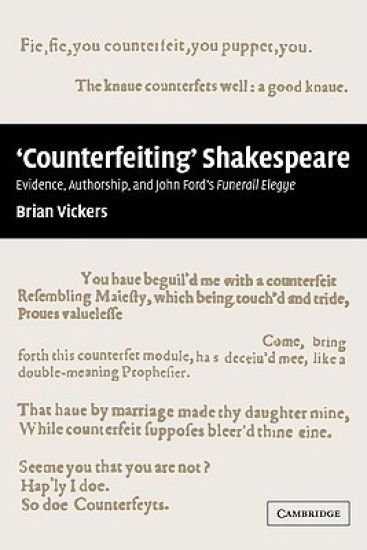
'Counterfeiting' Shakespeare

'Counterfeiting' Shakespeare

Brian Vickers

Cambridge University Press
2009
pokkari
'Counterfeiting' Shakespeare addresses the fundamental issue of what Shakespeare actually wrote, and how this is determined. In recent years his authorship has been claimed for two poems, the lyric 'Shall I die?' and A Funerall Elegye. These attributions have been accepted into certain major editions of Shakespeare's works but Brian Vickers argues that both attributions rest on superficial verbal parallels; both use too small a sample, ignore negative evidence, and violate basic principles in authorship studies. Through a fresh examination of the evidence, Professor Vickers shows that neither poem has the stylistic and imaginative qualities we associate with Shakespeare. In other words, they are 'counterfeits', in the sense of anonymously authored works wrongly presented as Shakespeare's. He argues that the poet and dramatist John Ford wrote the Elegye: its poetical language (vocabulary, syntax, prosody) is indistinguishable from Ford's, and it contains several hundred close parallels with his work. By combining linguistic and statistical analysis this book makes an important contribution to authorship studies.
Occult Scientific Mentalities

Occult Scientific Mentalities

Brian Vickers

Cambridge University Press
1986
pokkari
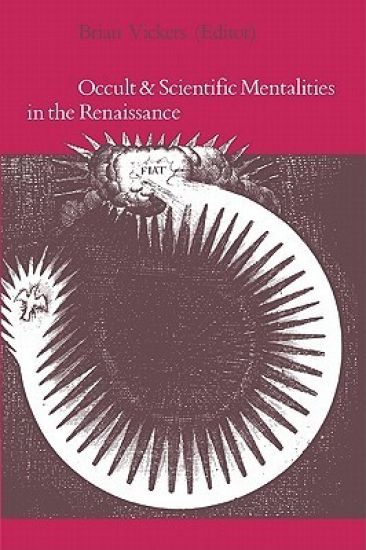
The essays in this volume present a collective study of one of the major problems in the recent history of science: To what extent did the occult 'sciences' (alchemy, astrology, numerology, and natural magic) contribute to the scientific revolution of the late Renaissance? These studies of major scientists (Kepler, Bacon, Mersenne, and Newton) and of occultists (Dee, Fludd, and Cardano), complemented by analyses of contemporary official and unofficial studies at Cambridge and Oxford and discussions of the language of science, combine to suggest that hitherto the relationship has been too crudely stated as a movement 'from magic to science'. In fact, two separate mentalities can be traced, the occult and the scientific, each having different assumptions, goals, and methodologies. The contributors call into question many of the received ideas on this topic, showing that the issue has been wrongly defined and based on inadequate historical evidence. They outline new ways of approaching and understanding a situation in which two radically different and, to modern eyes, incompatible ways of describing reality persisted side-by-side until the demise of the occult in the late seventeenth century. Their work, accordingly, sets the whole issue in a new light.
Shakespeare, 'A Lover's Complaint', and John Davies of Hereford
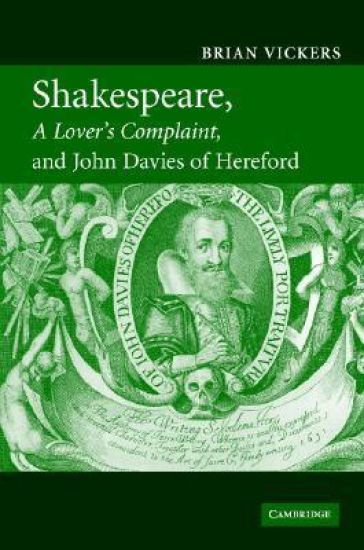
When Shakespeare's Sonnets were published in 1609 a poem called A Lover's Complaint was included by the publisher, Thomas Thorpe, who was notorious for several irregular publications. Many scholars have doubted its authenticity, but recent editions of the Sonnets have accepted it as Shakespeare's work. Now Vickers, in this text, the first full study of the poem, shows it to be un-Shakespearian both in its language and in its attitude to women. It is awkwardly constructed and uses archaic Spenserian diction, including many unusual words that never occur in Shakespeare. It frequently repeats stock phrases and rhymes, distorts normal word order far more often and more clumsily than Shakespeare did, while its attitude to female frailty is moralizing and misogynistic. By close analysis Vickers attributes the poem to John Davies of Hereford (1565–1618), a famous calligrapher and writing-master who was also a prolific poet. Vickers' book will re-define the Shakespeare canon.
The One King Lear

The One King Lear

Brian Vickers

Harvard University Press
2021
sidottu
King Lear exists in two different texts: the Quarto (1608) and the Folio (1623). Because each supplies passages missing in the other, for over 200 years editors combined the two to form a single text, the basis for all modern productions. Then in the 1980s a group of influential scholars argued that the two texts represent different versions of King Lear, that Shakespeare revised his play in light of theatrical performance. The two-text theory has since hardened into orthodoxy. Now for the first time in a book-length argument, one of the world’s most eminent Shakespeare scholars challenges the two-text theory. At stake is the way Shakespeare’s greatest play is read and performed.Sir Brian Vickers demonstrates that the cuts in the Quarto were in fact carried out by the printer because he had underestimated the amount of paper he would need. Paper was an expensive commodity in the early modern period, and printers counted the number of lines or words in a manuscript before ordering their supply. As for the Folio, whereas the revisionists claim that Shakespeare cut the text in order to alter the balance between characters, Vickers sees no evidence of his agency. These cuts were likely made by the theater company to speed up the action. Vickers includes responses to the revisionist theory made by leading literary scholars, who show that the Folio cuts damage the play’s moral and emotional structure and are impracticable on the stage.
Thomas Kyd

Thomas Kyd

Brian Vickers

PRINCETON UNIVERSITY PRESS
2024
sidottu
A groundbreaking new account of the author of The Spanish Tragedy that establishes him as a major Elizabethan dramatistThomas Kyd (1558–1594) was a highly regarded dramatist and the author of The Spanish Tragedy, the first revenge tragedy and the most influential Elizabethan play. In this first full study of his life and works, Brian Vickers discusses Kyd’s accepted canon as well as three additional plays Vickers has newly identified as having been written by Kyd—exciting discoveries that establish him as a major dramatist.Thomas Dekker, a fellow Elizabethan dramatist, referred to “industrious Kyd,” which suggests a greater output than the three plays traditionally attributed to him—The Spanish Tragedy, Soliman and Perseda, and Cornelia. Kyd worked between 1585 and 1594, when the plague led to the anonymous publication of many plays because of the breakup of several London theatre companies. Researching this corpus, Vickers has identified Kyd’s authorship of three more plays: Arden of Faversham, the first domestic tragedy, King Leir and his three daughters, a tragicomedy that provided Shakespeare with his main source, and Fair Em, a love comedy. These attributions are based on two forms of evidence: unique similarities of plot between Kyd’s acknowledged and newly attributed plays and many unique phrases shared by all six plays as identified by modern software.Discussing all the plays in detail and placing them in biographical and historical context, Thomas Kyd offers a major reassessment of an underappreciated Elizabethan playwright.
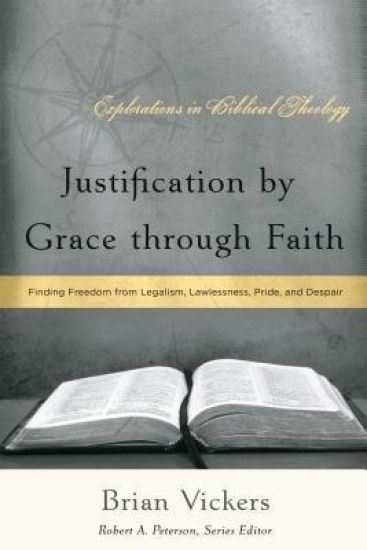
Justification by Grace Through Faith

Justification by Grace Through Faith

Brian Vickers

P R Publishing Co (Presbyterian Reformed)
2023
nidottu
Justification is God's declaration that sinners are made right with him through faith in Christ, whose life, death, and resurrection provide forgiveness and the righteousness God desires of his people. This doctrine of justification as an alien, imputed righteousness has been under attack for several years. Brian Vickers biblical theology of justification traces how the doctrine unfolds in Scripture, showing that in Christ, God provides everything needed for sinners to be made right with him. Whether struggling with legalism, lawlessness, pride, or despair, a biblical view of justification will lead us away from ourselves to the God who accepts us fully in Christ.
Mark

Mark

Brian Vickers

Faithlife Corporation
2025
pokkari
"WHO DO YOU SAY THAT I AM?" -- MARK 8:29Jesus asked his disciples this question, and no question is more important. The Gospel of Mark answers by presenting Jesus as the king who suffered and gave his life for us and invited us to take up our cross and follow him.Mark: A 40-Day Bible Study is meditative, gospel-centered, practical, and prayerful. Over forty days, you will: Read and reflect on Mark's Gospel.Meditate on Jesus and the good news he brings.Pray through Mark's Gospel.Apply Mark's Gospel to your life.Planted in the Word: Bible studies for individuals or small groups. Each volume provides forty days of guided Bible study written by respected scholars for everyday Christians. Short enough to read in 15 minutes or less, each day includes: Reading and meditation on ScriptureReflection on how the text points to ChristApplication of God's word to our livesPraying for God's helpSuggestions for further study or discussion. Each volume includes a reading plan for group study.