Kirjojen hintavertailu. Mukana 11 447 344 kirjaa ja 12 kauppaa.

Kirjahaku

Etsi kirjoja tekijän nimen, kirjan nimen tai ISBN:n perusteella.

6 kirjaa tekijältä Bridget Hill

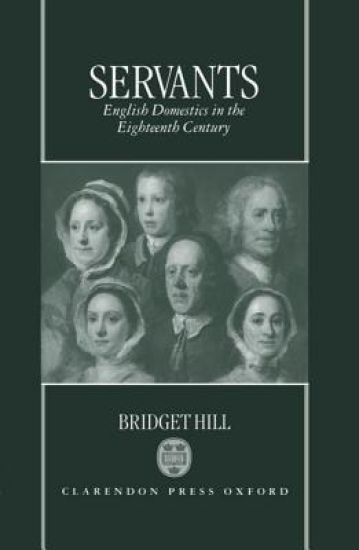
Servants

Servants

Bridget Hill

Clarendon Press
1996
sidottu
The importance of domestic service in the eighteenth century has long been recognized by historians but apart from a number of recent controversial articles, this IS the first detailed study of the subject since J. Jean Hecht's book of 1956. Bridget Hill's essays question the stereotype of the domestic servant - usually male and most often in large households employing many servants where a strict hierarchy prevailed - that has dominated all discussion hitherto. Using eighteenth-century diaries, journals and memoirs as well as the press and literature of the period, she examines the lives of the majority of domestic servants, who were employed in more modest establishments, or in single or two-servant households. The book looks at the life of the pauper apprentices to service, paid little or nothing for their efforts, and at the frequency with which both near and distant kin were employed as unpaid, or badly-paid, domestic servants. It also examines the vulnerability of female domestic servants to sexual harassment and discusses the sexuality of servants. Bridget Hill's fascinating and detailed essays provide a new perspective on an important facet of English domestic life in the eighteenth century.
Women Alone

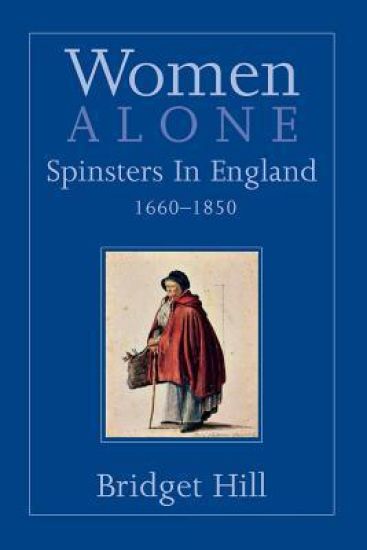
Women Alone

Bridget Hill

Yale University Press
2013
pokkari
We know very little about spinsters in earlier times, for the stigma attached to the unmarried state often rendered these women almost invisible. Now a fascinating book opens a window into the lives of British spinsters in the mid-seventeenth to mid-nineteenth centuries, assessing the opportunities open to them and the restrictions placed upon them within different social classes, occupations, and periods.Bridget Hill examines how often spinsters were able to earn enough money to live independently, what provision the Poor Law made for them if they did not, whether extreme poverty led to their involvement in crime or prostitution, and, if they stayed in the parental home, what kind of lives they led. She looks at the part single women played in religious organizations and the role of friendship and letter writing in their daily lives. She describes the nature of close relationships between women, some lesbian but many others not. Exploring the spinsters’ possibilities of escape from restrictive lives—particularly by emigration or crossdressing—she discusses how successful these were. She provides details about the degree of surveillance single women suffered from the authorities and how often they were seen as a threat to social order. Finally she addresses the question of whether all spinsters of this era were suffering victims, potential viragoes—or neither.
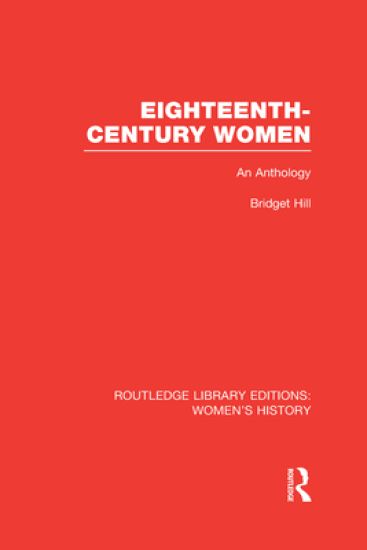
Eighteenth-century Women

Eighteenth-century Women

Bridget Hill

Routledge
2012
sidottu
When it was first published in 1984, this book filled an acknowledged gap in the social history of the period and made available hitherto inaccessible sources. The work draws on newspapers and journals, memoirs, diaries, courtesy books, county surveys and records, but also on the literature of the period, its novels, poetry and plays. It examines the role assigned to women in eighteenth-century society and the education thought fitting to perform it. It looks at attitudes to courtship and marriage, chastity and sexual passion. It explores the role of women as wives and mothers, as spinsters and widows, and focuses on the living and working experience of women whether in the home, agriculture, industry or domestic service. It contrasts the expectations of the rich and the poor, the leisured lady and the underpaid female agricultural labourer, the unmarried mother and the prostitute.
Eighteenth-century Women

Eighteenth-century Women

Bridget Hill

Routledge
2014
nidottu
When it was first published in 1984, this book filled an acknowledged gap in the social history of the period and made available hitherto inaccessible sources. The work draws on newspapers and journals, memoirs, diaries, courtesy books, county surveys and records, but also on the literature of the period, its novels, poetry and plays. It examines the role assigned to women in eighteenth-century society and the education thought fitting to perform it. It looks at attitudes to courtship and marriage, chastity and sexual passion. It explores the role of women as wives and mothers, as spinsters and widows, and focuses on the living and working experience of women whether in the home, agriculture, industry or domestic service. It contrasts the expectations of the rich and the poor, the leisured lady and the underpaid female agricultural labourer, the unmarried mother and the prostitute.
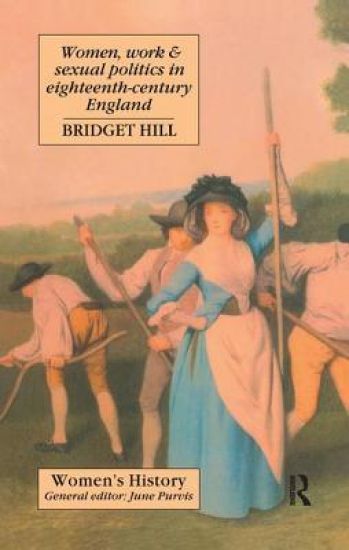
Women, Work And Sexual Politics In Eighteenth-Century England
The author offers a reassessment of how women's experience of work in 18th- century England was affected by industrialization and other elements of economic, social and technological change.; This study focuses on the household, the most important unit of production in the 18th century. Hill examines the work done by the women of the household, not only in "housework" but also in agriculture and manufacturing, and explains what women lost as the household's independence as a unit of economic production was undermined.; Considering the whole range of activities in which women were involved - including many occupations unrecorded in censuses which have, therefore, been largely ignored by historians - Hill charts the increasing sexual division of labour and highlights its implications. She also discusses the role of service in husbandry and apprenticeship, as sources of training for women, and the consequences of their decline.; The final part of the book considers how the changing nature of women's work influenced courtship, marriage and relations between the sexes. Among the topics discussed are the importance of the women's contribution to setting up and maintaining a household; labouring women's attitudes to marriage and divorce and the customary alternatives to them; and the role of spinsters and widows. The author concludes by asking to what extent the industrial revolution improved the overall position of women and the opportunities open to them.; This series aims to re-establish women's history, and to challenge the assumptions of much mainstream history. Focusing on the modern period and encouraging perspectives from other disciplines, it seeks to concentrate upon areas of focal importance in the history of Britain and continental Europe.; Bridget Hill is the author of "Eighteenth-Century Women: An Anthology" and "The First English Feminist".
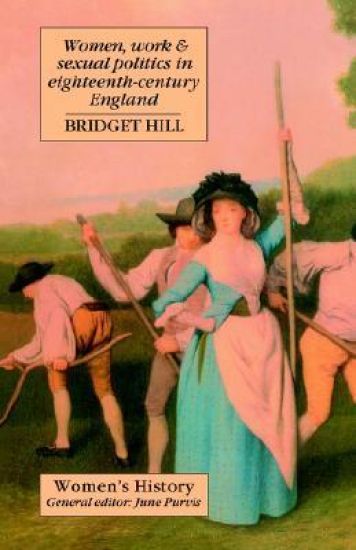
Women, Work And Sexual Politics In Eighteenth-Century England
The author offers a reassessment of how women's experience of work in 18th- century England was affected by industrialization and other elements of economic, social and technological change.; This study focuses on the household, the most important unit of production in the 18th century. Hill examines the work done by the women of the household, not only in "housework" but also in agriculture and manufacturing, and explains what women lost as the household's independence as a unit of economic production was undermined.; Considering the whole range of activities in which women were involved - including many occupations unrecorded in censuses which have, therefore, been largely ignored by historians - Hill charts the increasing sexual division of labour and highlights its implications. She also discusses the role of service in husbandry and apprenticeship, as sources of training for women, and the consequences of their decline.; The final part of the book considers how the changing nature of women's work influenced courtship, marriage and relations between the sexes. Among the topics discussed are the importance of the women's contribution to setting up and maintaining a household; labouring women's attitudes to marriage and divorce and the customary alternatives to them; and the role of spinsters and widows. The author concludes by asking to what extent the industrial revolution improved the overall position of women and the opportunities open to them.; This series aims to re-establish women's history, and to challenge the assumptions of much mainstream history. Focusing on the modern period and encouraging perspectives from other disciplines, it seeks to concentrate upon areas of focal importance in the history of Britain and continental Europe.; Bridget Hill is the author of "Eighteenth-Century Women: An Anthology" and "The First English Feminist".