Kirjojen hintavertailu. Mukana 11 365 010 kirjaa ja 12 kauppaa.

Kirjahaku

Etsi kirjoja tekijän nimen, kirjan nimen tai ISBN:n perusteella.

15 kirjaa tekijältä Brij Mohan

Global Development

Global Development

Brij Mohan

Praeger Publishers Inc
1992
sidottu
This intriguing book's focus on post-material consciousness, a concept that has not been developed in American literature, offers a fresh perspective on the human condition and its social development as a vehicle of global welfare. Brij Mohan contends that post-modern societies, despite their affluence and the superpower thaw, remain in a state of flux, and that the traditional approaches on the Left and Right have failed to present a viable program for peace, development, and prosperity. Mohan's formulation is premised on three assumptions: existing ideologies, theories, and practices of national and international development are fraught with contradictions and anomalies; the world climate and its challenges call for a new thinking beyond bureaucratized disciplines; and post-material consciousness lends support to a bio-global strategy that is conceptually compatible with humankind's ultimate agenda for coexistence based on justice, equality, and peace.Part One deals with theoretical considerations in light of contemporary social events, and Part Two offers comparative analyses of three different societies--the United States, Germany, and India--with a particular emphasis on social development issues. Concepts such as end of history, end of ideology, and even third world are called into question. Global Development, premised on the notion of humanity's one-ness, unravels the paradoxes of diversity and offers a rational, humane basis for a dignified existence of the human race beyond the ossified structures of conceptual boundaries and organizational morass.
Eclipse of Freedom

Eclipse of Freedom

Brij Mohan

Praeger Publishers Inc
1993
sidottu
Eclipse of Freedom unravels the dynamics of oppression that frustrates human aspiration, highlights policy linkages that explain unwarranted misery, assesses the human damage caused by dysfunctional social policies and fragmented services, and identifies a progressive mechanism of social transformation. Brij Mohan posits social theory and the human condition in a post-material context that emphasizes peace, justice, and equality as biodiverse needs of the human family. The focus of the study is the structure of oppression: racism, sexism, ageism, classism, as well as poverty, AIDS, homelessness, and other scourges that affect the alienated underclass. Mohan rejects the New World Order as a perversion of Nietzschean logic and challenges scientists, philosophers, and policymakers to think critically and to act responsibly in search of universal freedom.
Democracies of Unfreedom

Democracies of Unfreedom

Brij Mohan

Praeger Publishers Inc
1996
sidottu
The United States and India—the most powerful and the most populous constitutional democracies, respectively—have more in common than is apparent from a casual comparison of life in, say, Agra and Omaha. While the material circumstances of an average family in the one city may be dramatically different from the circumstances of its counterpart in the other, the political cultures that protect and sometimes encroach upon the freedoms of each family are in many ways remarkably similar. The arrogant ambitions of one of Agra's representatives in New Delhi can likely find a match in the designs of one of Omaha's legislators in Washington, D.C. So, too, could we expect to find sincere concern for their constituents in the hearts of other political figures on Capitol Hill and in the Subcontinent. In this probing critical comparison of political culture in the United States and India, Professor Brij Mohan argues that much can be learned about the parochial roots and global expansion of representative government by studying both the successes and the failures—both the promise and disappointment—of these two great experiments in constitutional democracy.
Introduction to Sociology

Introduction to Sociology

Brij Mohan

TAYLOR FRANCIS LTD
2022
sidottu
This textbook explores the emergence of sociology as a distinct social science. Focusing on the evolution of social theories, movements and ideas through history, it analyses the dynamic relationship between the individual and the larger social forces around them.This volume examines the definitive aspects of societies, communities and social groups, and their intersections with culture, political and economic movements and religious institutions. It establishes the connections between sociology and other disciplines such as philosophy, history, political science, economics, psychology and anthropology to explore the interdependence between different realms of social life. The chapters in this book explain and highlight the significance of quantitative and qualitative methods of research in understanding the dynamics of social life. Drawing from the works of classical social theorists such as Auguste Comte, Herbert Spencer, Karl Marx, Emile Durkheim and Max Weber, this book traces the development of sociological perspectives and theories and their relevance in the history of ideas.Lucid and comprehensive, this textbook will be useful for undergraduate and postgraduate students of sociology, development studies, history of ideas, sociological thought, social theory, research methods, political science and anthropology.
Introduction to Sociology

Introduction to Sociology

Brij Mohan

TAYLOR FRANCIS LTD
2022
nidottu
This textbook explores the emergence of sociology as a distinct social science. Focusing on the evolution of social theories, movements and ideas through history, it analyses the dynamic relationship between the individual and the larger social forces around them.This volume examines the definitive aspects of societies, communities and social groups, and their intersections with culture, political and economic movements and religious institutions. It establishes the connections between sociology and other disciplines such as philosophy, history, political science, economics, psychology and anthropology to explore the interdependence between different realms of social life. The chapters in this book explain and highlight the significance of quantitative and qualitative methods of research in understanding the dynamics of social life. Drawing from the works of classical social theorists such as Auguste Comte, Herbert Spencer, Karl Marx, Emile Durkheim and Max Weber, this book traces the development of sociological perspectives and theories and their relevance in the history of ideas.Lucid and comprehensive, this textbook will be useful for undergraduate and postgraduate students of sociology, development studies, history of ideas, sociological thought, social theory, research methods, political science and anthropology.
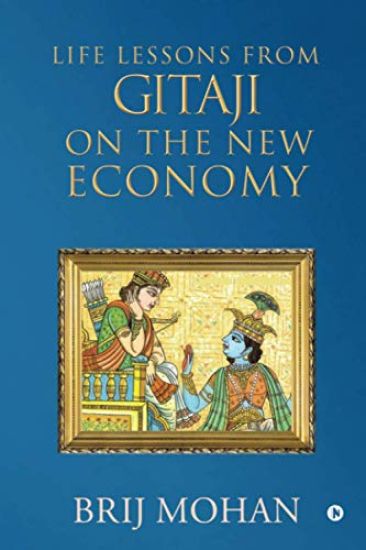
Life Lessons from Gitaji on the New Economy
We are now doing business in a global village. The sourcing of raw material, its manufacturing, selling and distribution are done, irrespective of geographical boundaries, through seamless transaction over the internet. The new style of business and economy is transcending time and space boundaries, and monetary transactions are now faceless and paperless. Needless to mention, we need to equip ourselves with updated technologies and infrastructure to cope with the new environment of doing business under a new ecosystem.Besides this qualitative change in the way of doing business, at present, another challenge is the turmoil caused by the sudden onslaught of the pandemic and the world over, the impact of COVID-19 on people's daily life continues to be terrible. We now have better medical facilities and medicines but poorer health, higher IQ and intellectual brain but poorer common sense and spiritual experience, potent weaponry to eliminate enemy in a war but poor bravery to sustain peace and statesmanship. We have twisted and wound up ourselves too much and are now unable to look at our simple life scenario with straight and simple eyes. Therefore the time has come for us to learn how we should unwind and relax ourselves to enjoy our fruits of labour that we have earned.This Book titled 'Life Lessons from Gitaji on New Economy' would be dealing with these issues in the light of Wisdom as explained in Gita by Bhagwan Krishna on human behaviour (Karma) in tandem (Yoga) with the Laws of the Nature. The language and approach may look somewhere out of context but that has been done purposefully to provoke its reader to think out of Box.
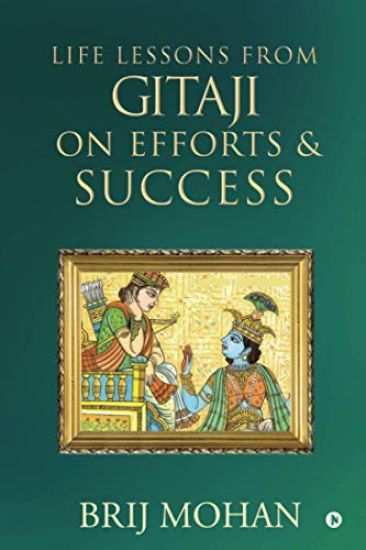
Life Lessons from Gitaji on Efforts & Success
Different people and sections of society, suiting to their own relevance and convenience, have interpreted the teachings of The Gita in different ways. Unfortunately, the most quoted teaching of Lord Krishna regarding karma (duty) and its phal (result) has been grossly misunderstood, i.e., "Do your duties without bothering about the result." Though the message is very clear, still people think - "If the desired result is not in my hands then why should I put any efforts at all?"The result of such misunderstanding has been catastrophic for society. Indians have become a confused lot, unable to decide what to do and when to do, resulting in an inactive, insensitive and directionless society. The masses have become dormant and unmindful of the state of affairs, as if everybody is a philosopher of his mind. We started denouncing materialism, and even few bandits and scoundrels expelled from their own land could come to kill and take over the throne to rule the country and devastate its glorious culture and opulence.The author has been deliberating upon this dilemma to find out the logic and science behind the message of Bhagwan Krishna in The Gita. Everyone will agree that we have a right on action but how come we have no right on the result of the action? The answer to this mysterious co-relationship between efforts and success is given in Gitaji itself.
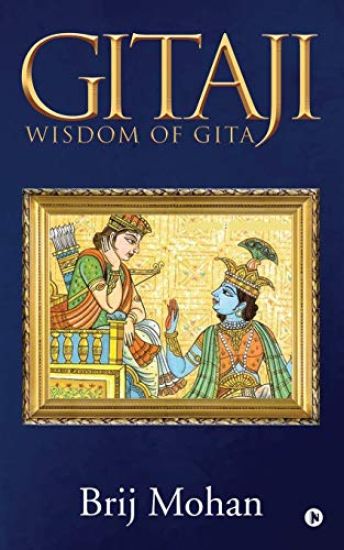
Gitaji: Wisdom of GITA

Gitaji: Wisdom of GITA

Brij Mohan

Notion Press
2018
nidottu
Gitaji is a treasure house of practical and applied wisdom. It is a true friend, philosopher and guide to its reader. I was introduced to Gita Mata by my father Pt. Rameshwar Vyas. He was a yoga teacher and social worker. He used to hold satsang with learned Sanskrit scholars, and I used to listen to their interpretation on Ved, Upnishad, Ramayan, Mahabharat, and of course, Gitaji. Gitaji does not counter or propagate any 'ism' or school of thoughts. It reveals universal, psychological, philosophical and scientific facts to its reader. It says that whatever way you tread, i.e., action, knowledge or devotion, it all leads you to your inner peace and freedom. Gitaji is a brief version of Sanskrit verse translated into English. It tries to simplify as well as co-ordinate related topics dealt within the epic sermon by Lord Krishna.
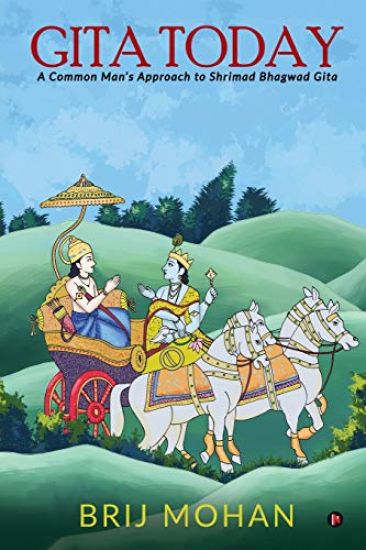
Gita Today

Gita Today

Brij Mohan

Notion Press
2019
pokkari
Gita needs no introduction. The whole great Vedic civilization of Indians are known and related to the philosophy enumerated by this book. The sermon of Bhagwan Krishna to grief-stricken Arjun was told in the battlefield where two armies were standing to start the battle.Since birth, every person starts his fight; one may call this as action or living. But it is a form of fight where we are not alone to live, to act; we are always with our opponent offering resistance to us. The battle might get over due to our abandoning the fight but the cause remains alive, kicking us in our brain, creating a violent environment converting us into a person with ever-agitating, complaining mind and intellect. The non-violence wrapped under the cowardice is more dangerous than the demonstrated violence.Throughout the teachings of Gita we can notice the tone of universalism in suggesting self-elevation for all irrespective of caste, creed, and education-level of holy texts - Vedas and Upanishads. Teachings of Gita have broken all those misgivings of a common man. One can also practice meditation by learning the knowledge of truth and can identify SELF as different from the material body. Uniqueness in teachings of Gita is its direct approach to a common man. It suggests a direct relationship and communication between Man and God. In Gita, Bhagwan Krishna dwells upon the wisdom about reality as well as a practical way of living day-to-day life and improving our SELF. While reading Gita we would learn Bhagwan Krishna discoursing on the most secret and sacred knowledge and now here we are learning the tips for our better behaviour and conduct. I wish and pray for the readers a purposeful and happy life. Kindly accept my regards to read Gita for your all-round growth and self-elevation. With due respect and regards to all the schools of thought I would like to draw inference from their interpretations to make it purposeful and a learning experience. The objective of my writing this book is to start a thinking process amongst us the useful and relevant message to improve our day to day life with the blessings of Mother Gita.
Rediscovery of Society

Rediscovery of Society

Brij Mohan

NOVA SCIENCE PUBLISHERS INC
2021
nidottu
A social work pioneer debunks the myth of a Great Society. Embedded in a contrapuntal culture, while societal dysfunctionality and institutional meltdown play havoc with mortals, we stand on the edge of an existential abyss. Humanity confronts its own monsters: Fury of fires, floods; scourges of a pandemic; random mass shootings; and mayhem, not to speak of the ravages of pervasive inequality, injustice, and ubiquity of fear. A culture of falsification, terror, and nihilist narcissism obscures small steps toward progress. The algorithms of change thwart human and social development since structural anomalies breed dysfunctional outcomes. They also manifest contours of frayed institutions in a broken society. The result is paradoxical convulsions of hope and despair. Once the structure of values erodes, our social-institutional foundation requires transformational renewal. The author calls for a new Social Contract and Enlightenment Two -- a movement of reconstruction -- in search of a new society. Implicit here is a compelling argument to reinvent homo-sapiens and rediscover the purpose of life (ie: global harmony).