
Kirjojen hintavertailu. Mukana 11 244 527 kirjaa ja 12 kauppaa.

Kirjahaku

Etsi kirjoja tekijän nimen, kirjan nimen tai ISBN:n perusteella.

3 kirjaa tekijältä Bruce S. Thornton

Decline & Fall

Decline & Fall

Bruce S. Thornton

Encounter Books,USA
2007
sidottu
Once a colossus dominating the globe, Europe today is a doddering convalescent. Sluggish economic growth, high unemployment, an addiction to expensive social welfare entitlements, a dwindling birth-rate among native Europeans, and most important, an increasing Islamic immigrant population chronically underemployed yet demographically prolific--all point to a future in which Europe will be transformed beyond recognition, a shrinking museum culture riddled with ever-expanding Islamist enclaves. Decline and Fall tells the story of this decline by focusing on the larger cultural dysfunctions behind the statistics. The abandonment of the Christian tradition that created the West's most cherished ideals--a radical secularism evident in Europe's indifference to God and church--created a vacuum of belief into which many pseudo-religions have poured. Scientism, fascism, communism, environmentalism, multiculturalism, sheer hedonism-- all have attempted and failed, sometimes bloodily, to provide Europeans with an alternative to Christianity that can show them what is worth living and dying for. Meanwhile a resurgent Islam, feeding off the economic and cultural marginalization of European Muslims, knows all too well not just what is worth dying for, but what is worth killing for. Crippled by fashionable self-loathing and fantasies of multicultural inclusiveness, Europeans have met this threat with capitulation instead of strength, appeasement and apologies instead of the demand that immigrants assimilate. As Decline and Fall shows, Europe's solution to these ills--a larger and more powerful European Union--simply exacerbates the problems, for the EU cannot address the absence of a unifying belief that can spur Europe even to defend itself, let alone to recover its lost grandeur. As these problems worsen, Europe will face an unappetizing choice between two somber destinies: a violent nationalistic or nativist reaction, or, more likely, a long descent into cultural senescence and slow-motion suicide.
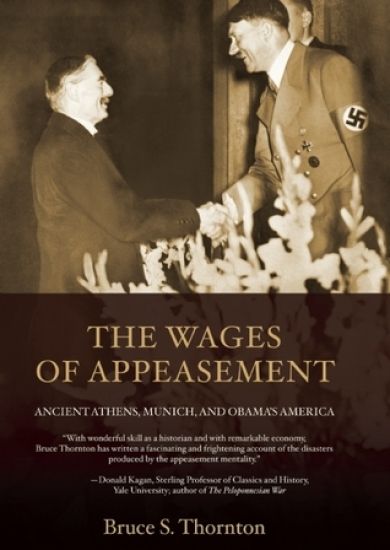
The Wages of Appeasement

The Wages of Appeasement

Bruce S. Thornton

Encounter Books,USA
2011
sidottu
Wages of Appeasement explores the reasons why a powerful state gives in to aggressors. It tells the story of three historical examples of appeasement: the greek city-states of the fourth century b.c., which lost their freedom to Philip II of Macedon; England in the twenties and thirties, and the failure to stop Germany's aggression that led to World War II; and America's current war against Islamic jihad and the 30-year failure to counter Iran's attacks on the U.S. The inherent weaknesses of democracies and their bad habit of pursuing short-term interests at the expense of long-term security play a role in appeasement. But more important are the bad ideas people indulge, from idealized views of human nature to utopian notions like pacifism or disarmament. But especially important is the notion that diplomatic engagement and international institutions like the u.n. can resolve conflict and deter an aggressor----the delusion currently driving the Obama foreign policy in the middle east. Wages of Appeasement combines narrative history and cultural analysis to show how ideas can have dangerous and deadly consequences.
Greek Ways

Greek Ways

Bruce S. Thornton

Encounter Books,USA
2002
pokkari
In the classics departments of today's universities, Bruce Thornton says, the Greeks are accused of stealing their achievements from black Egyptians, of oppressing their wives and daughters, and of hypocritically speculating about freedom while holding slaves. Most of all, classic Greek culture has come under attack precisely because its glorious achievement, extended into history, is what defines the West and makes it distinct. In Greek Ways, Thornton clears away these misconceptions. Writing with wit and erudition, he discusses in fascinating detail those areas of Greek life - sexuality and sexual roles; slavery and war; philosophy and politics - that some modern critics have made into "contested sites." Perhaps more importantly, he also reclaims the importance of those core ideas the Greeks invented, ideas about human fate and purpose that have shaped the modern world. Nearly seventy years ago, Edith Hamilton published The Greek Way, a book that educated two generations of readers about the debt we owe the handful of city-states that developed "the spirit of the West" some 2500 years ago. Bruce Thornton's Greek Ways is for our time what Hamilton's book was for a prior era: a classic inquiry holding up a mirror to Greek culture in which we can see ourselves.