Kirjojen hintavertailu. Mukana 12 290 406 kirjaa ja 12 kauppaa.

Kirjahaku

Etsi kirjoja tekijän nimen, kirjan nimen tai ISBN:n perusteella.

14 kirjaa tekijältä Bruce B. Lawrence

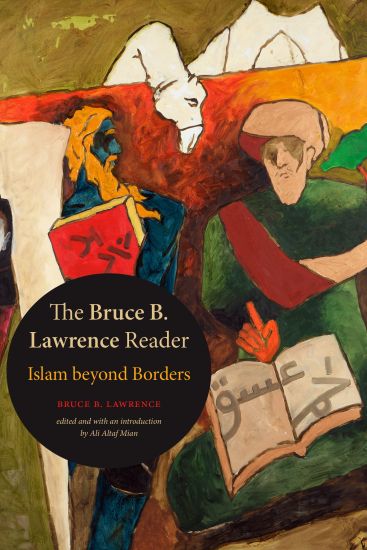
The Bruce B. Lawrence Reader

The Bruce B. Lawrence Reader

Bruce B. Lawrence

Duke University Press
2021
sidottu
Over the course of his career, Bruce B. Lawrence has explored the central elements of Islamicate civilization and Muslim networks. This reader assembles more than two dozen of Lawrence's key writings, among them analyses of premodern and modern Islamic discourses, practices, and institutions and methodological reflections on the contextual study of religion. Six methodologies serve as the organizing rubric: theorizing Islam, revaluing Muslim comparativists, translating Sufism, deconstructing religious modernity, networking Muslims, and reflecting on the Divine. Throughout, Lawrence attributes the resilience of Islam to its cosmopolitan character and Muslims' engagement in cross-cultural dialogue. Several essays also address the central role of institutional Sufism in various phases and domains of Islamic history. The volume concludes with Lawrence's reflections on Islam's spiritual and aesthetic resources in the context of global comity. Modeling what it means to study Islam beyond political and disciplinary borders as well as a commitment to linking empathetic imagination with critical reflection, this reader presents the broad arc of Lawrence's prescient contributions to the study of Islam.
The Bruce B. Lawrence Reader

The Bruce B. Lawrence Reader

Bruce B. Lawrence

Duke University Press
2021
pokkari
Over the course of his career, Bruce B. Lawrence has explored the central elements of Islamicate civilization and Muslim networks. This reader assembles more than two dozen of Lawrence's key writings, among them analyses of premodern and modern Islamic discourses, practices, and institutions and methodological reflections on the contextual study of religion. Six methodologies serve as the organizing rubric: theorizing Islam, revaluing Muslim comparativists, translating Sufism, deconstructing religious modernity, networking Muslims, and reflecting on the Divine. Throughout, Lawrence attributes the resilience of Islam to its cosmopolitan character and Muslims' engagement in cross-cultural dialogue. Several essays also address the central role of institutional Sufism in various phases and domains of Islamic history. The volume concludes with Lawrence's reflections on Islam's spiritual and aesthetic resources in the context of global comity. Modeling what it means to study Islam beyond political and disciplinary borders as well as a commitment to linking empathetic imagination with critical reflection, this reader presents the broad arc of Lawrence's prescient contributions to the study of Islam.
New Faiths, Old Fears

New Faiths, Old Fears

Bruce B. Lawrence

Columbia University Press
2002
sidottu
As a result of immigration from Asia in the wake of the passage of the 1965 Hart-Celler Immigration Act, the fastest-growing religions in America-faster than all Christian groups combined-are Islam, Hinduism, Buddhism, and Sikhism. In this remarkable book, a leading scholar of religion asks how these new faiths have changed or have been changed by the pluralist face of American civil society. How have these new religious minorities been affected by the deep-rooted American ambivalence toward foreign traditions? Bruce Lawrence casts a comparativist eye on the American religious scene and explores the ways in which various groups of Asian immigrants have, and sometimes have not, been integrated into the American polity. In the process, he offers several important correctives. Too often, Lawrence argues, profiles of Asian American experience focus exclusively on immigrants from East Asia, to the exclusion of South Asian and West Asian voices.New Faiths, Old Fears seeks to make all Asians equally important and to break free of traditional geographic markers, most reflecting nineteenth-century imperial values, that artificially divide the people of the "Middle East" from the rest of Asia, with whom they share certain religious and cultural ties. Iranian Americans, in particular, emerge as a vital bridge group whose experience tells us much about how Asians of many different backgrounds have found their way in their new nation. Beyond simply expanding and refining our conception of who Asian Americans are, Lawrence draws instructive comparisons between Asian Americans' experience and those of Native, African, and Hispanic Americans, exposing undercurrents of racial and class antagonisms. He concludes that we cannot fully comprehend the contours and valences of culture and religion in America without understanding how this racialized class prejudice shapes the views of the dominant class toward immigrants and other marginal groups.
New Faiths, Old Fears

New Faiths, Old Fears

Bruce B. Lawrence

Columbia University Press
2004
pokkari
As a result of immigration from Asia in the wake of the passage of the 1965 Hart-Celler Immigration Act, the fastest-growing religions in America-faster than all Christian groups combined-are Islam, Hinduism, Buddhism, and Sikhism. In this remarkable book, a leading scholar of religion asks how these new faiths have changed or have been changed by the pluralist face of American civil society. How have these new religious minorities been affected by the deep-rooted American ambivalence toward foreign traditions? Bruce Lawrence casts a comparativist eye on the American religious scene and explores the ways in which various groups of Asian immigrants have, and sometimes have not, been integrated into the American polity. In the process, he offers several important correctives. Too often, Lawrence argues, profiles of Asian American experience focus exclusively on immigrants from East Asia, to the exclusion of South Asian and West Asian voices.New Faiths, Old Fears seeks to make all Asians equally important and to break free of traditional geographic markers, most reflecting nineteenth-century imperial values, that artificially divide the people of the "Middle East" from the rest of Asia, with whom they share certain religious and cultural ties. Iranian Americans, in particular, emerge as a vital bridge group whose experience tells us much about how Asians of many different backgrounds have found their way in their new nation. Beyond simply expanding and refining our conception of who Asian Americans are, Lawrence draws instructive comparisons between Asian Americans' experience and those of Native, African, and Hispanic Americans, exposing undercurrents of racial and class antagonisms. He concludes that we cannot fully comprehend the contours and valences of culture and religion in America without understanding how this racialized class prejudice shapes the views of the dominant class toward immigrants and other marginal groups.
Shattering the Myth

Shattering the Myth

Bruce B. Lawrence

Princeton University Press
2000
pokkari
Islam is often portrayed, especially in Western media, as an alien, violent, hostile, and monolithic religion, whose adherents are intent upon battling nonbelievers throughout the world. Shattering the Myth demonstrates that these conceptions more accurately reflect the bias of Western reporters than they do the realities of contemporary Islam. Westerners are barraged by images of violence that usually originate from armed confrontations in one small corner of the world. Islam, Bruce Lawrence argues, is a complex, international religious system that cannot be reduced to stereotypes. As Lawrence demonstrates, Islam is a religion shaped as much by its own postulates and ethical demands as by the specific circumstances of Muslim people in the modern world. The last two hundred years have brought many challenges for Muslims, from colonial subjugation through sporadic revivalism to elitist reform movements and, most recently, pervasive struggles with fundamentalism. During each period, Muslims have had to address internal tensions, as well as external threats. Today Muslims in the post-colonial era, only some of whom are Arab and living in the Middle East, are playing ever greater roles in economic changes, both regional and international. As the impact of these changes has become evident in societies around the globe, new leaders have come into public view. The most remarkable emerging presence is that of Muslim women. Lawrence argues that it is the experience of Muslim women in particular that calls for a more nuanced understanding of Islam today. It is time, Lawrence believes, to replace inaccurate images of Islam with a recognition of the multifaceted character of this global religion and of its widely diverse adherents. Here he describes changes that are taking place throughout the world, particularly in Southeast Asia, enacted by governments and nongovernmental organizations alike. In a time of rapid international change, Lawrence suggests that it is time for our images of Islam to reflect more clearly the realities of Islam as it is lived. Shattering the Myth provides significant insights into the history of Islam and a greater understanding of the varied experiences of Muslims today. "An informed interpretation of the contemporary Muslim experience ...Lawrence's explanations for the particular states of affairs in Egypt, Iran, Pakistan, and Malaysia, among other cases, are compelling ...[A] distinguished contribution."--From the foreword by James Piscatori and Dale F. Eickelman
The Koran in English

The Koran in English

Bruce B. Lawrence

PRINCETON UNIVERSITY PRESS
2017
sidottu
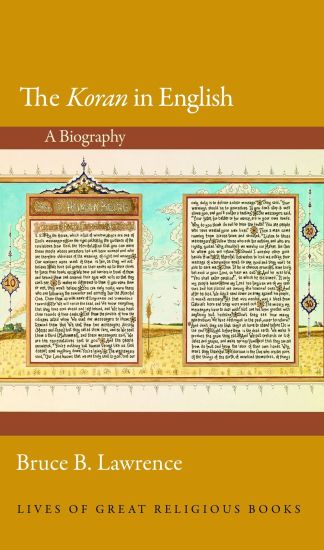
The untold story of how the Arabic Qur'an became the English Koran For millions of Muslims, the Qur'an is sacred only in Arabic, the original Arabic in which it was revealed to the Prophet Muhammad in the seventh century; to many Arab and non-Arab believers alike, the book literally defies translation. Yet English translations exist and are growing, in both number and importance. Bruce Lawrence tells the remarkable story of the ongoing struggle to render the Qur'an's lyrical verses into English--and to make English itself an Islamic language. The "Koran" in English revisits the life of Muhammad and the origins of the Qur'an before recounting the first translation of the book into Latin by a non-Muslim: Robert of Ketton's twelfth-century version paved the way for later ones in German and French, but it was not until the eighteenth century that George Sale's influential English version appeared. Lawrence explains how many of these early translations, while part of a Christian agenda to "know the enemy," often revealed grudging respect for their Abrahamic rival. British expansion in the modern era produced an anomaly: fresh English translations--from the original Arabic--not by Arabs or non-Muslims but by South Asian Muslim scholars. The first book to explore the complexities of this translation saga, The "Koran" in English also looks at cyber Korans, versions by feminist translators, and now a graphic Koran, the American Qur'an created by the acclaimed visual artist Sandow Birk.
The Koran in English

The Koran in English

Bruce B. Lawrence

Princeton University Press
2020
pokkari
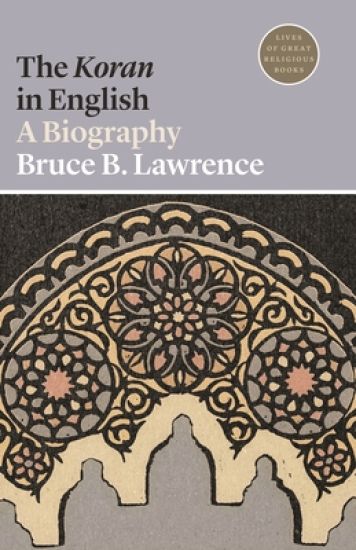
The untold story of how the Arabic Qur'an became the English KoranFor millions of Muslims, the Qur'an is sacred only in Arabic, the original Arabic in which it was revealed to the Prophet Muhammad in the seventh century. To many Arab and non-Arab believers alike, the book literally defies translation, yet English translations are growing in both number and importance. Bruce Lawrence tells the remarkable story of the centuries-long quest to translate the Qur'an's lyrical verses—and to make English itself an Islamic language. A translation saga like no other, this panoramic book looks at cyber Korans, versions by feminist translators, and even a graphic Qur'an by the acclaimed visual artist Sandow Birk.
Islamicate Cosmopolitan

Islamicate Cosmopolitan

Bruce B. Lawrence

Wiley-Blackwell (an imprint of John Wiley Sons Ltd)
2021
sidottu
Islam can not be considered - past, present, or future - except from a specific place and time. The place I occupy is the West, North America, the USA, and the time is the late 20th century now eliding into a new century, the 21st, and a new millennium, the third in a Christian frame of time. During the long 20th century the complexity and subtlety of Islam were consistently ignored in the West, just as its resilience and persistence were routinely underestimated. It is impossible to talk about the future of Islam without revisiting several points in the near past when its future was depicted with certainty, only to have events reveal that the forecasters had the vision of bats. To try yet again to imagine the future of Islam without revisiting prior estimates of its future would be both foolhardy and reckless. The past may be a foreign country, as David Lowenthal quipped, yet we need to revisit it in order to discover the place of Islam in the 21st century.For THE FUTURE OF ISLAM I have elected to look at four dates that mark both the history of the West and the attempt of Western analysts - scholars and public policy pundits alike - to contain the genie of Islam in a tiny bottle. The genie has now sprung free from that pitiful bottle, and it is time to revisit moments in the near past that help us better anticipate the near term future. We cannot reckon what might unfold in the 21st century without noting how 'certain' were the issues and moments, the trends and predictions, that defined Islam in the past. I begin with the end of World War II. By 1950 four vectors or profiles of Islam - the political and social, the cultural and the mystical - filled the imagination of Europeans and Americans alike when they thought about Islam and Muslims. With few exceptions Muslims were seen as citizens of the Middle East; Other Muslims who lived outside the Middle East, whether in Africa, Asia or the West, were ignored outright, or at most given limited, fleeting attention.Islam is not monolithic. One cannot talk about either its past or its future without attention to its internal differentiation. I have selected four vectors - the political and social, the cultural and the mystical - because each had its traits and force, its options and limits, that have persisted beyond 1950, but also became distinctively identifiable from that moment on. The same recurrent pattern of vectors, with overlapping yet competing features, can be traced In 1975 and again in 2000, and it will recur yet again in 2025.
Islamicate Cosmopolitan Spirit

Islamicate Cosmopolitan Spirit

Bruce B. Lawrence

Wiley-Blackwell (an imprint of John Wiley Sons Ltd)
2021
nidottu
Discover the essence of the Islamicate Cosmopolitan Spirit and what it has contributed to societies across the ages In Islamicate Cosmopolitan Spirit, author and expert, Bruce B. Lawrence, delivers a spiritual elan filtered through cultural practices and artefacts. Neither juridical nor creedal, the book expresses a desire for the just and the beautiful. The author sets out an original and fascinating theory, that Islamicate cosmopolitanism marks a new turn in global history. An unceasing, self-critical pursuit of truth, hitched to both beauty and justice, its history is marked by male elites who were scientific exemplars in the pre-modern period. In the modern period, these exemplars include women as well as men, artists as well as scientists. The Islamicate Cosmopolitans have had special impact across the Afro-Eurasian ecumene at the heart of civilized exchange between multiple groups with competing yet convergent interests. The Islamicate Cosmopolitan Spirit is a boundary busting challenge to those who think of the world merely in terms of an “Arab” Middle East. Readers will also benefit from: A thorough introduction to the Islamicate Cosmopolitan Spirit across time and space An exploration of premodern Afro-Eurasia and Persianate Culture in the Indian Ocean A practical discussion of the future of the Islamicate Cosmopolitan Spirit Perfect for all students of Islamicate civilization, both traditional and progressive, Islamicate Cosmopolitan Spirit will also earn a place in the libraries of general readers of world history and those grounded in the larger history of Islamicate Asia will find a perspective that centers their own contribution to the Islamicate Cosmopolitan Spirit.
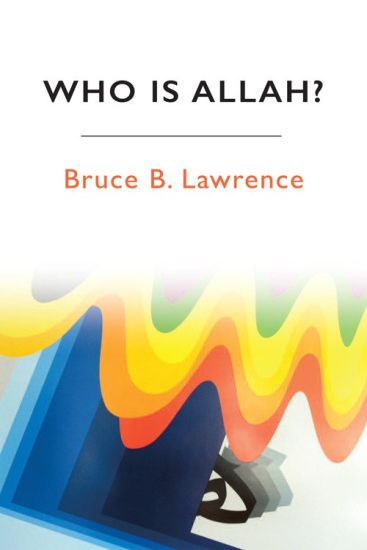
Who is Allah?

Who is Allah?

Bruce B. Lawrence

Edinburgh University Press
2015
sidottu
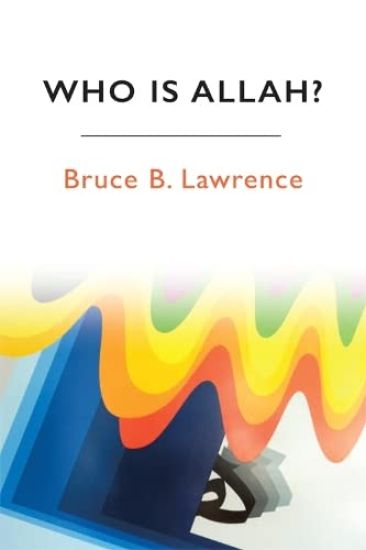
Engaging with the age old question of who is the God of Islam, Bruce B. Lawrence stakes out the historical nuance of Allah throughout the past 1500 years, from the earliest mention of his name to his appropriation by cyberspace. It introduces a broad range of perspectives, practices and problems linked to Allah, including debates that are intra-religious as well as inter-religious, concerning differences among Muslims as well as between Muslims and non-Muslim others. Chapters cover the range of Muslim perspectives on Allah and tackle such topics as war in the name of Allah and controversies about the use of the name Allah/ God. Throughout the author highlights the need to look at Islam with fresh eyes and to understand Allah/ God with dispassionate insight.
Who is Allah?

Who is Allah?

Bruce B. Lawrence

Edinburgh University Press
2015
nidottu
Allah is the most common and contested name in the Islamic tradition - but who is he? Engaging with the age old question of who is the God of Islam, Bruce B. Lawrence stakes out the historical nuance of Allah throughout the past 1500 years, from the earliest mention of his name to his appropriation by cyberspace. It introduces a broad range of perspectives, practices and problems linked to Allah, including debates that are intra religious as well as inter religious, concerning differences among Muslims as well as between Muslims and non Muslim others. Chapters cover the range of Muslim perspectives on Allah and tackle such topics as war in the name of Allah and controversies about the use of the name Allah/ God. Throughout the author highlights the need to look at Islam with fresh eyes and to understand Allah/ God with dispassionate insight. It mixes historical overview with contemporary analysis. It includes a guide to further reading and a glossary of technical terms. It considers the future of Allah in cyberspace. It also includes sidebars to illustrate key terms and a glossary of Arabic/ Islamic words, persons and practices.
Shahrastani on the Indian Religions

Shahrastani on the Indian Religions

Bruce B. Lawrence

Mouton de Gruyter
1976
sidottu
The series Religion and Society (RS) contributes to the exploration of religions as social systems– both in Western and non-Western societies; in particular, it examines religions in their differentiation from, and intersection with, other cultural systems, such as art, economy, law and politics. Due attention is given to paradigmatic case or comparative studies that exhibit a clear theoretical orientation with the empirical and historical data of religion and such aspects of religion as ritual, the religious imagination, constructions of tradition, iconography, or media. In addition, the formation of religious communities, their construction of identity, and their relation to society and the wider public are key issues of this series.
The Qur'an

The Qur'an

M.A.R. Habib; Bruce B. Lawrence

WW NORTON CO
2024
sidottu
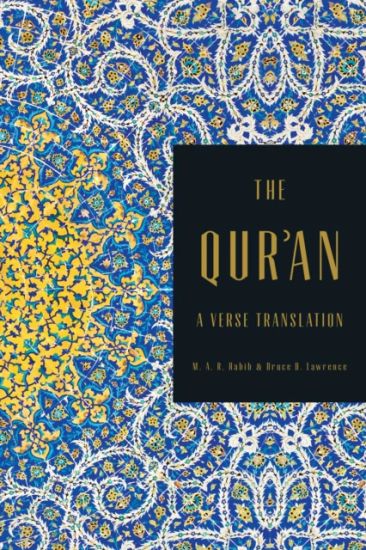
The product of a ten-year-long collaboration between one of our most respected scholars of Islam (Bruce B. Lawrence) and a poet and scholar of literature (M.A.R. Habib), The Qur’an: A Verse Translation offers readers the first edition in English to echo, in accessible and resonant verse, the sonorous beauty of the Arabic original as well as the complex nuances of its meaning. Those familiar with the Arabic—and especially the faithful who hear the text recited aloud—know that the Qur’an is a perfect blend of sound and sense. While no translation can perfectly capture these complementary virtues of the original, Habib and Lawrence have come closest to an accessible, clear and fluid English Qur’an that all readers, no matter their faith or familiarity with the text, can read with pleasure and with a deeper appreciation for the book and the religious tradition founded upon it.
The Qur'an

The Qur'an

M.A.R. Habib; Bruce B. Lawrence

W W NORTON CO LTD
2026
nidottu
The product of a ten-year-long collaboration between one of our most respected scholars of Islam (Bruce B. Lawrence) and a poet and scholar of literature (M.A.R. Habib), The Qur’an: A Verse Translation offers readers the first edition in English to echo, in accessible and resonant verse, the sonorous beauty of the Arabic original as well as the complex nuances of its meaning. Those familiar with the Arabic—and especially the faithful who hear the text recited aloud—know that the Qur’an is a perfect blend of sound and sense. While no translation can perfectly capture these complementary virtues of the original, Habib and Lawrence have come closest to an accessible, clear and fluid English Qur’an that all readers, no matter their faith or familiarity with the text, can read with pleasure and with a deeper appreciation for the book and the religious tradition founded upon it.