Kirjojen hintavertailu. Mukana 11 699 587 kirjaa ja 12 kauppaa.

Kirjahaku

Etsi kirjoja tekijän nimen, kirjan nimen tai ISBN:n perusteella.

8 kirjaa tekijältä Bruce Brooks Pfeiffer

Frank Lloyd Wright: The Crowning Decade (1949-1959)

Frank Lloyd Wright: The Crowning Decade (1949-1959)

Bruce Brooks Pfeiffer

SOUTHERN ILLINOIS UNIVERSITY PRESS
1989
sidottu
In the last ten years of his life, Frank Lloyd Wright became a respected public figure honored throughout the world. The shift from maverick to honoree changed his architecture, which became simpler and more sensuous.This decade also saw an incredible increase in production from Wright. Between the ages of 82 and 92, he designed the Price Tower, the Beth Shalom Synagogue, the Dallas Theater Center, the Guggenheim Museum, and at the time of his death, there were 86 projects in various stages of completion in the drafting room.The Crowning Decade views Wright's final years from five perspectives: as Wright saw himself; as the outside world saw him; as he appears in the private memoirs of Olgivanna Lloyd Wright; as his daughter, Iovanna Wright, saw him; and in a composite portrait by his Taliesin Fellows.
Frank Lloyd Wright Designs

Frank Lloyd Wright Designs

Bruce Brooks Pfeiffer

Rizzoli International Publications
2011
sidottu
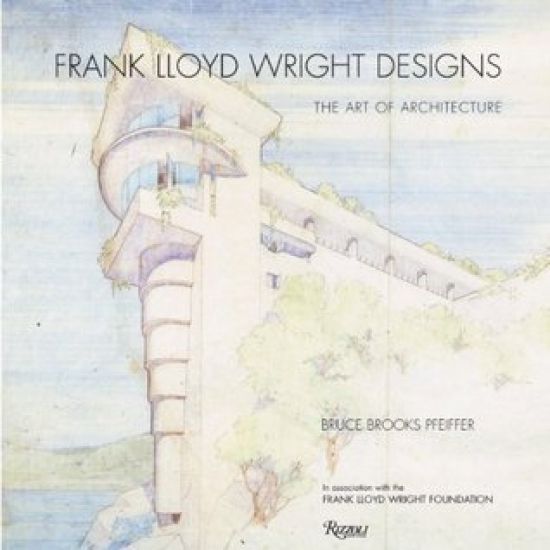
The first major presentation in decades of the visionary drawings of the artist-architect and master designer. Frank Lloyd Wright was an architect of vast and unprecedented vision, whose work is not only still admired by the critics and carefully studied by historians but is also widely beloved. Comfortable spaces, humanly scaled, with extraordinary attention to detail-as seen in a range of architectural forms-are at the center of Wright’s enduring appeal. This vision and attention is nowhere more evident than in the drawings. It has been said that had Wright left us only drawings, and not his buildings as well, he would still be celebrated for his brilliant artistry, and this is borne out here. Even more significant, and shown here as never before, are the magical first moments of invention and inspiration-Wright’s earliest sketches, some never before published-which offer unique insight into the mind of the master architect.Frank Lloyd Wright Designs is the most important and comprehensive book to be published on the drawings, designs, conceptual sketches, elevations, and plans of Wright, with particular emphasis on the development of certain important projects. It includes the best-known and beloved projects-like Fallingwater, The Coonley House, Midway Gardens, the Guggenheim, the Imperial Hotel-as well as a range of intriguing, unfamiliar, and previously unpublished drawings by Wright.
Frank Lloyd Wright

Frank Lloyd Wright

Bruce Brooks Pfeiffer

Taschen GmbH
2015
sidottu
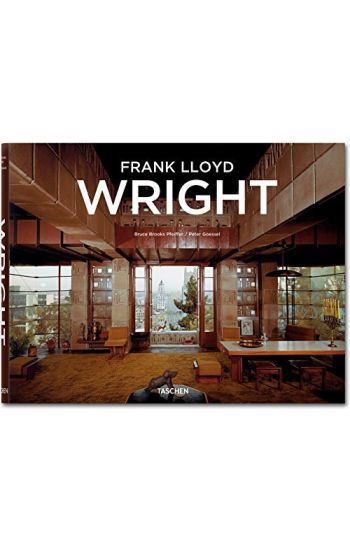
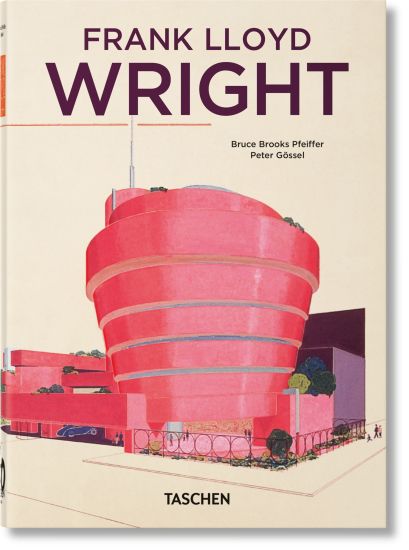
A building by Frank Lloyd Wright (1867-1959) is at once unmistakably individual, and evocative of an entire era. Notable for their exceptional understanding of an organic environment, as well as for their use of steel and glass to revolutionize the interface of indoor and outdoor, Wright’s designs helped announce the age of modernity, as much as they secured his own name in the annals of architectural genius. This meticulous compilation from TASCHEN’s previous three-volume monograph assembles the most important works from Wright’s extensive, paradigm-shifting oeuvre into one authoritative and accessibly priced overview of America's most famous architect. Based on unlimited access to the Frank Lloyd Wright Archives in Taliesin, Arizona, the collection spans the length and breadth of Wright’s projects, both realized and unrealized, from his early Prairie Houses, through the Usonian concept home, epitomized by Fallingwater, the Tokyo years, his progressive “living architecture” buildings, right through to later schemes like the Guggenheim Museum, New York, and fantastic visions for a better tomorrow in the “living city.” Author Bruce Brooks Pfeiffer, who served as Wright’s apprentice during the 1950s, discusses recent research on Wright and gives his own insights on these game-changing buildings.
F.L. Wright

F.L. Wright

Bruce Brooks Pfeiffer

TASCHEN GMBH
2015
sidottu
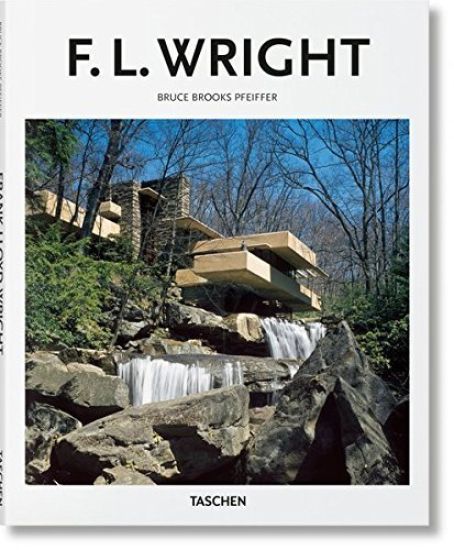
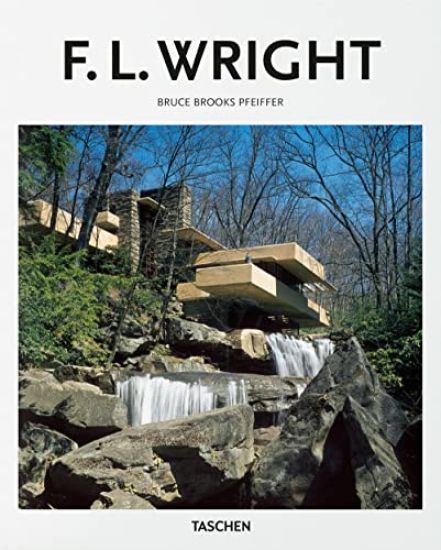
Acclaimed as the “father of skyscrapers,” the quintessentially American icon Frank Lloyd Wright (1867–1959) was an architect of aspiration. He believed in giving cultivated American life its fitting architectural equivalent and applied his idealism to structures across the continent, from suburban homes to churches, offices, skyscrapers, and the celebrated Guggenheim Museum. Wright’s work is distinguished by its harmony with humanity and its environment, a philosophy he called organic architecture, and which found its paradigm at Fallingwater, a house in rural Pennsylvania, cited by the American Institute of Architects as “the best all-time work of American architecture.” Wright also made a particular mark with his use of industrial materials, and by the simple L or T plan of his Prairie House which became a model for rural architecture across America. Wright was also often involved in many of the interior elements of his buildings, such as the furniture and stained glass, paying particular attention to the balance between individual needs and community activity. Exploring Wright’s aspirations to augment American society through architecture, this book offers a concise introduction to his at once technological and Romantic response to the practical challenges of middle-class Americans.
F.L. Wright

F.L. Wright

Bruce Brooks Pfeiffer

Taschen GmbH
2015
sidottu
Acclaimed as the “father of skyscrapers,” the quintessentially American icon Frank Lloyd Wright (1867–1959) was an architect of aspiration. He believed in giving cultivated American life its fitting architectural equivalent and applied his idealism to structures across the continent, from suburban homes to churches, offices, skyscrapers, and the celebrated Guggenheim Museum. Wright’s work is distinguished by its harmony with humanity and its environment, a philosophy he called organic architecture, and which found its paradigm at Fallingwater, a house in rural Pennsylvania, cited by the American Institute of Architects as “the best all-time work of American architecture.” Wright also made a particular mark with his use of industrial materials, and by the simple L or T plan of his Prairie House which became a model for rural architecture across America. Wright was also often involved in many of the interior elements of his buildings, such as the furniture and stained glass, paying particular attention to the balance between individual needs and community activity. Exploring Wright’s aspirations to augment American society through architecture, this book offers a concise introduction to his at once technological and Romantic response to the practical challenges of middle-class Americans.
F.L. Wright

F.L. Wright

Bruce Brooks Pfeiffer

TASCHEN GMBH
2015
sidottu
Acclaimed as the “father of skyscrapers,” the quintessentially American icon Frank Lloyd Wright (1867–1959) was an architect of aspiration. He believed in giving cultivated American life its fitting architectural equivalent and applied his idealism to structures across the continent, from suburban homes to churches, offices, skyscrapers, and the celebrated Guggenheim Museum. Wright’s work is distinguished by its harmony with humanity and its environment, a philosophy he called organic architecture, and which found its paradigm at Fallingwater, a house in rural Pennsylvania, cited by the American Institute of Architects as “the best all-time work of American architecture.” Wright also made a particular mark with his use of industrial materials, and by the simple L or T plan of his Prairie House which became a model for rural architecture across America. Wright was also often involved in many of the interior elements of his buildings, such as the furniture and stained glass, paying particular attention to the balance between individual needs and community activity. Exploring Wright’s aspirations to augment American society through architecture, this book offers a concise introduction to his at once technological and Romantic response to the practical challenges of middle-class Americans.
Frank Lloyd Wright. 45th Ed.

Frank Lloyd Wright. 45th Ed.

Bruce Brooks Pfeiffer

TASCHEN GMBH
2024
sidottu
A building by Frank Lloyd Wright (1867–1959) is at once unmistakably individual and evocative of an entire era. Notable for their exceptional harmony with their environment, as well as for their use of steel and glass to revolutionize the interface of indoor and outdoor, Wright’s designs helped announce the age of modernity, as much as they secured his place in the annals of architectural genius.This meticulous compilation from TASCHEN’s previous monograph assembles the most important works from Wright’s extensive, paradigm-shifting oeuvre into one authoritative overview of America’s most famous architect. Based on unlimited access to the Frank Lloyd Wright Foundation’s archives at Taliesin West in Arizona, the collection spans the length and breadth of Wright’s projects, both realized and unrealized, from his early prairie houses, the Usonian concept homes, and the extraordinary Fallingwater to the Tokyo years, his designs for administrative buildings and places of worship, and later high-profile projects like the Guggenheim Museum in New York, as well as his fantastic visions for a better tomorrow with “The Living City.”