Kirjojen hintavertailu. Mukana 11 342 296 kirjaa ja 12 kauppaa.

Kirjahaku

Etsi kirjoja tekijän nimen, kirjan nimen tai ISBN:n perusteella.

3 kirjaa tekijältä Bruce W. Winter

The Book of Acts in its Ancient Literary Setting

The Book of Acts in its Ancient Literary Setting

Bruce W. Winter

William B Eerdmans Publishing Co
1994
nidottu
This Prodigious New Six-Volume series presents the results of interdisciplinary research between New Testament, Jewish, and classical scholarship. Working to place the Book of Acts within its first-century setting, well-known historians and biblical scholars from Australia, the United States, Canada, Russia, and the United Kingdom have collaborated here to provide a stimulating new study that replaces The Beginnings of Christianity and other older studies on Acts. Starting with the understanding that the Book of Acts is rooted within the setting of the peoples and cultures of the Mediterranean in the first century A.D., this comprehensive series provides a multifaceted approach to the Acts of the Apostles in its literary, regional, cultural, ideological, and theological contexts. The composition of Acts is discussed beside the writing of ancient literary monographs and intellectual biographies. Recent epigraphic and papyrological discoveries also help illumine the text of Acts. Archaeological fieldwork, especially in Greece and Asia Minor, has yielded valuable information about the local setting of Acts and the religious life of urban communities in the Roman Empire.These volumes draw on the best of this research to elucidate the Book of Acts against the background of activity in which early Christianity was born. The Book of Acts in Its Ancient Literary Setting is the first volume in this groundbreaking series. The book includes fourteen chapters devoted to the literary framework that undergirds the Book of Acts. Topics include the text as an historical monograph, ancient rhetoric and speeches, the Pauline corpus, biblical history, subsequent ecclesiastical histories, and modernliterary method. All of these chapters arise out of a consultation by the project's scholars at Cambridge in March 1993.
After Paul Left Corinth

After Paul Left Corinth

Bruce W. Winter

William B Eerdmans Publishing Co
2000
pokkari
After Paul Left Corinth gathers for the first time all the relevant extant material from literary, nonliterary, and archaeological sources on what life was like in the first-century Roman colony of Corinth. Using this evidence, Bruce Winter not only opens a fascinating vista on day-to-day living in the Graeco-Roman world but, more importantly, helps us understand what happened to the Christian community after Paul left Corinth. As Winter shows, the origin of many of the problems Paul dealt with in 1 Corinthians can be traced to culturally determined responses to aspects of life in Corinth. The significance of the role that culture played in the life of the Corinthian Christians has either been ignored or underestimated in explaining the reasons for their difficulties after Paul left. Winter first examines the extent to which Paul communicated alternative ways of behaving while he was in Corinth. Winter then explores the social changes that occurred in Corinth after Paul left.Severe grain shortages, the relocation of the Isthmian Games, the introduction of a new federal imperial cult, the withdrawal of kosher meat from the official market-all of these cultural events had a substantial impact on the life of the emerging Christian community. Accentuated with photos of relevant archaeological artifacts, this volume provides a significant new perspective from which to read Paul's Corinthian correspondence.
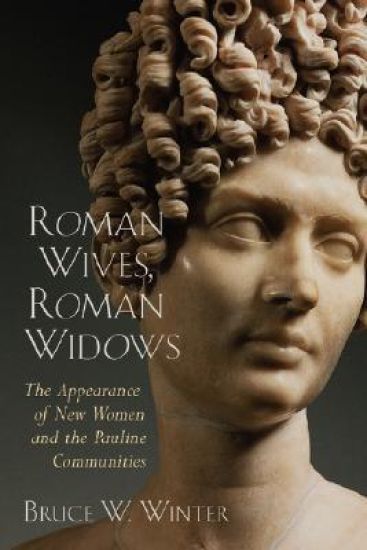
Roman Wives, Roman Widows

Roman Wives, Roman Widows

Bruce W. Winter

William B Eerdmans Publishing Co
2003
pokkari
In Roman law you were what you wore. This legal principle became highly significant because, beginning in the first century A.D., a "new" kind of woman emerged across the Roman empire - a woman whose provocative dress and sometimes promiscuous lifestyle contrasted starkly with the decorum of the traditional married woman. What a woman chose to wear came to identify her as either "new" or "modest." Augustus legislated against the "new" woman. Philosophical schools encouraged their followers to avoid embracing her way of life. And, as this fascinating book demonstrates for the first time, the presence of the "new" woman was also felt in the early church, where Christian wives and widows were exhorted to emulate neither her dress code nor her conduct. Using his extensive knowledge both of the Graeco-Roman world and of the New Testament writings, Bruce Winter shows how changing social mores among women impacted the Pauline communities.This helps to explain the controversial texts on marriage veils in 1 Corinthians, instructions in 1 Timothy regarding dress code and the activities of young widows, and exhortations in Titus for older women to call new wives "back to their senses" regarding their marriage and family responsibilities.Based on a close investigation of neglected literary and archaeological evidence, Roman Wives, Roman Widows makes groundbreaking contributions to our understanding of first-century women, including their participation in public life as lawyers, magistrates, and political figures, which in turn affected women's ministry in the Pauline communities.