Kirjojen hintavertailu. Mukana 11 244 527 kirjaa ja 12 kauppaa.

Kirjahaku

Etsi kirjoja tekijän nimen, kirjan nimen tai ISBN:n perusteella.

2 kirjaa tekijältä Bruno Boccara

Socio-Analytic Dialogue

Socio-Analytic Dialogue

Bruno Boccara

Lexington Books
2014
sidottu
In this book, Bruno Boccara argues that complex and changing psychosocial issues, in particular those related to the societal unconscious, must be assessed and incorporated in public policy analysis through Socio-Analytic Dialogue, a psychosocial approach aimed at understanding and addressing emotional issues surrounding public policies worldwide through empathic dialogue. Taking into account societal level anxieties and defense mechanisms—at both the conscious and unconscious levels—when formulating and implementing policies increases the awareness and understanding of psychosocial issues, and decreases the need, and therefore the likelihood, of societies adopting regressive social defenses. Covering international topics including research from the United States; Tunisia and the Arab spring; discontent and riots in Chile, Israel, and the United Kingdom; and humiliation in Sub-Saharan Africa, the book identifies how country-level psychosocial dynamics impact public policies, and suggests that policies themselves can become social defenses. Two case studies, firstly on the World Bank and foreign aid, and secondly on Bolivia, illustrate how a deep understanding of psychosocial issues can provide new insights on the functioning of organizations (perverse dynamics) and on a country’s policy choices and economic performance. Building upon recent work in sociology and psychoanalysis, the book demonstrates that Socio-Analytic Dialogue has the potential to make a significant contribution to understanding worldwide discontent and anxieties.
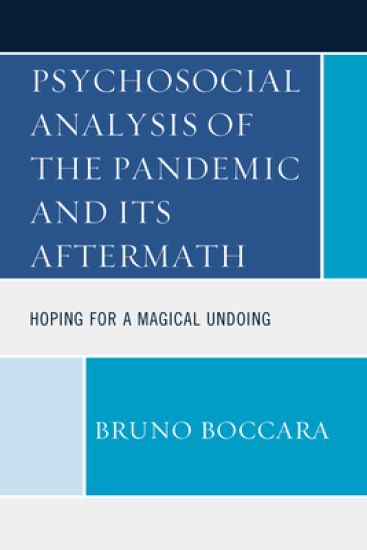
Psychosocial Analysis of the Pandemic and Its Aftermath

Psychosocial Analysis of the Pandemic and Its Aftermath

Bruno Boccara

UNIVERSITY PRESS OF AMERICA
2022
nidottu
This manifesto is motivated by the daunting psychosocial issues that were so strikingly revealed by the Covid-19 pandemic. Of particular interest is the collective denial of facts, which resulted in public health policy mistakes and fostered distrust. In hindsight, this could have been prevented. Boccara shows how the core psychosocial response to the pandemic observed in most countries turned out to be wishing for it to either magically go away, as if it had never happened or be dealt with in an effortless way. Magical thinking and, as a consequence denying reality, often prevailed. As such, the psychosocial dynamics deepened the denial even further as several countries ended-up deciding to “live with the virus”. Yet, deliberately choosing endemicity of the coronavirus may lead to insurmountable challenges. Humanity is, therefore, truly finding itself at a turning point. Boccara argues that successfully facing systemic challenges ahead will require societies to systematically take into account ways in which psychosocial dynamics -particularly those operating at the societal unconscious level- impact public policy and societal level dialogue. By this, we mean understanding how mental representations and fantasies, shared anxieties, and social defenses mobilized against those anxieties impact the society; in other words how nations function as social systems. There has probably never been a more critical time than now for societies worldwide to approach critical decisions from a psychosocial perspective. Failing to do so could lead to psychosocial tipping points whereas the world as whole would increasingly mobilized regressed defenses that would make it impossible for societies to manage such challenges.There comes a time when ideas potentially capable of profoundly changing the world must be brought to the centers of decision making. That time is now upon us.