

Kirjahaku
Etsi kirjoja tekijän nimen, kirjan nimen tai ISBN:n perusteella.
3 kirjaa tekijältä Bryan Bunch
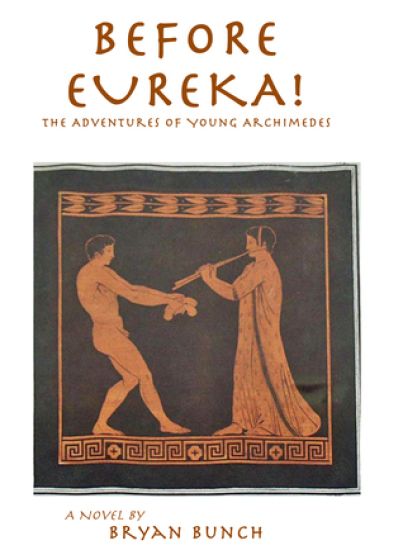
Before Eureka!: The Adventures of Young Archimedes
Bryan Bunch
Createspace Independent Publishing Platform
2014
nidottu
Before Eureka The novel takes the young Archimedes of Syracuse (in Sicily) from the age of nine until he leaves for Alexandria. The many discoveries Archimedes makes in his adult life are prefigured by life-threatening adventures as a child and a teenager-laws of hydrostatics, levers, balance points, and counting theory, and inventions such as concentrating sunlight, screws, catapults, and other devices. These help Archimedes escape sacrifice to a god, drowning, earthquakes, kidnapping, battles, and direct attacks on his life. He is also involved with the well-known great events of the day, events that led to the First Punic War between Rome and Carthage, interacting with kings Pyrrhus and Hiero II (a relative), along with lesser-known politicians and warriors. In another strand that runs through the books, Archimedes, known by his childhood nickname of "Figures" (for his mathematical habits) participates twice in the Syracuse Games pentathlon. His fictional companions include a tomboy of his own age (Phyllis), her younger brother, a distant relative who also is threatened by the villain, and friends and adversaries among the other boys of Syracuse. The story proceeds as a series of adventures, facing a villain who has reasons to kill Archimedes, being trapped in a cave, participation in war and battles, and failure and success as an athlete. Greek culture suffuses the book, with habits, dress, dwellings, and pastimes included. In this fiction, Archimedes and his family are Pythagoreans, who do not believe in Greek gods, while his best friend Phyllis is not only a true believer, but even becomes a priestess of the patron goddess of Syracuse, Artemis. In a number of cases, it might appear that Artemis controls some of the events of the book, rather in the way Athena and other gods control the Trojan War and the adventures of Odysseus, although Archimedes thinks it is just luck. The postlog summarizes Archimedes and his life with the historical event of the Roman Cicero uncovering his grave. An appendix that purports to be the known lost biography of Archimedes by his friend Heracleides concludes the book.PROFESSIONAL REVIEWS The] novel took this reader happily through last week's blizzard and then found its spot on the "keeper shelf" to be read again-and to be shared with various young readers. ...this book is a great story, suitable for readers young and old. Please don't miss it.Ann La Farge in The Hudson Valley NewsBunch's novel retains the Homeric signature of being both simple and profound, a difficult thing to do.... The young adult novel genre in America remains mired in narcissistic fantasy or trivial emotional realism. This novel presents an enlightened counterstroke, moving the genre toward both practical imagination and real life. Kevin T. McEneaney in The Millbrook Independent
STEM Chronology by Bryan Bunch (with contributions from Alexander Hellemans) consists of about 10,000 chronological reports from 3,400,000 BCE through 2017 detailing the main contributions to SCIENCE, TECHNOLOGY, ENGINEERING, and MATHEMATICS for each year. Interspersed among the entries are 182 short essays on topics of special interest and short biographies of 200 scientists (lists attached). Although the text is based on The History of Science and Technology (published by Houghton Mifflin in 2004), STEM Chronology is considerably revised, using a different format while adding many new entries and details to existing entries, extending the manuscript in both directions chronologically so that it now covers from 3,400,000 BCE to 2017 (2018 to be added before publication.) There is also a completely new, extensive index.STEM Chronology is simpler than The History of Science and Technology in that the long introductions to different periods in history and all the artwork/photography are omitted. The format is simple. Each year that is covered includes notable events in the four categories grouped by category.Unlike other histories of science, technology, engineering, or mathematics, STEM Chronology attempts to explain every important event in those subjects rather than focusing on a broad approach to major developments. In the age of Google, a researcher can often locate information about a topic, but he or she needs to know what to ask for, which is not always easy to find. The entries in STEM Chronology get to the heart of the matter without mixing information from other events. Internal cross-references make it easy to trace the development of important topics from year to year.