Kirjojen hintavertailu. Mukana 12 016 292 kirjaa ja 12 kauppaa.

Kirjahaku

Etsi kirjoja tekijän nimen, kirjan nimen tai ISBN:n perusteella.

5 kirjaa tekijältä Bryan D. Jones

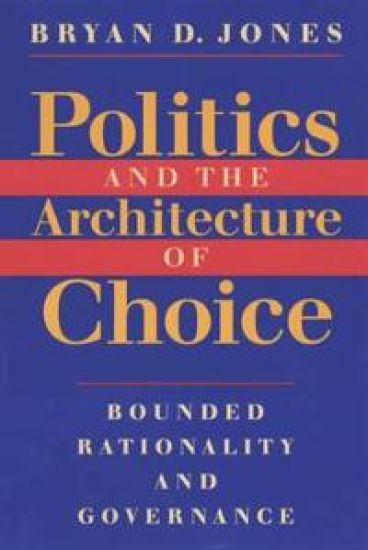
Politics and the Architecture of Choice

Politics and the Architecture of Choice

Bryan D. Jones

University of Chicago Press
2001
sidottu
This text draws on work in political science, economics, cognitive science and psychology to offer an innovative theory of how people and organizations adapt to change and why these adaptations do not always work. The author argues that our decision-making capabilities are rational and adaptive, but because our rationality is bounded and our adaptability limited, our actions are not based simply on objective information from our environments. Instead, we overemphasize some factors and neglect others, and our inherited limitations - such as short-term memory capacity - all act to affect our judgement.
Politics and the Architecture of Choice

Politics and the Architecture of Choice

Bryan D. Jones

University of Chicago Press
2001
nidottu
This text draws on work in political science, economics, cognitive science and psychology to offer an innovative theory of how people and organizations adapt to change and why these adaptations do not always work. The author argues that our decision-making capabilities are rational and adaptive, but because our rationality is bounded and our adaptability limited, our actions are not based simply on objective information from our environments. Instead, we overemphasize some factors and neglect others, and our inherited limitations - such as short-term memory capacity - all act to affect our judgement.
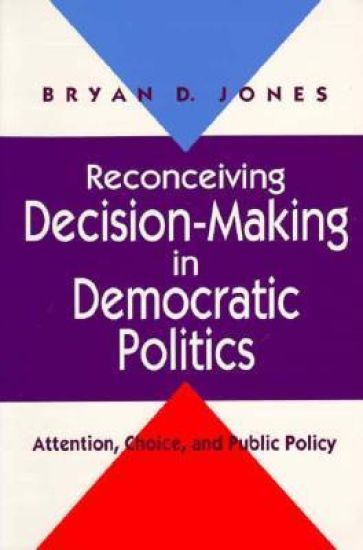
Reconceiving Decision-Making in Democratic Politics

Reconceiving Decision-Making in Democratic Politics

Bryan D. Jones

University of Chicago Press
1995
sidottu
Most models of political decision-making maintain that individual preferences remain relatively constant. Why, then, are there often sudden abrupt changes in public opinion on political issues? Or total reversals in congressional support for specific legislation, as happened with the voting on the Superconducting Supercollider? Bryan D. Jones answers these questions by connecting insights from cognitive science and rational choice theory to political life. Individuals and political systems alike, Jones argues, tend to be attentive to only one issue at a time. Using numerous examples from elections, public-opinion polls, congressional deliberations and bureaucratic decision-making, he shows how shifting attentiveness can and does alter choices and political outcomes - even when underlying preferences remain relatively fixed. An individual, for example, may initially decide to vote for a candidate because of her stand on spending, but change his vote when he learns of her position on abortion, never really balancing the two options.
Reconceiving Decision-Making in Democratic Politics

Reconceiving Decision-Making in Democratic Politics

Bryan D. Jones

University of Chicago Press
1995
nidottu
Most models of political decision-making maintain that individual preferences remain relatively constant. Why, then, are there often sudden abrupt changes in public opinion on political issues? Or total reversals in congressional support for specific legislation, as happened with the voting on the Superconducting Supercollider? Bryan D. Jones answers these questions by connecting insights from cognitive science and rational choice theory to political life. Individuals and political systems alike, Jones argues, tend to be attentive to only one issue at a time. Using numerous examples from elections, public-opinion polls, congressional deliberations and bureaucratic decision-making, he shows how shifting attentiveness can and does alter choices and political outcomes - even when underlying preferences remain relatively fixed. An individual, for example, may initially decide to vote for a candidate because of her stand on spending, but change his vote when he learns of her position on abortion, never really balancing the two options.