Kirjojen hintavertailu. Mukana 11 699 587 kirjaa ja 12 kauppaa.

Kirjahaku

Etsi kirjoja tekijän nimen, kirjan nimen tai ISBN:n perusteella.

11 kirjaa tekijältä Bryan G. Norton

Toward Unity among Environmentalists

Toward Unity among Environmentalists

Bryan G. Norton

Oxford University Press Inc
1995
nidottu
This book presents an argument that the environmental movement is a coalition of many groups working toward common objectives without common values. Norton believes this lack of unity causes unnecessary and divisive controversy and debate within the environmentalist community which impedes the development of effective and timely environmental management policies. The various participants in environmental debates see events so differently, and describe them in such diverse vocabularies, that the environmental movement, unlike other social action movements, lacks common theoretical principles. Norton's goal is to create a common language for discussing environmental issues as a first step towards a unified theory of environmental management. This book will be of a value to general readers with an interest in environmental and ecological issues; environmental planners and policy makers; conservation biologists, wildlife biologists; and ecologists.

Sustainable Values, Sustainable Change

Sustainable Values, Sustainable Change

Bryan G. Norton

University of Chicago Press
2015
sidottu
Sustainability is a nearly ubiquitous concept today, but can we ever imagine what it would be like for humans to live sustainably on the earth? No, says Bryan G. Norton in Sustainable Values, Sustainable Change. One of the most trafficked terms in the press, on university campuses, and in the corridors of government, sustainability has risen to prominence as a buzzword before the many parties laying claim to it have come close to agreeing how to define it. But the term's political currency urgently demands that we develop an understanding of this elusive concept. While economists, philosophers, and ecologists argue about what in nature is valuable, and why, Norton here offers an action-oriented, pragmatic response to the disconnect between public and academic discourse around sustainability. Looking to the arenas in which decisions are made-and the problems that are driving these decisions-Norton reveals that the path to sustainability cannot be guided by fixed, utopian objectives projected into the future; sustainability will instead be achieved through experimentation, incremental learning, and adaptive management. Drawing inspiration from Aldo Leopold's famed metaphor of "thinking like a mountain" for a spatially explicit, pluralistic approach to evaluating environmental change, Norton replaces theory-dependent definitions with a new decision-making process guided by deliberation and negotiation across science and philosophy, encompassing all stakeholders and activists and seeking to protect as many values as possible. Looking across scales to today's global problems, Norton urges us to learn to think like a planet.
Sustainable Values, Sustainable Change

Sustainable Values, Sustainable Change

Bryan G. Norton

University of Chicago Press
2015
nidottu
Sustainability is a nearly ubiquitous concept today, but can we ever imagine what it would be like for humans to live sustainably on the earth? No, says Bryan G. Norton in Sustainable Values, Sustainable Change. One of the most trafficked terms in the press, on university campuses, and in the corridors of government, sustainability has risen to prominence as a buzzword before the many parties laying claim to it have come close to agreeing how to define it. But the term's political currency urgently demands that we develop an understanding of this elusive concept. While economists, philosophers, and ecologists argue about what in nature is valuable, and why, Norton here offers an action-oriented, pragmatic response to the disconnect between public and academic discourse around sustainability. Looking to the arenas in which decisions are made-and the problems that are driving these decisions-Norton reveals that the path to sustainability cannot be guided by fixed, utopian objectives projected into the future; sustainability will instead be achieved through experimentation, incremental learning, and adaptive management. Drawing inspiration from Aldo Leopold's famed metaphor of "thinking like a mountain" for a spatially explicit, pluralistic approach to evaluating environmental change, Norton replaces theory-dependent definitions with a new decision-making process guided by deliberation and negotiation across science and philosophy, encompassing all stakeholders and activists and seeking to protect as many values as possible. Looking across scales to today's global problems, Norton urges us to learn to think like a planet.
Sustainability

Sustainability

Bryan G. Norton

University of Chicago Press
2005
sidottu
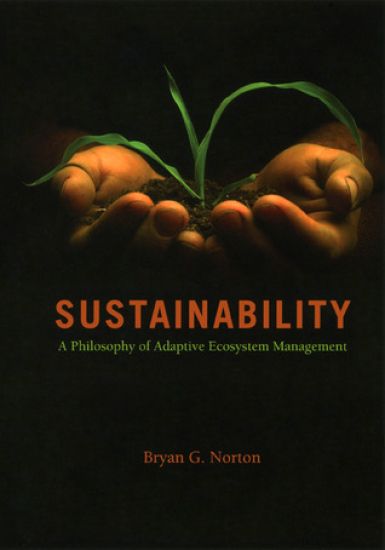
While many disciplines contribute to environmental conservation, there is little successful integration of science and social values. Arguing that the central problem in conservation is a lack of effective communication, Bryan Norton shows in "Sustainability" how current linguistic resources discourage any shared, multidisciplinary public deliberation over environmental goals and policy. In response, Norton develops a new, interdisciplinary approach to defining sustainability - the corner-stone of environmental policy - using philosophical and linguistic analyses to create a nonideological vocabulary that can accommodate scientific and evaluative environmental discourse. Emphasizing cooperation and adaptation through social learning, Norton provides a practical framework that encourages an experimental approach to language clarification and problem formulation, as well as an interdisciplinary approach to creating solutions. By moving beyond the scientific arena to acknowledge the importance of public discourse, "Sustainability" offers an entirely novel approach to environmentalism.
Sustainability

Sustainability

Bryan G. Norton

University of Chicago Press
2005
nidottu
While many disciplines contribute to environmental conservation, there is little successful integration of science and social values. Arguing that the central problem in conservation is a lack of effective communication, Bryan Norton shows in "Sustainability" how current linguistic resources discourage any shared, multidisciplinary public deliberation over environmental goals and policy. In response, Norton develops a new, interdisciplinary approach to defining sustainability - the corner-stone of environmental policy - using philosophical and linguistic analyses to create a nonideological vocabulary that can accommodate scientific and evaluative environmental discourse. Emphasizing cooperation and adaptation through social learning, Norton provides a practical framework that encourages an experimental approach to language clarification and problem formulation, as well as an interdisciplinary approach to creating solutions. By moving beyond the scientific arena to acknowledge the importance of public discourse, "Sustainability" offers an entirely novel approach to environmentalism.
Searching for Sustainability

Searching for Sustainability

Bryan G. Norton

Cambridge University Press
2002
pokkari
This book examines from a multidisciplinary viewpoint the question of what we mean - what we should mean - by setting sustainability as a goal for environmental management. The author, trained as a philosopher of science and language, explores ways to break down the disciplinary barriers to communication and deliberation about environment policy, and to integrate science and evaluations into a more comprehensive environmental policy. Choosing sustainability as the keystone concept of environmental policy, the author explores what we can learn about sustainable living from the philosophy of pragmatism, from ecology, from economics, from planning, from conservation biology and from related disciplines. The idea of adaptive, or experimental, management provides the context, while insights from various disciplines are integrated into a comprehensive philosophy of environmental management. The book will appeal to students and professionals in the fields of environmental policy and ethics, conservation biology, and philosophy of science.
Searching for Sustainability

Searching for Sustainability

Bryan G. Norton

Cambridge University Press
2002
sidottu
This book examines from a multidisciplinary viewpoint the question of what we mean - what we should mean - by setting sustainability as a goal for environmental management. The author, trained as a philosopher of science and language, explores ways to break down the disciplinary barriers to communication and deliberation about environment policy, and to integrate science and evaluations into a more comprehensive environmental policy. Choosing sustainability as the keystone concept of environmental policy, the author explores what we can learn about sustainable living from the philosophy of pragmatism, from ecology, from economics, from planning, from conservation biology and from related disciplines. The idea of adaptive, or experimental, management provides the context, while insights from various disciplines are integrated into a comprehensive philosophy of environmental management. The book will appeal to students and professionals in the fields of environmental policy and ethics, conservation biology, and philosophy of science.
Why Preserve Natural Variety?

Why Preserve Natural Variety?

Bryan G. Norton

Princeton University Press
2014
pokkari
A valuable and unique contribution both to environmental ethics and public policy analysis of the preservation of species question. Norton provides a critical overview of the range of thought on the issue, presents a new and comprehensive rationale for preservation of both species and ecosystems, and addresses policy issues. Originally published in 1988. The Princeton Legacy Library uses the latest print-on-demand technology to again make available previously out-of-print books from the distinguished backlist of Princeton University Press. These editions preserve the original texts of these important books while presenting them in durable paperback and hardcover editions. The goal of the Princeton Legacy Library is to vastly increase access to the rich scholarly heritage found in the thousands of books published by Princeton University Press since its founding in 1905.
The Preservation of Species

The Preservation of Species

Bryan G. Norton

Princeton University Press
2014
pokkari
For all persons seriously concerned about the destruction of natural environments in the contemporary world, this book presents a comprehensive rationale for preserving wild species and ecosystems. Bryan G. Norton appeals most centrally to "transformative value," the power of human contacts with wild species to transform and uplift the human spirit. Until now species preservationists have found a theoretical basis for their policies in the "demand" value of wild species for fulfilling certain narrowly defined human needs or in controversial and badly understood proposals about the "intrinsic" values of species. This work examines such rationales and diverges from them by pointing to new sources of value for wild species: they have worth because they can transform human values. Because of the central role of biological diversity in environmental concerns, the book also provides a fresh perspective on environmental ethics more generally. Why Preserve Natural Variety? is sponsored by the Center for Philosophy and Public Policy at the University of Maryland, as was The Preservation of Species: The Value of Biological Diversity, which was edited by Professor Norton. Originally published in 1986. The Princeton Legacy Library uses the latest print-on-demand technology to again make available previously out-of-print books from the distinguished backlist of Princeton University Press. These editions preserve the original texts of these important books while presenting them in durable paperback and hardcover editions. The goal of the Princeton Legacy Library is to vastly increase access to the rich scholarly heritage found in the thousands of books published by Princeton University Press since its founding in 1905.
Why Preserve Natural Variety?

Why Preserve Natural Variety?

Bryan G. Norton

Princeton University Press
2016
sidottu
A valuable and unique contribution both to environmental ethics and public policy analysis of the preservation of species question. Norton provides a critical overview of the range of thought on the issue, presents a new and comprehensive rationale for preservation of both species and ecosystems, and addresses policy issues. Originally published in 1988. The Princeton Legacy Library uses the latest print-on-demand technology to again make available previously out-of-print books from the distinguished backlist of Princeton University Press. These editions preserve the original texts of these important books while presenting them in durable paperback and hardcover editions. The goal of the Princeton Legacy Library is to vastly increase access to the rich scholarly heritage found in the thousands of books published by Princeton University Press since its founding in 1905.
The Preservation of Species

The Preservation of Species

Bryan G. Norton

Princeton University Press
2016
sidottu
For all persons seriously concerned about the destruction of natural environments in the contemporary world, this book presents a comprehensive rationale for preserving wild species and ecosystems. Bryan G. Norton appeals most centrally to "transformative value," the power of human contacts with wild species to transform and uplift the human spirit. Until now species preservationists have found a theoretical basis for their policies in the "demand" value of wild species for fulfilling certain narrowly defined human needs or in controversial and badly understood proposals about the "intrinsic" values of species. This work examines such rationales and diverges from them by pointing to new sources of value for wild species: they have worth because they can transform human values. Because of the central role of biological diversity in environmental concerns, the book also provides a fresh perspective on environmental ethics more generally. Why Preserve Natural Variety? is sponsored by the Center for Philosophy and Public Policy at the University of Maryland, as was The Preservation of Species: The Value of Biological Diversity, which was edited by Professor Norton. Originally published in 1986. The Princeton Legacy Library uses the latest print-on-demand technology to again make available previously out-of-print books from the distinguished backlist of Princeton University Press. These editions preserve the original texts of these important books while presenting them in durable paperback and hardcover editions. The goal of the Princeton Legacy Library is to vastly increase access to the rich scholarly heritage found in the thousands of books published by Princeton University Press since its founding in 1905.